NR-509 Week 7 is, by the arc's logic, integration: the regional exams assembled into one continuous head-to-toe sequence, performed smoothly, narrated aloud, and documented in the order it ran. This is also the natural rehearsal window for the course's recorded check-off and on-ground immersion, both pass/fail, whenever your section schedules them. The write-up this week is a full-body objective record with no seams showing. Your section may print this as NR 509 or NR509; it is the same course.
Chamberlain publishes no syllabi outside Canvas. The placement here is our teaching judgment from the course's catalog arc; your section's rubric decides what your week actually asks.
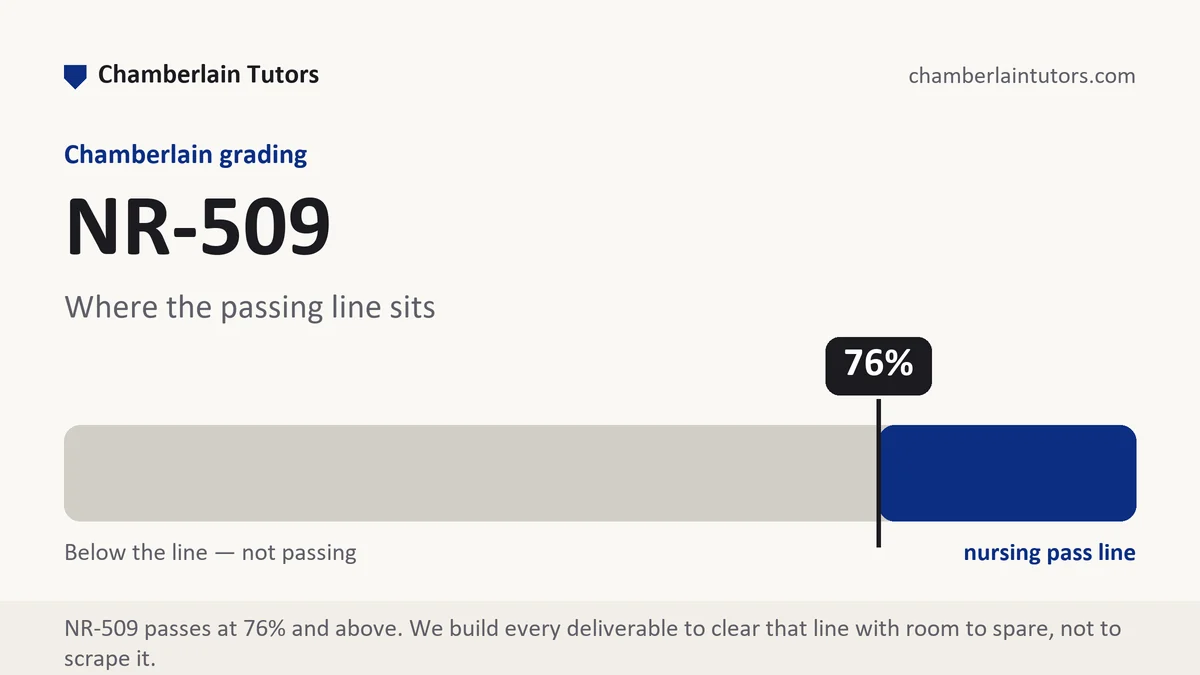
What NR-509 Week 7 asks for
Every discipline that teaches by regions eventually owes its students the whole, and in an 8-week session the second-to-last week is where the whole usually arrives: a comprehensive examination run top to bottom on one patient, with the roughly 25 lab hours the catalog describes now paying off as muscle memory. The graded deliverable is typically the comprehensive write-up itself, sometimes with a practice recording or peer exam attached, and your week's rubric decides the exact shape.
This is also the strategic week. The catalog lists a recorded remote check-off and a required on-ground immersion skills lab, both pass/fail, and the course page's warning is worth repeating: failing either reverts the course grade to an F regardless of your written average. Wherever your section places those events, the integration stage is when rehearsal must be running daily, because a sequence is only smooth after it has been boring for a week.
One boundary, stated once and absolutely: the person on that recording is you. We drill sequences, build narration scripts and rehearse transitions with you as many times as it takes, and no one from any honest service will ever stand in. Preparation is the entire product.
The NR-509 Week 7 method, step by step
Six moves that turn six regional exams into one examination.
-
Fix one personal sequence and stop editing it
Choose a defensible head-to-toe order that satisfies your section's expectations, write it as a one-page script, and freeze it. Sequence changes mid-practice are how rehearsed exams fall apart under a camera.
-
Script the transitions, not just the maneuvers
The seams between regions, repositioning, equipment swaps, draping, are where time and composure leak. Write one sentence of patter for each seam and practice the seams as deliberately as the maneuvers.
-
Narrate aloud from the first rehearsal
Saying each finding as you elicit it is a separate skill from performing, and a recorded exam grades both. Rehearsing silently and planning to narrate later is planning to improvise.
-
Time full runs and log the misses
Run the complete sequence against a clock, note every skipped or fumbled element, and drill only the misses between full runs. Improvement lives in the log, not in repetition alone.
-
Document immediately, in performed order
Write the record straight after each run, in the exact order you examined, while the sequence is still in your hands. This trains the documentation to mirror the exam, which is what integration rubrics look for.
-
Audit the write-up against the script
Lay the one-page sequence beside the finished record and tick each element. Anything performed but undocumented, or documented but unperformed, is a seam showing, and this week grades seams.
A structure for the comprehensive record
Desk proportions for a 1,000 to 1,300 word comprehensive objective write-up. They are planning figures, not Chamberlain quotas; your rubric may weight regions differently and wins if it does.
| Block | What the record needs | Suggested length |
|---|---|---|
| Survey and vital signs | Committed general impression, complete vitals with technique noted once. | 70-100 words |
| Integument | Color, temperature, moisture, turgor, any lesion in full grammar, brief this week. | 60-90 words |
| Head and neck | The regional exam condensed: instruments used, key structures, chains and lobes. | 130-170 words |
| Chest, heart and lungs | The paired-system record with locations and timing kept, prose tightened. | 150-190 words |
| Abdomen | The four-stage sequence in its correct order, spans in numbers. | 100-140 words |
| Musculoskeletal | Gait, motion and strength at screening depth unless a concern deepens one joint. | 90-120 words |
| Neurological | Cranial nerve account, reflexes, sensation and coordination at screening depth. | 100-140 words |
| Closing statement | One sentence on overall status and any finding needing follow-up. | 30-60 words |
Evidence and citation craft for an integration week
Name the standard your sequence follows. Comprehensive exam orders differ slightly between authoritative texts, and both are defensible. Cite the reference whose order you adopted and then be consistent with it; consistency with a named standard is the graded virtue, not the choice between standards.
Cite technique sources at skill level, not trivia level. Claims about why an order is preferred, listening before touching the abdomen, comparing sides in the same position, deserve a technique citation. Individual normal values you have cited in earlier weeks do not need re-arguing here.
Keep skills references current and say when they are not. Examination technique moves slowly, so a five-year-old skills text can still be the standard; if yours is older, one clause acknowledging its standing keeps the citation honest.
Verbs for a screening exam stay modest. A comprehensive exam screens; it does not settle. Write findings as within normal limits for the element tested, and let anything suspicious carry a verb that points at follow-up rather than conclusion.
Five mistakes that cost points in integration territory
- Documenting in template order after examining in sequence order. The mismatch is visible, and integration rubrics read order as evidence of how the exam actually ran.
- Depth where the week wants breadth. Spending 300 words on one region and starving three others misreads the assignment; comprehensive means proportioned.
- Writing the record from memory hours later. Detail decays fast, and invented averages fill the gaps. The write-up drafted straight after the run is measurably denser and safer.
- Treating the pass/fail events as background. A reverted course grade does not average with anything. Rehearsal belongs on the calendar this week, not after the written work clears.
- Rehearsing maneuvers but not words. Blank narration on a recording reads as a blank exam, whatever the hands did. The mouth needs as many repetitions as the hands.
The run-through check before submission
- The written order matches the performed order, region for region
- Every region appears at proportionate depth, none starved, none bloated
- The abdomen's internal order is correct inside the larger sequence
- Screening depth and focused depth are labeled where they differ
- The record was drafted the same day as the exam it describes
- Your check-off rehearsal log shows full runs, not just fragment drills
Integration week closing in?
Send your rubric and sequence. We return a comprehensive write-up at this standard in 24 to 48 hours and build your narration script and drill plan for the recorded events. First sample free.