The closing stage of a scientific underpinnings course usually asks for one integrated piece: the theoretical foundation for the practice work you intend to do. Philosophy of science, framework selection, concept clarity, structural evaluation, applied mapping and translation model all have to arrive in a single argument that a committee could read and act on. This is a synthesis, not a portfolio, and the difference is whether the parts argue together or merely appear in order. Your section may print this as NR 700 or NR700; it is the same course. Chamberlain publishes no syllabi outside Canvas. The placement here is our teaching judgment from the course's catalog arc; your section's rubric decides what your week actually asks.
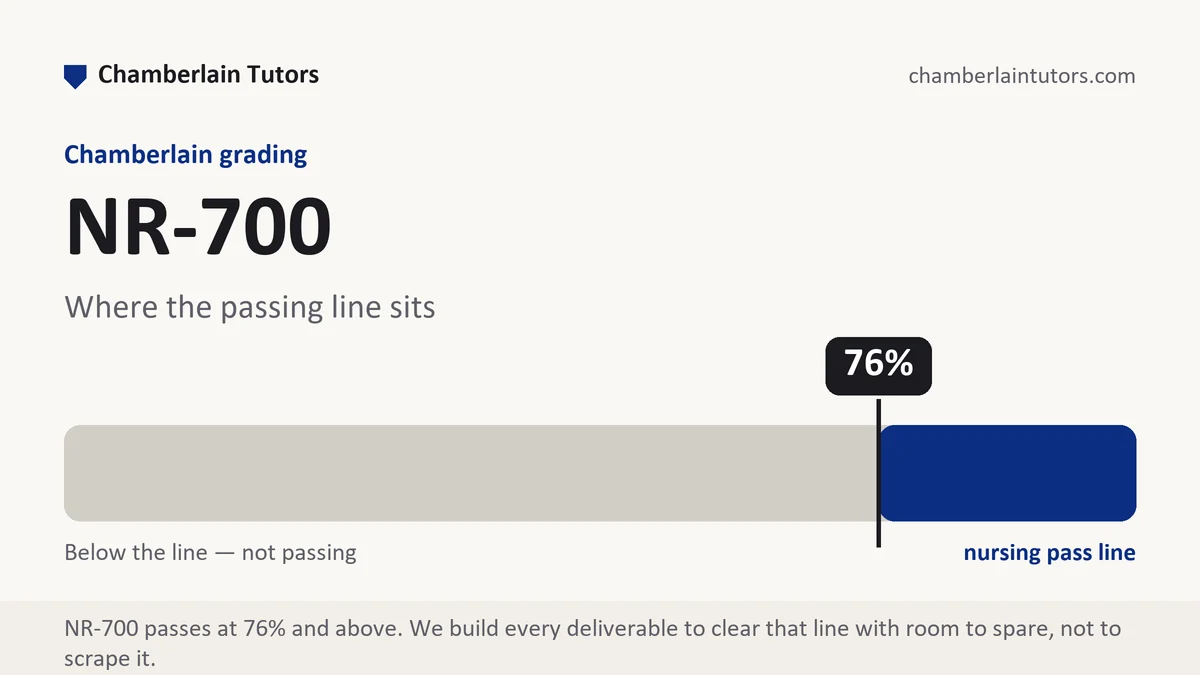
What NR-700 Week 8 asks for
A nurse who runs the discharge process for two med-surg floors reaches the last stage of the course with seven weeks of good material and a bad instinct: staple it together, add an introduction, submit. What arrives is a chronological tour of everything she learned, and it scores in the middle band despite containing better work than papers that score higher. The reason is that a final synthesis is judged on the join. A reader wants to see that the epistemological position chosen in the opening stage is the reason a particular kind of evidence was weighted later, and that the concept clarified in the middle is the concept the evaluation plan proposes to measure. When those threads are visible, the paper reads as one argument.
The content that belongs in a theoretical foundation is reasonably stable. A practice problem stated with population, setting, magnitude and consequence. A short account of how you decide what counts as evidence for this problem. The selected explanatory framework with its justification compressed to essentials. The central concept, defined operationally, with its empirical referents. The framework's structural limits, stated honestly. The implementation or translation model that will carry the change, distinguished from the explanatory theory. And a closing statement of what the whole foundation obliges: what will be measured, what would count as success, what would count as failure.
Keep the doctoral register accurate to the last paragraph. The work being founded here translates existing evidence into a change at a site; it does not generate new knowledge and it is not a thesis. Nothing you write should promise how an oversight body will classify the project, and nothing should describe an improvement evaluation as though it were a trial with arms and assignment. Precision on these points is not pedantry in a course whose entire subject is the scientific basis of practice.
Expect a longer written paper than earlier stages carried, sometimes with a closing board post reflecting on the arc. If a reflection is required, make it analytic: say what changed in how you weigh evidence and give an instance, rather than describing the course as a journey. Posts do not reopen once submitted in Canvas.
The NR-700 Week 8 method, step by step
Six analytic moves that turn eight weeks of material into one argument.
-
Write the thesis of the whole foundation in one sentence first
Something of the form: this problem, understood through this framework and this concept, calls for this kind of change, evaluated this way. Every section afterwards either serves that sentence or comes out.
-
Compress rather than reproduce earlier work
Each previous stage becomes a paragraph or two carrying only what the thesis needs. A synthesis that reprints an entire concept analysis has spent its word budget on material the reader does not need again.
-
Build the joins explicitly with transitional claims
End each section with a sentence that states what the next section is now required to address. Because the concept is defined this way, measurement has to do the following. That single sentence is what separates a synthesis from a compilation.
-
Reconcile anything the earlier stages left contradictory
Eight weeks of writing often contains a framework praised in one paper and criticized in another. Address it directly: say what the evaluation found, why the framework is still the right foundation, and what supplement covers the fault.
-
State the evaluation logic in outcome terms
Name what would be measured, distinguishing implementation outcomes from clinical ones, and say what result would tell you the theory did not hold. A foundation that cannot fail cannot be a foundation for anything.
-
Close on what a committee could now approve or challenge
End with the obligations the foundation creates rather than with a summary. A doctoral reader should finish knowing what you would do next and on what grounds someone could disagree with you.
A layout and word budget for a theoretical foundation paper
Our frame for an integrated closing paper, sized for roughly 2,200 to 2,800 words, which is longer than most stages in this course. It is our own outline rather than anything the university issues, and your week's rubric outranks it wherever the two disagree.
| Section | What belongs in it | Word target |
|---|---|---|
| Thesis and problem | The single-sentence foundation claim, then the practice problem with population, setting, magnitude and consequence. | 300 to 380 |
| Evidentiary stance, compressed | How you decide what counts as evidence here, in a paragraph rather than a philosophy essay. | 200 to 260 |
| Explanatory framework | The theory, its justification reduced to the deciding criteria, and its structural limits acknowledged. | 380 to 460 |
| Central concept and referents | The operational definition and how each attribute would be observed in your setting. | 320 to 400 |
| Translation model | The implementation framework, kept distinct from the explanatory theory, with its job stated. | 320 to 400 |
| Evaluation logic | Implementation and clinical outcomes, the data sources for each, and what would disconfirm the reasoning. | 340 to 420 |
| Obligations and next steps | What the foundation commits you to, and the grounds on which a reader could challenge it. | 200 to 260 |
Evidence craft for a closing synthesis
Rebuild the reference list rather than merging seven of them. A synthesis should cite what the argument uses, which is fewer sources than the sum of the earlier stages. Sources carried forward out of habit dilute the list and invite a grader to check whether each one is actually used.
Refresh anything time-sensitive. Standards, guidelines and practice statements get revised, and a foundation paper submitted with a superseded edition of a document you cited in the opening stage undercuts the care the rest of the paper demonstrates.
Keep self-citation of your own earlier coursework out. Reusing your own prior submissions across courses is governed by academic integrity policy and by your instructor, so if you intend to build on earlier work in any way, ask first and follow whatever answer you get.
Hold the practice-doctorate vocabulary to the end. Translation, implementation, evaluation, practice change, dissemination to practice audiences. Not hypothesis testing, not subjects, not thesis. The last paragraph is where tired writers slip.
Report magnitudes with base and window every time they recur. A number that appeared in an earlier stage still needs its denominator when it reappears here, because this paper is meant to stand alone in front of a reader who has seen none of the others.
Five mistakes that cost points in this week's territory
- Assembly instead of synthesis. Seven sections in chronological order with no argument running through them is the defining failure of a final stage.
- Reprinting earlier papers at full length. The word budget goes to the joins and the evaluation logic, not to material already graded.
- Unreconciled contradictions. Praising a framework here that you criticized two stages ago, without addressing the change, reads as inattention.
- No failure condition. A foundation with no statement of what would disconfirm it is an argument that cannot be tested and therefore cannot be defended.
- Research vocabulary in the closing paragraphs. Calling the work a thesis or a study at the end of a course about the scientific basis of practice is a costly last-minute error.
Before you submit
- A single thesis sentence appears in the opening paragraph
- Each section ends with a claim that obliges the next one
- The explanatory framework and the translation model are clearly distinguished
- The central concept is defined operationally with observable referents
- Implementation and clinical outcomes are separated in the evaluation logic
- A disconfirming result is named
- No claim is made about oversight determinations, and no research vocabulary describes the project
- Every reference appears in the text and every in-text citation appears in the list
Finishing NR-700?
Send the rubric and your earlier stages out of Canvas. A premium original draft comes back in 24 to 48 hours built as one argument rather than seven sections, and revisions run until the grade lands.