NR-700 Scientific Underpinnings is a three-credit doctoral theory course at Chamberlain, and it grades one thing above all others: whether you can take a named body of theory and put it to work on a real practice problem at the highest level of nursing practice. The writing is not a report on what theorists said. It is an argument that a particular framework explains a particular clinical situation better than the alternatives, and that the explanation changes what a doctorally prepared nurse would do next.
What NR-700 actually grades
The catalog describes NR-700 as the scientific underpinnings of nursing practice and the application of theory to advanced practice at the highest level. Read that phrase as two separate scoring demands stacked on top of each other. The first half asks whether you know where nursing knowledge comes from: the philosophy of science behind it, the difference between borrowed and discipline-specific theory, the distance between a grand theory and a middle-range one. The second half asks whether the knowledge survives contact with a practice setting you actually work in.
Doctoral graders read for the join between those halves. A submission can be flawless on the history of a framework and still score low because the practice half never arrives, or arrives as a paragraph tacked on at the end. The reverse is equally common: a vivid clinical narrative with a theory name dropped into the introduction and never used again. The rows that pay in this course are the rows where a concept from the framework is doing visible work on the problem, sentence by sentence.
How we help in NR-700
Our doctoral bench drafts theory application work the way a committee reads it: framework first, then the concept-by-concept mapping, then the practice implications that the mapping earns. Every draft comes back with the reasoning shown, so the theory you submit is one you can defend in a live discussion rather than one you are meeting for the first time on the page.
Deliverables run the standard promise: a premium original draft in 24 to 48 hours, targeted at the A band of your course's actual scale, through the eight-person pipeline with both QA passes and the floor check, revised free until it lands.
In NR-700 right now?
Send the week and the rubric from Canvas. First premium sample free, floor-checked, back in 24 to 48 hours.
Read the rubric before you read the prompt
The prompt in a theory course tends to be short and inviting. The rubric is long and specific, and it is the document your grader actually fills in. Open both in Canvas, then work only from the rubric until you have an outline. Copy the criterion rows into a blank file, one to a line, and reduce each to its governing verb. Doctoral rows in this course tend to run on verbs like analyze, synthesize, evaluate and apply, and those verbs are not interchangeable. A row that says analyze wants the framework taken apart into its concepts. A row that says synthesize wants two or more sources fused into a position that neither one states alone. A row that says apply wants the practice setting on the page.
Now price the rows. Weight is a depth instruction written as a percentage. Suppose the week caps your paper at 2,400 words and the scoring guide carries four rows weighted 40, 25, 25 and 10 percent. Multiply through and the budget reads 960 words, 600 words, 600 words and 240 words. Write those four numbers beside your four headings before you draft a sentence. The uncomfortable result is normal: in NR-700 the fattest row is almost always the application row, which means the practice-setting section deserves 960 words while the theorist biography you were tempted to write deserves none at all.
Keep the numbers visible until the draft is finished, and treat a section that lands far under its share as a signal that the thinking is thin rather than that the prose is efficient. Unless your guide rules otherwise, the title page, the reference list and any appendix fall outside the count. If two rows overlap, as an analysis row and a synthesis row often do, write the deeper one first and let the shallower one refer back rather than repeat.
The shape of a theory application paper
Most graded writing in NR-700 is a theory application in one form or another, whether the prompt calls it a paper, a scholarly analysis or an extended board post. Each part below carries one obligation, and a grader either sees it discharged or does not.
| Part | What it has to prove | How a thin version looks |
|---|---|---|
| The practice problem, stated once | A specific, bounded situation in a real setting, named in two or three sentences with a population and a consequence attached. | A national statistic standing in for a local problem. |
| Why this framework | A defended choice: what this theory sees that a rival framework would miss in your situation. | The theory named, admired, and never compared to anything. |
| Concepts defined in the theorist's terms | Each concept you plan to use, defined from the primary source, not paraphrased from a textbook chapter. | Dictionary definitions of ordinary words the theory uses technically. |
| The mapping | Concept by concept, what each one corresponds to in your setting, with the correspondence argued rather than asserted. | A table that pairs terms without explaining any pairing. |
| What the framework predicts | A statement of what should change if the theory is right, phrased so that it could be checked. | A promise of improved outcomes with nothing specified. |
| Limits and the honest gap | Where the framework stops fitting your setting, and what you would need beyond it. | A sentence conceding that no theory is perfect. |
| Implication for doctoral practice | What you would do differently on Monday, described at the level of a practice leader rather than a bedside task. | Advice general enough to attach to any diagnosis or unit. |
Evidence and citation craft at the doctoral level
Four habits do most of the work in separating a paper that reads as doctoral from one that reads as a capable master's submission.
Use the theorist's own words, not a textbook's paraphrase of them. A framework's own book or seminal article is the source that defines its concepts. Secondary summaries drift, and doctoral graders notice when a definition matches a textbook table rather than the original. Foundational theory sources are exempt from any recency expectation because the work is the origin; the empirical studies you use to support the framework are not, and where your guide sets no rule, anything past five years old should carry its justification in the sentence.
Design and sample before the finding. No result should reach the reader ahead of its provenance. Ten words of setup, such as a prospective cohort of 1,240 medical-surgical nurses followed across two years, turns an assertion into evidence. The sentence that skips the setup stays an assertion no matter how well sourced it is.
Match the verb to the design. Theory papers tempt writers into causal language because frameworks are written in causal grammar. Where the supporting study is observational, the defensible verbs are associated with, predicted, and occurred more often among. Where it is a controlled trial, caused and produced become available. Borrowing the strong verb for the weak design is the single most reliable way to lose an evidence row.
Every rate carries a denominator and a window. A percentage with no base and no time period is decoration. Write that 38 of 210 patients readmitted within 30 days, then give the percentage if you want it. The order matters because the denominator is the part a doctoral reader checks first.
What separates a pass from a strong pass here
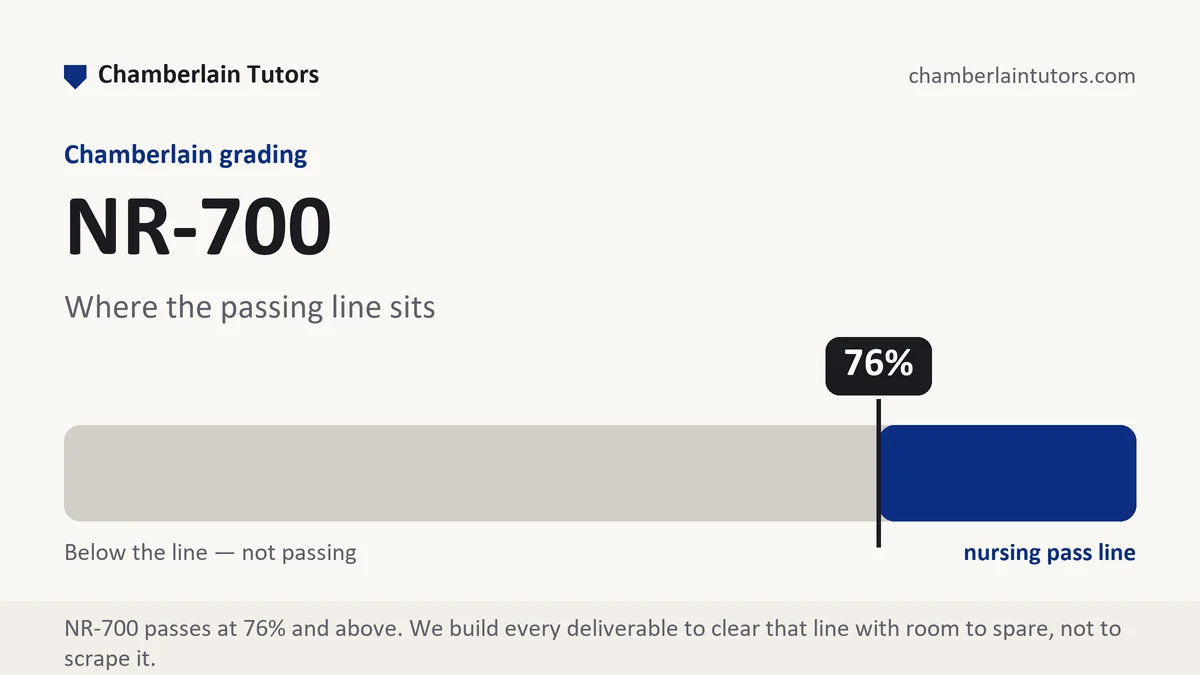
A passing NR-700 paper is accurate. It names a real theory, defines its concepts correctly, cites real sources and offends nobody. The published floor in Chamberlain's core nursing courses is 76 percent, and no amount of extra submission lifts a weighted average that has already sagged, so an accurate but unremarkable run of submissions is a slower problem than a single bad week. Whatever margin you end the session with was earned inside the graded pieces.
Strong papers pull away in three ways a reader can point at. They commit to one framework and go deep instead of surveying three politely, because depth is what the analysis rows measure. They argue the choice of framework against a named alternative, which is the move that converts description into scholarship. And they end somewhere specific: a change in how a unit measures something, a change in what gets escalated, a change in what a team is taught, described concretely enough that a reader could picture the first meeting. Theory that ends in a general call for further attention has done none of the work the course exists to teach.
Six mistakes that cost points in NR-700
- Writing the theorist's biography. Where the theory was developed and by whom is background, not analysis. It earns space only when the origin explains a limit you go on to use.
- Choosing a grand theory for a narrow problem. A framework built to describe all of nursing rarely produces a checkable prediction about one unit's handoff process. Middle-range theory usually fits the assignments here better, and saying why you chose that level is itself worth points.
- Leaving the practice setting anonymous. A problem with no population, no setting and no consequence cannot be mapped onto anything. Bound it in the first paragraph.
- Treating a doctoral board post as a draft. Discussion posts at Chamberlain do not reopen once submitted. Compose in a separate document, read it aloud once, then paste the one version you are prepared to defend.
- Citing a review article for a number. Reviews are for framing and for locating the debate. Values belong to the study that produced them, and doctoral graders trace them.
- Ending on the framework instead of on practice. A conclusion that restates the theory has skipped the row that usually carries the most weight. Close on what changes.
Questions NR-700 students ask
Can I use a theory from outside nursing, like a change or systems model?
How much of the paper should be philosophy of science versus application?
My paper is accurate but keeps landing just above the floor. What is missing?
The weeks, one by one
Week 1
NR-700 opens by asking where nursing knowledge comes from and how a practice doctorate is supposed to use it. Read the full Week 1 manual.
Week 2
The second stage of a scientific underpinnings course usually turns on altitude: how abstract a theory is, what that abstraction buys, and what it costs when you try to use it on a real practice problem. Read the full Week 2 manual.
Week 3
Around the middle of a scientific underpinnings arc the reading widens past nursing's own frameworks into theory imported from psychology, sociology, systems engineering, economics and organizational science. Read the full Week 3 manual.
Week 4
Midway through a scientific underpinnings arc the work usually narrows from whole frameworks to single concepts, because a theory is only as usable as the precision of the ideas inside it. Read the full Week 4 manual.
Week 5
By the middle of this course you have chosen a framework and clarified its central concept; this stage asks you to judge the framework itself. Read the full Week 5 manual.
Week 6
Late in a scientific underpinnings arc the writing turns applied: take the framework you selected and evaluated, and show it doing visible work on a real practice problem, concept by concept. Read the full Week 6 manual.
Week 7
Near the end of a scientific underpinnings arc the course usually names the thing the whole practice doctorate is built on: translation. Read the full Week 7 manual.
Week 8
The closing stage of a scientific underpinnings course usually asks for one integrated piece: the theoretical foundation for the practice work you intend to do. Read the full Week 8 manual.