NR-701 Applications of Analytic Methods is a three-credit doctoral course, and what it grades is judgment about other people's research. The catalog frames it as applying original research to practice, evaluating clinical practice guidelines and examining research for scientific merit. In writing terms that means appraisal, not summary. Your grader wants to see you take a study apart at the joints, say where it holds and where it does not, and then decide whether it can be trusted in your setting.
What NR-701 actually grades
Every scored deliverable in this course circles the same skill: can you tell a strong study from a weak one for reasons you can name. The three objects you appraise are different in kind. An original research report is judged on design, sampling, measurement and analysis. A clinical practice guideline is judged on who wrote it, what evidence they had, how recommendations were graded and whether the developers declared their interests. A body of evidence is judged on consistency, directness and how much of it points the same way.
Graders at this level look for the appraisal to be specific and located. A sentence saying the sample was small earns nothing. A sentence saying that 61 participants in a two-arm trial gave roughly 30 per group, which cannot detect the modest difference the authors were looking for, is appraisal. The rows that pay in NR-701 reward that move over and over: the criticism attached to a number, a design feature or a named threat to validity.
How we help in NR-701
Our doctoral writers appraise the way reviewers do, working from the methods section outward, so the critique lands on the study's actual weaknesses rather than on its topic. Every draft comes back with the appraisal logic visible, which is what lets you answer a follow-up question in the board thread without rereading the article.
Deliverables run the standard promise: a premium original draft in 24 to 48 hours, targeted at the A band of your course's actual scale, through the eight-person pipeline with both QA passes and the floor check, revised free until it lands.
In NR-701 right now?
Send the article, the guideline and your rubric from Canvas. First premium sample free, floor-checked, back in 24 to 48 hours.
Turn the rubric into an appraisal plan
Appraisal work punishes students who start from the article. Start from the rubric instead. Lift each criterion row into a blank document and label it with the part of the study it interrogates: question, design, sample, measurement, analysis, results, applicability. That labelling is the whole outline, because a rubric for an appraisal is almost always a checklist of study parts wearing academic language.
Then convert weight into words. Say the week caps you at 1,800 words and the scoring guide carries five rows at 35, 25, 18, 12 and 10 percent. The arithmetic hands 630 words to the heaviest row, then 450, 324, 216 and 180. In this course the heaviest row is usually methods, which is exactly the section most students skim because it is the hardest to read. Budgeting 540 words to methods forces the rereading that produces the marks.
One extra step helps here. Beside each row, write the page or table number in the article where the evidence for that row lives. If you cannot find a location, that absence is itself a finding worth writing: a trial that never reports how randomization was concealed has told you something. Keep the budget visible while you draft, and treat a section running far under its share as unfinished rather than concise.
The shape of a critical appraisal
Whether your week asks for a single-study critique, a guideline appraisal or a short evidence brief, the same skeleton carries it. Each part answers one question about the study, and a reader can tell at a glance whether it was answered.
| Part | What it has to prove | How a thin version looks |
|---|---|---|
| The question the study asked | Restated in your words with population, comparison and outcome visible, so a mismatch with the design becomes obvious. | The title copied out as if it were the research question. |
| Design named and matched | The design identified precisely, then judged against the question it was asked to answer. | Calling any study with numbers quantitative and moving on. |
| Sample and setting | Who was recruited, who was excluded, who finished, and what that leaves you able to say about whom. | The enrolled number quoted with no attrition. |
| Measurement | What instrument produced each variable and whether it has been validated in this population. | Outcomes accepted as reported because they sound clinical. |
| Analysis | Whether the statistical approach fits the data type and the design, including how missing data was handled. | A sentence saying appropriate statistical tests were used. |
| Results with precision | The effect and its confidence interval, read for size as well as significance. | A p value reported as though it measured importance. |
| Applicability to your setting | A judgment about transfer, naming the specific difference that would help or hinder it. | A closing line saying more research is needed. |
Evidence and citation craft in appraisal work
Four working habits stand between an appraisal that reads as doctoral and one that reads as a book report.
Appraise with a named instrument, and say which one. Doctoral appraisal is not freehand. Whichever appraisal tool your rubric permits, name it, cite it, and let its domains organize your paragraphs. A critique that follows a published tool is auditable; a critique built from personal impressions is not.
Provenance before finding, every time. Nine words of setup convert an assertion into evidence. Write that in a double-blind trial of 412 postoperative adults across three hospitals, then give the result. Where your guide sets no recency rule, treat anything past five years old as needing a reason in the sentence, and check a guideline's publication date against the date of the trials it cites, because a guideline can be recent and its evidence old.
Let the design set the verb. Observational data buys associated with, predicted, and occurred more often among. Randomized data buys reduced, caused and produced. The most common evidence-row failure in this course is a correlational study described in causal language, and it is easy for a grader to spot because the methods section contradicts the sentence.
Every rate arrives with a denominator and a window. A figure with no base and no period cannot be appraised. Write that 47 of 388 patients were readmitted within 30 days, then convert to a percentage if you want one. When you compare two rates, check that both used the same denominator rule before you call the difference real.
What separates a pass from a strong pass here
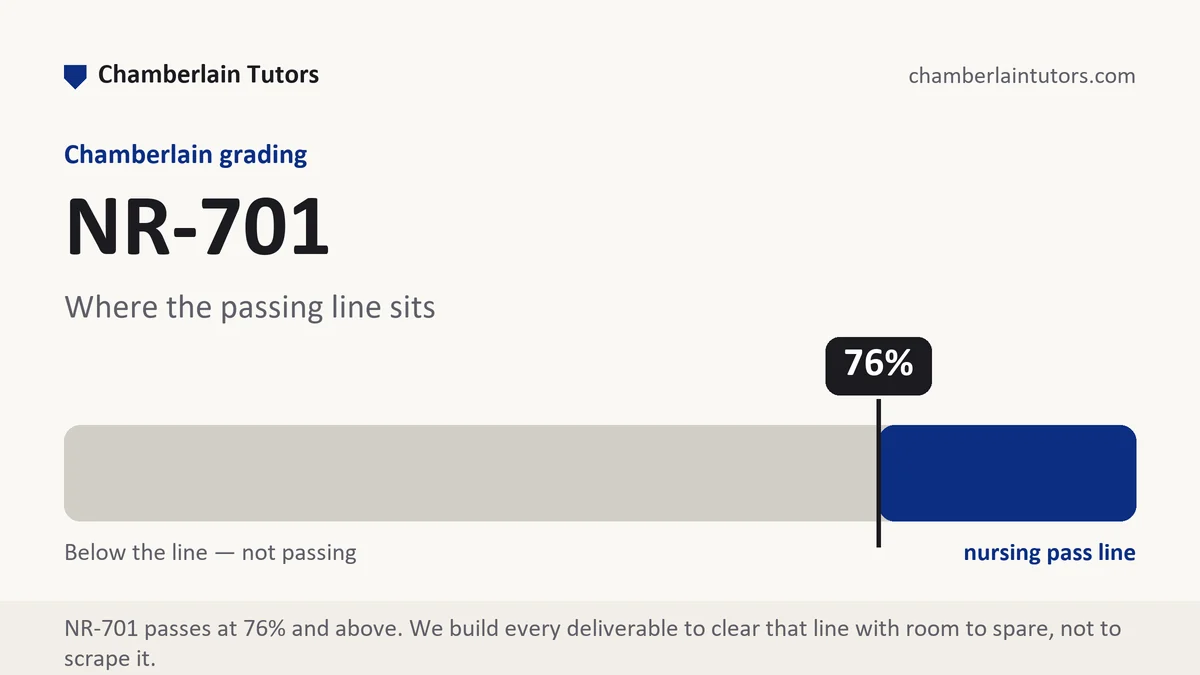
A passing appraisal identifies real limitations. It notices a small sample, a single site, a short follow-up. Those observations are true and they are also the ones every classmate makes, which is why an accurate appraisal can sit just above the line all session. Core nursing courses at Chamberlain pass at 76 percent, and an average that has drifted low cannot be repaired by adding submissions, so a run of adequate weeks is a slow leak rather than a single dramatic failure.
Strong appraisals do three things differently. They weight their criticisms, saying which flaw actually threatens the conclusion and which is cosmetic, because a doctoral reader wants a verdict rather than a list. They quantify wherever the article allows it, converting vague concern into a number the authors themselves printed. And they finish with a decision: whether this evidence would change practice in a named setting, under what conditions, and what evidence would have to surface for your judgment to be wrong. An appraisal that never reaches a decision has stopped one section early.
Six mistakes that cost points in NR-701
- Rewriting the abstract. Summary sections that report what the authors found without judging how they found it consume the word budget the methods row needed.
- Appraising the topic instead of the study. Whether the subject matters is not a scoring row. Whether the design can answer the question is.
- Treating a guideline as primary evidence. Guidelines are recommendations built on studies. Cite them for the recommendation and cite the trial for the number.
- Ignoring who dropped out. Attrition and its pattern often matter more than the enrolled sample size, and most students never mention it.
- Posting a board critique in one pass. Chamberlain discussion posts do not reopen once submitted. Draft in a separate file, check every claim against the article, then paste once.
- Ending with a call for more research. That sentence is available to any reader who has not read the study. Close on a decision about use instead.
Questions NR-701 students ask
Which appraisal tool should I use if the prompt does not name one?
The only study on my topic is twelve years old. Can I still use it?
How do I criticize the statistics when my own statistics background is thin?
The weeks, one by one
Week 1
An analytic methods course opens by making your practice problem searchable. Read the full Week 1 manual.
Week 2
Once the search is defensible, the appraisal starts, and the doctoral version of appraisal is domain-based rather than impressionistic. Read the full Week 2 manual.
Week 3
This stage moves the appraisal from whether a study is trustworthy to what its numbers actually say. Read the full Week 3 manual.
Week 4
Qualitative evidence is appraised against its own standards, not against the ones used for trials, and confusing the two is the fastest way to lose this stage. Read the full Week 4 manual.
Week 5
A guideline is not evidence; it is a set of recommendations built on evidence by a panel, through a process that can be strong or weak, with interests that may or may not have been declared. Read the full Week 5 manual.
Week 6
It is a single argument about what a set of studies, taken together, supports for a specific decision. Read the full Week 6 manual.
Week 7
Late in an analytic methods course the object of appraisal usually shifts from published studies to the data a practice setting produces about itself. Read the full Week 7 manual.
Week 8
The closing stage of an analytic methods course usually asks you to convert eight weeks of appraisal into something a practice audience would act on: a recommendation with its evidence base, its strength, its limits and its measurement plan attached. Read the full Week 8 manual.