NR-707A runs DNP Project and Practicum III at 2 credits and 128 clinical hours, and it is where the practice change is actually implemented. The writing that carries this block is an implementation narrative, and its job is to record what happened rather than what was planned. Dates, counts, deviations and decisions. Students find this harder than planning because it requires admitting that reality diverged from the document, and the divergence is precisely what a doctoral reader wants to see written down.
This service never puts in a practicum hour, never approaches a preceptor or a site, never signs a placement form, never enters a line in an hour log and never takes an assessment. Everything we do is written: the implementation narrative, the interim data presentation and the scholarly sections the rubric grades.
What NR-707A actually grades
The first row is whether the account is contemporaneous and specific. An implementation narrative built from memory at the end of the session reads differently from one built from notes taken as events happened, and graders can tell because the second one has dates. Every launch, every training session, every change of approach and every problem needs a date and a count attached, or the section becomes an impression of a busy period.
The second row is honesty about delivery. Implementation writing is the place where the difference between what was designed and what reached patients becomes visible. A doctoral submission that records the shift where the protocol was not used, the week when the champion was on leave and uptake fell, or the eligibility rule staff interpreted differently, is doing exactly what the course is for. A narrative in which everything went as intended is either exceptional or unexamined, and readers assume the second.
How we help in NR-707A
Our doctoral writers turn your notes into an implementation record with a timeline, counts and denominators, decisions attributed by role and date, and deviations reported rather than smoothed. Drafts return with interim data presented at a level the design can support, which keeps the evaluation course honest later.
Deliverables run the standard promise: a premium original draft in 24 to 48 hours, targeted at the A band of your course's actual scale, through the eight-person pipeline with both QA passes and the floor check, revised free until it lands.
In NR-707A right now?
Send your rubric, your protocol and whatever notes and interim counts you have. First premium sample free, floor-checked, back in 24 to 48 hours.
Read the rubric before the prompt
At the implementation stage, rubrics often ask for a narrative and a data element together. Copy the criterion rows into a blank file and mark which ones can only be satisfied by something you recorded at the time. Those are the rows that cannot be reconstructed in the final week, and identifying them early is the difference between writing a report and inventing one.
Then price the narrative. A 1,200-word account with three rows at 45, 35 and 20 percent leaves 540, 420 and 240 words. The 540-word row is usually the account of delivery, and the 240-word row is usually the restatement of the plan. Students consistently invert this, spending a third of the piece re-describing an intervention the reader already approved.
Keep a running implementation log from day one, even a rough one. Date, what happened, who was involved, what was decided, what number you have. Ten minutes a week produces the material this deliverable needs, and it also produces the raw record for the fidelity and evaluation deliverables in later blocks. Reconstructing that log at the end costs several times more effort and produces weaker writing.
The shape of an implementation narrative
These are the parts a committee reads for. Each records something a later reader will need, and its absence is conspicuous.
| Part | What it has to prove | How a thin version looks |
|---|---|---|
| Timeline of what happened | Dated events from preparation through launch to the current point, in sequence. | A description of activities with no dates. |
| Who was reached | Counts of staff trained or oriented, out of how many were eligible. | A statement that staff were educated. |
| What was delivered | How many patients or encounters the intervention actually reached, with the denominator of those eligible. | The intervention described as implemented. |
| Deviations from plan | Each departure from the protocol or the timeline, with its date and reason. | Minor adjustments mentioned in passing. |
| Decisions and who made them | Choices made during implementation, attributed by role and dated. | Changes described in the passive voice. |
| Data collection as performed | Whether the measurement plan ran as written, and what was missed. | An assurance that data was collected as planned. |
| Interim numbers, cautiously | Early counts with denominators, presented as description rather than as result. | An early improvement announced as success. |
Evidence craft during implementation
Four habits keep the record defensible.
Write from documentation, not from recollection. Attendance sheets, system reports, meeting notes and your own dated log are the sources. Say which one supports each claim when it matters, particularly for counts, because a number with a source can be re-derived later and a remembered number cannot.
Report reach with the denominator that makes it meaningful. Write that 41 of 58 eligible nurses completed the orientation before launch, and that the intervention was delivered to 96 of 134 eligible admissions in the first six weeks. Those two sentences carry more information than several paragraphs about engagement, and they set up the fidelity work in the next block.
Keep the verb inside what has happened so far. Interim movement in a measure buys the measure rose from and was higher during. It does not buy the intervention improved. Early data in an uncontrolled project is especially vulnerable to ordinary variation, and claiming effect at week two is one of the fastest ways to lose credibility with a committee. Where you cite implementation literature, keep the same discipline about design.
Protect identities in the record. Use roles rather than names for staff, aggregate small counts, and never include patient identifiers. A narrative that identifies a single nurse whose practice differed is a professional problem as well as an academic one.
What separates a pass from a strong pass here
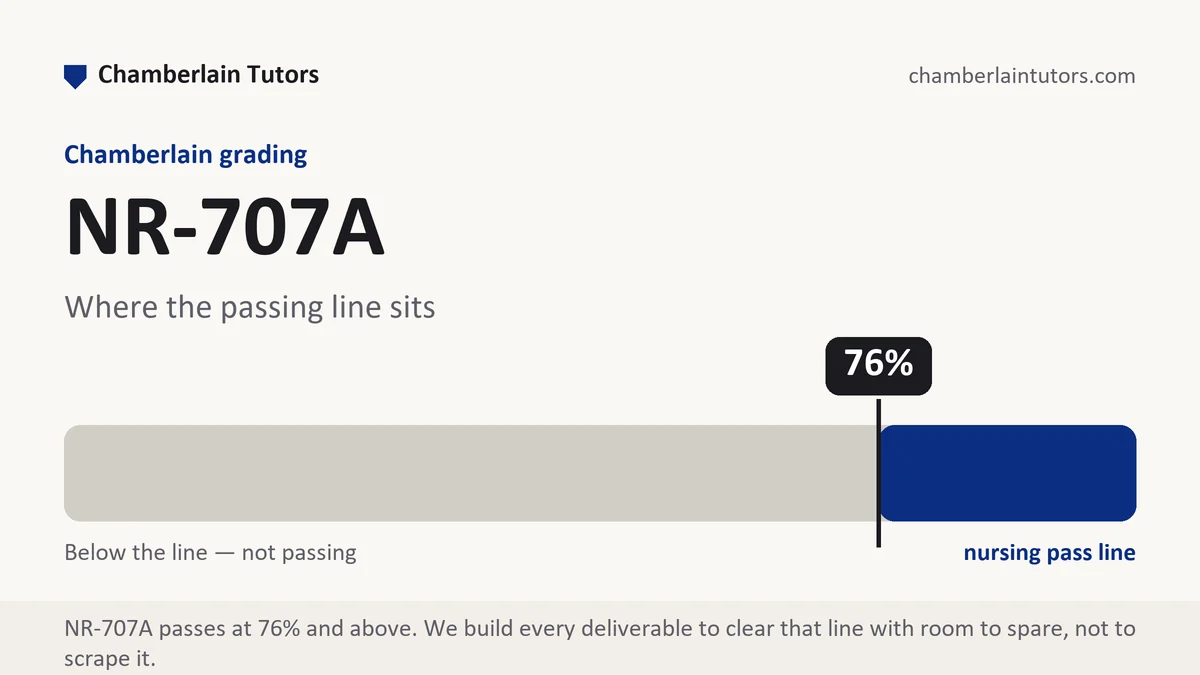
A passing NR-707A narrative describes an implementation that went broadly as planned, with a few challenges mentioned generally. Its usual weakness is that it could have been written before the project started. Core nursing courses at Chamberlain pass no lower than 76 percent, and supplementary work will not restore an average that has drifted, so a narrative stage written from memory rather than from record leaves marks on the table and weakens every later deliverable.
Strong implementation writing is specific about the unglamorous parts. It names the week where uptake dropped and what was happening on the unit that week. It reports the count of eligible patients the intervention missed as carefully as the count it reached. It attributes decisions to roles and dates so that a reader can follow how the project actually moved. And it resists interpreting early data, which is the discipline that makes the evaluation block possible: a project that has already declared success at the halfway point has nothing left to evaluate honestly.
Six mistakes that cost points in NR-707A
- Rewriting the plan. The plan was graded in an earlier block. This deliverable is about what happened instead.
- Impressions instead of counts. Well received is not data. Numbers reached, out of numbers eligible, is.
- Undated events. A narrative without dates cannot show sequence, and sequence is what makes an implementation account interpretable.
- Hiding deviations. A departure recorded is method. A departure discovered later by a reader is a credibility problem.
- Claiming effect from interim data. Early movement in an uncontrolled project is usually variation, and asserting otherwise costs marks now and in the evaluation block.
- Naming individuals. Roles, aggregates and de-identified detail only, particularly on a small unit where one description identifies a person.
Questions NR-707A students ask
My implementation slipped by three weeks. How do I write that?
Staff are not following the protocol consistently. Should that go in this deliverable?
How much detail about meetings and conversations belongs in the narrative?
Where NR-707A sits in Chamberlain's programs
Open the exact program map for sequence, credit, and option context. The current student schedule and syllabus remain authoritative after transfer evaluation, electives, state rules, and approved plan changes.
The weeks, one by one
Week 1
NR-707A carries 2 practicum credits and 128 clinical hours, which is roughly sixteen hours a week across an eight-week session, and it is the block where an already-approved practice change is put into operation at a site. Read the full Week 1 manual.
Week 2
Once an implementation is live, the central written product of this block is a narrative of what actually happened, dated and counted, written close enough to events that it records rather than remembers. Read the full Week 2 manual.
Week 3
Early in a live implementation the question that matters is not whether the change is working but whether it is happening, and answering that requires a small structured audit and a written account of it. Read the full Week 3 manual.
Week 4
By the midpoint of a live block the designed change and the delivered change have diverged, because they always do, and the doctoral task is to write that divergence as a reasoned record rather than to hide it. Read the full Week 4 manual.
Week 5
Around the middle of a live block the first real numbers arrive, and the written task is to present them in a form that shows variation over time and says only what the data can support. Read the full Week 5 manual.
Week 6
Late in an implementation block the writing turns outward, to the people at the site who have to keep the change alive after your session ends. Read the full Week 6 manual.
Week 7
The seventh stage is where numbers become an argument. Read the full Week 7 manual.
Week 8
The final stage of a 2-credit implementation block closes the written record: what was implemented, how far it reached, what the interim data shows, what remains in motion, and who holds the change now. Read the full Week 8 manual.