NR-707B runs DNP Project and Practicum III at 3 credits and 192 clinical hours. With more implementation time comes the question a committee will ask first when the results arrive: how much of your intervention was actually delivered as written. That is fidelity, and documenting it is the writing this block usually carries. Fidelity is not a feeling about how well things went. It is an element-by-element measurement with denominators, a threshold set in advance, and a corrective action when the number falls short.
Practicum hours, any approach to a preceptor or a site, placement paperwork, hour logs and proctored assessments sit outside what we do and always will. The written deliverables sit inside it: the fidelity report, the audit method, the corrective action narrative and the scholarly sections your rubric grades.
What NR-707B actually grades
The first row is whether fidelity was measured rather than assumed. Each element of your protocol needs its own answer: how many times it was performed out of how many opportunities it had. A protocol with five steps has five fidelity numbers, and they are usually very different from each other, which is the point. Reporting a single overall adherence figure hides exactly the information that would let you fix something.
The second row is a threshold set before the data arrives. Deciding after seeing 71 percent adherence that 70 was acceptable is not an assessment. Writing in advance that below 80 percent on the core elements would trigger a retraining cycle and a workflow review makes the fidelity work a decision instrument. Doctoral rubrics reward that ordering, and committees notice when it is missing.
How we help in NR-707B
Our doctoral writers build fidelity reporting element by element, with opportunity denominators, an audit method described so it could be repeated, thresholds stated in advance and corrective actions attributed by role and date. Drafts return with the re-measurement written in, because a fidelity report that ends at the shortfall is only half a deliverable.
Deliverables run the standard promise: a premium original draft in 24 to 48 hours, targeted at the A band of your course's actual scale, through the eight-person pipeline with both QA passes and the floor check, revised free until it lands.
In NR-707B right now?
Send your rubric, your protocol and your audit data. First premium sample free, floor-checked, back in 24 to 48 hours.
Read the rubric before the prompt
Fidelity deliverables mix a data artifact with an analytic narrative, and the rows usually split cleanly between them. Copy them into a blank file and mark which require a table of numbers and which require reasoning about what the numbers mean. A common loss here is a thoughtful narrative with no table, which leaves the measurement rows unsatisfied no matter how good the prose is.
Then price the narrative. A 1,500-word report with four rows at 32, 32, 24 and 12 percent gives 480, 480, 360 and 180 words. The two 480-word rows are typically the fidelity results and the analysis of shortfalls, which leaves the audit method at 360 and the project recap at 180. Method deserves precision rather than length: how the sample was drawn, by whom, against what checklist.
Before drafting, decide what an opportunity is for each element. This sounds trivial and it is where most fidelity reporting goes wrong. If a step applies only to patients meeting a condition, the denominator is patients meeting that condition, not all patients on the unit. Writing the opportunity rule for each element first makes the whole table interpretable.
The shape of a fidelity report
These are the columns and elements a committee reads for. Each answers one question about delivery, and a blank entry stands out.
| Element | What it has to carry | How a thin version looks |
|---|---|---|
| Protocol element | Each step listed separately, in the protocol's own wording and order. | The intervention treated as a single unit. |
| Core or adaptable | Whether the element carries the mechanism or is packaging, decided before implementation. | All elements treated as equally essential. |
| Measurement method | Observation, record audit or system report, with who performed it and when. | Adherence assessed, method unstated. |
| Opportunity denominator | The number of times the element could have been performed, defined by rule. | A percentage with no base. |
| Adherence result | Performed over opportunities, reported as counts with the percentage alongside. | A single overall adherence figure. |
| Pre-set threshold | The level agreed in advance as acceptable for this element, with its basis. | A judgment of acceptable made after the fact. |
| Reason for shortfall | What was found when the gap was investigated, described as a mechanism. | Staff non-compliance offered as the reason. |
| Action and re-measure | What changed, who owned it, when, and the result of the second audit. | An intention to reinforce education. |
Evidence craft in fidelity measurement
Four habits keep fidelity data defensible.
Prefer observation or record audit to self-report. Asking staff whether they followed a protocol produces reliably higher numbers than checking. Where self-report is the only feasible method, say so and treat the figure as an upper bound rather than as a measurement.
Describe the sampling rule, not just the sample. Write that 40 consecutive eligible encounters were audited across four weeks, covering all shifts, rather than that a sample of records was reviewed. Convenience samples drawn from day shift will overstate fidelity in most settings, and naming the risk is better than being asked about it.
Check that two auditors would agree. If more than one person collected fidelity data, report how you checked consistency, even informally: a set of records reviewed by both, with disagreements resolved by rule. Where you were the only auditor, say so and name the bias that introduces.
Keep the verb inside the measurement, and separate fidelity from outcome. Fidelity data buys the element was performed in and adherence rose to. It says nothing about whether the intervention worked, and mixing the two is the most common analytic error at this stage. Where you cite implementation literature about fidelity and adaptation, keep the same discipline about what those study designs support, and give sources older than five years a stated justification unless your guide sets another rule.
What separates a pass from a strong pass here
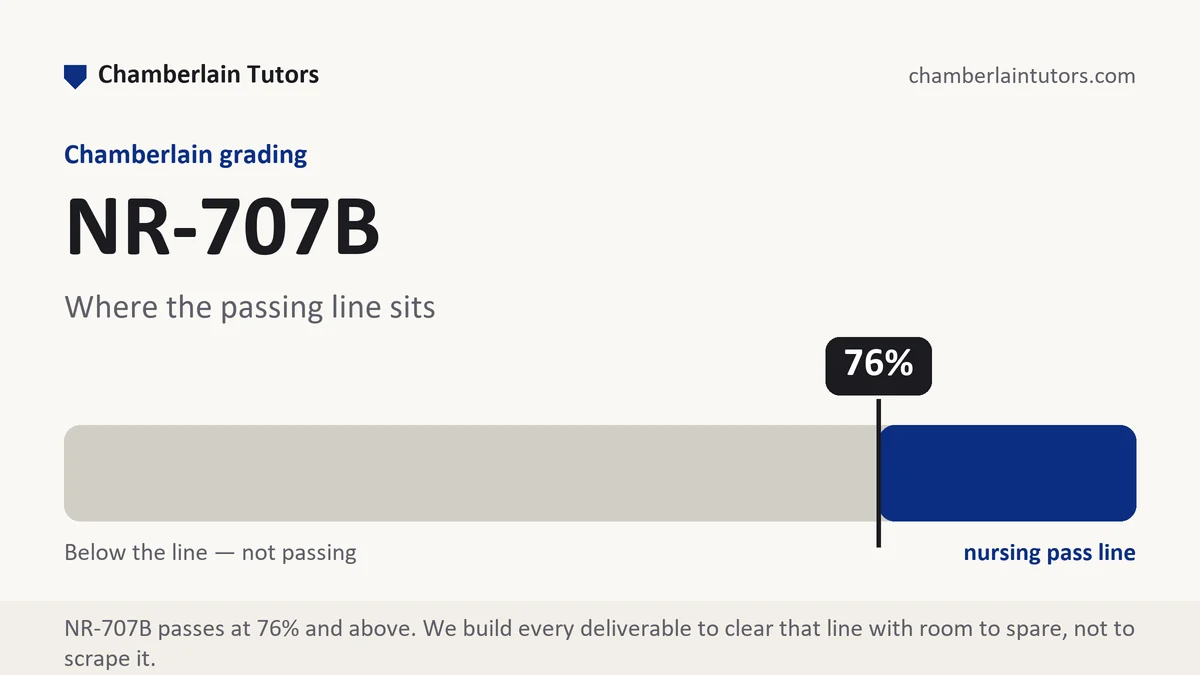
A passing NR-707B report presents adherence figures and comments on them. Its usual weaknesses are a single aggregate number, a threshold that appeared after the data, and shortfalls explained as staff behavior. The passing line for Chamberlain's core nursing courses is 76 percent, and no extra assignment recovers a weighted average that has already weakened, so a stage where the same three weaknesses recur across deliverables is worth correcting deliberately.
Strong fidelity work is diagnostic. It separates elements so that a reader can see the one step everybody skips, then investigates that step rather than the people performing it: the form that is three clicks away, the trigger that fires during the busiest hour, the eligibility rule two shifts read differently. It then records a change, an owner, a date and a second measurement, which is what turns a report into an improvement cycle. And it says plainly which core elements were delivered well enough for the outcome data to mean anything, because that judgment is what the evaluation block will depend on.
Six mistakes that cost points in NR-707B
- One overall adherence number. Aggregation hides the failing step, which is the only thing the report could have fixed.
- Self-report as the only method. It measures belief about practice, not practice, and readers discount it accordingly.
- No threshold set in advance. A standard invented after the result is not a standard.
- A single audit. Without a second measurement after a change, there is no cycle and no evidence the action worked.
- Confusing fidelity with outcome. High adherence is not success, and low adherence does not prove the intervention would have failed.
- Explaining shortfalls as attitude. Non-compliance is a label. The workflow conflict, the timing, the ambiguity in the rule are causes you can act on.
Questions NR-707B students ask
How many records should I audit for fidelity?
What if fidelity is low and I do not have time for another cycle?
How do I decide which elements are core?
Where NR-707B sits in Chamberlain's programs
Open the exact program map for sequence, credit, and option context. The current student schedule and syllabus remain authoritative after transfer evaluation, electives, state rules, and approved plan changes.
The weeks, one by one
Week 1
NR-707B carries 3 practicum credits and 192 clinical hours, which works out near twenty-four hours a week across an eight-week session, and it is the block where a practice change that has already been approved is run at a site and evaluated. Read the full Week 1 manual.
Week 2
By the second stage of a 192-hour implementation block the change is meeting the actual work, and the written task is analytic rather than descriptive: show where the new step sits inside an existing workflow, what it displaces, who absorbs the extra minute, and how ready the setting genuinely was. Read the full Week 2 manual.
Week 3
Around the third stage of a 192-hour implementation block the measurement layer has to be written down and frozen, because every number you report in week six depends on a definition you either fixed now or improvised later. Read the full Week 3 manual.
Week 4
Midway through a 192-hour implementation block the question stops being whether the change is a good idea and becomes whether it is actually happening, in the form it was designed, to the people it was designed for. Read the full Week 4 manual.
Week 5
By the fifth stage of a 192-hour block the change has been live long enough to have side effects, and the written task is to report them before anyone else finds them. Read the full Week 5 manual.
Week 6
Late in a 192-hour block the question that decides whether the change survives is not clinical, it is economic: what does this cost to run, who pays for it, and what would have to be true for the organization to keep it after you leave. Read the full Week 6 manual.
Week 7
Near the end of a 192-hour implementation block the writing turns outward. Read the full Week 7 manual.
Week 8
The final stage of a 192-hour block produces two things at once: a synthesis that tells a doctoral reader what the block established and what it did not, and a handover that lets the site keep running the change without you. Read the full Week 8 manual.