NR-707C runs DNP Project and Practicum III at 4 credits and 256 clinical hours, the longest implementation block. Over that much time every project meets obstacles and changes shape, and the writing this block usually carries is the account of that: barriers documented as evidence rather than as complaints, adaptations recorded with dates and reasons, and a judgment about whether the intervention that ran is still the intervention you designed. Handled well this is the most intellectually interesting deliverable in the sequence.
Your hours, your site relationships, your forms, your log and your assessments stay entirely with you and Chamberlain, and we neither perform nor assist with any of them. Writing is what we do here: the barrier and adaptation record, its analysis, and the scholarly sections your rubric grades.
What NR-707C actually grades
The first row is whether a barrier is evidenced. Anyone can assert that time pressure limited uptake. A doctoral submission shows it: the shift with the lowest adherence, the count of eligible patients during a period of reduced staffing, the observation that the step sits at the moment two admissions arrive together. A barrier described concretely can be designed around. A barrier described as an attitude cannot.
The second row is whether adaptations were recorded as they happened and judged against the core elements. Every long implementation adapts, and adaptation is legitimate. What is not legitimate is quietly dropping the element that carried the mechanism and reporting the outcome as though the original intervention had been delivered. The record needs to say what changed, when, why, who decided, and whether the change touched a core element or packaging.
How we help in NR-707C
Our doctoral writers build the barrier and adaptation record as a dated log with evidence attached to each entry, then write the analysis that says which adaptations preserved the mechanism and which changed the intervention. Drafts return with the implications for the evaluation block already stated, so nothing surprises your committee later.
Deliverables run the standard promise: a premium original draft in 24 to 48 hours, targeted at the A band of your course's actual scale, through the eight-person pipeline with both QA passes and the floor check, revised free until it lands.
In NR-707C right now?
Send your rubric, your protocol and your implementation notes. First premium sample free, floor-checked, back in 24 to 48 hours.
Read the rubric before the prompt
Rubrics at this stage tend to reward reflection that is anchored in data, which is a narrow target. Copy the criterion rows into a blank file and, beside each, write the specific piece of evidence you would attach. Rows you can only answer with a general observation are the ones to work on first, because reflection without evidence is where this deliverable most often loses marks.
Then price it. A 2,000-word account with five rows at 28, 24, 20, 18 and 10 percent leaves 560, 480, 400, 360 and 200 words. The 560-word row is normally the analysis of barriers, not the list of them, which is a useful correction: a catalog of obstacles is quick to write and scores modestly, while an explanation of why one of them occurred and what it revealed about the workflow scores well.
Before drafting, sort your barriers into three types: things about the setting, things about the intervention, and things about the people delivering it. The middle category is the most productive and the most neglected. If a step is skipped constantly, the honest first hypothesis is that the step is badly designed, not that staff are unwilling.
The shape of a barriers and adaptations record
These are the columns a committee reads for. Each carries a claim a reader can check against your own record.
| Column | What it has to carry | How a thin version looks |
|---|---|---|
| Barrier described concretely | What specifically got in the way, at the level of a step, a time of day or a system behavior. | Time constraints listed as a barrier. |
| When it appeared | The date or week it was first noticed, and whether it was present from launch. | Barriers presented without any sequence. |
| Who it affected | Which role, shift or patient group encountered it, with counts where available. | A claim that it affected everyone. |
| Evidence it was real | The audit result, the observation, the report or the count that establishes it. | An impression reported as a finding. |
| Adaptation made | Exactly what changed in the protocol or the delivery, with the date and the decision-maker. | An informal adjustment mentioned without detail. |
| Core element preserved | A judgment on whether the change touched the mechanism, referenced to your earlier core list. | No assessment of what the change cost. |
| Effect on measures | What happened to fidelity or process measures after the adaptation. | An assumption that the fix worked. |
| What you would do differently | The design change you would make from the start next time, stated specifically. | A general reflection on the value of flexibility. |
Evidence craft with barriers and adaptations
Four habits keep this section analytic rather than anecdotal.
Attach a number to every barrier you can. Uptake fell during a period is weak; adherence on night shift was 9 of 31 opportunities against 24 of 29 on days is a finding that points at a cause. Where no number exists, describe the observation precisely and label it as observation.
Date every adaptation and name the decision-maker by role. Adaptations that appear in the record only when results are being explained look retrospective, whether or not they were. A dated entry made at the time is worth more than a paragraph of recollection, and it protects you if the outcome data later splits at that date.
Use an adaptation framework and cite it. Published frameworks separate what was modified, by whom, when and whether it was planned, which gives your record a structure a reader can follow. Cite the source rather than inventing categories. Where your guide sets no recency rule, implementation literature past five years old needs its justification written into the sentence.
Keep verbs inside what your evidence supports. A drop in a measure after an event buys followed and coincided with. It does not buy caused, because implementation periods contain many simultaneous changes, including seasonal ones. Saying that explicitly is stronger than a confident attribution a committee will challenge.
What separates a pass from a strong pass here
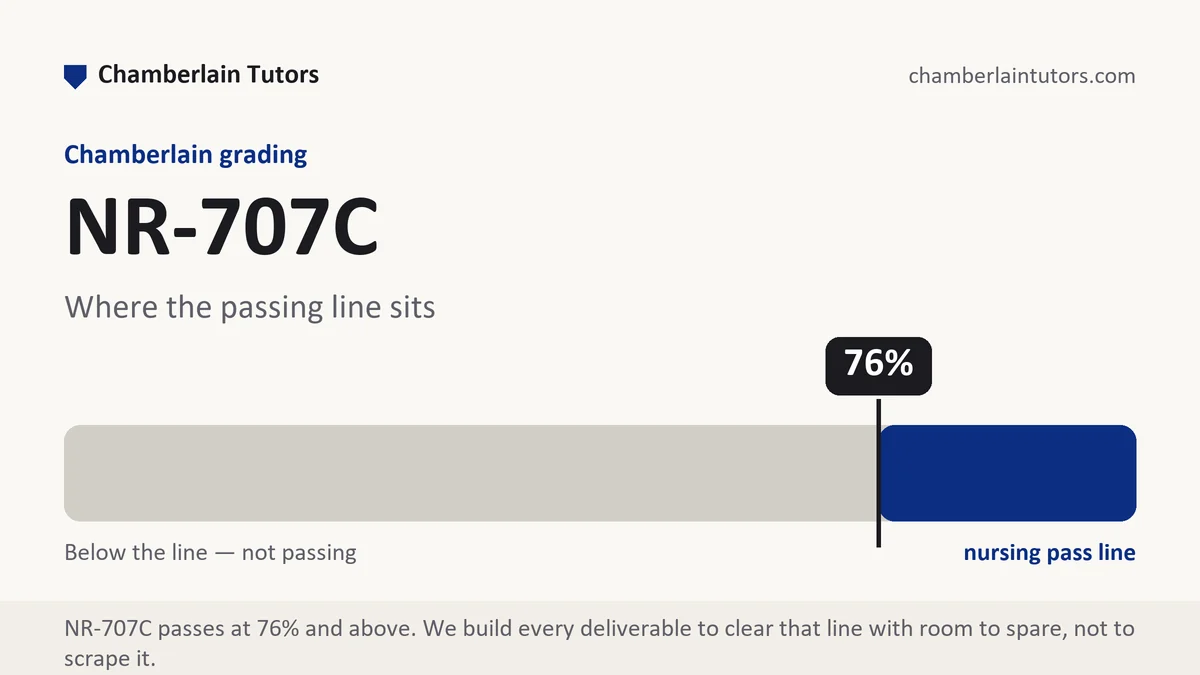
A passing NR-707C submission lists barriers, describes adaptations and reflects generally on flexibility. Its usual weakness is that the barriers are the ones any project would report and the adaptations are described without dates or consequences. Chamberlain fixes 76 percent as the floor for core nursing courses, and an average below it cannot be rescued by taking on more work, so a long block that produces a generic account leaves marks unclaimed across several deliverables.
Strong writing at this stage treats the project as an experiment in implementation rather than as a task being completed. It finds the barrier nobody predicted and explains what it revealed about how the work actually runs. It is candid when an adaptation weakened a core element, and it says what that means for interpreting the results rather than leaving the reader to discover it. And it converts the experience into design knowledge: the specific thing you would build differently from the first day, which is the sentence that shows the doctoral learning this block exists to produce.
Six mistakes that cost points in NR-707C
- Barriers written as complaints about staff. The workflow, the timing and the system design are the analyzable causes.
- Adaptations with no record. An undated change cannot be linked to a shift in the data, which wastes the most useful evidence you have.
- A core element quietly dropped. If the mechanism was removed, the outcome data is testing something else, and that has to be said.
- No evidence a barrier existed. Assertion is not analysis, and the evidence rows in this block are specifically about that difference.
- Adaptations reconstructed after seeing results. Retrospective explanation is visible to experienced readers and it undermines the whole record.
- Nothing learned. A reflection that ends at persistence pays nothing. Name the design change you would make next time.
Questions NR-707C students ask
My biggest barrier was that my sponsor left. Is that a legitimate thing to write about?
How do I tell whether an adaptation broke the intervention?
Should I still report barriers that I could not solve?
Where NR-707C sits in Chamberlain's programs
Open the exact program map for sequence, credit, and option context. The current student schedule and syllabus remain authoritative after transfer evaluation, electives, state rules, and approved plan changes.
The weeks, one by one
Week 1
NR-707C carries 4 practicum credits and 256 clinical hours, which is close to a thirty-two hour week across an eight-week session, and it is the block where an approved practice change is operated and evaluated at a site. Read the full Week 1 manual.
Week 2
Early in a 256-hour block the written work turns to the machinery behind the numbers: which system holds each measure, who can extract it, under what authorization, on what refresh cycle, and how the extract will be validated before anything is claimed from it. Read the full Week 2 manual.
Week 3
By the third stage of a 256-hour block the change is running and being adjusted, and the written task is to make those adjustments legible as method rather than as improvisation. Read the full Week 3 manual.
Week 4
A 256-hour block is one of the few practicum stages with enough time for a change to stabilize in one place and then be offered to a second, and the written work at this point is about that extension: what transfers, what has to be rebuilt locally, and how the evaluation has to change once two settings are involved. Read the full Week 4 manual.
Week 5
Around the fifth stage of a 256-hour block there is enough data to look at, and the discipline required is restraint. Read the full Week 5 manual.
Week 6
A change that improves an average can widen a gap, and a 256-hour block has enough data and enough time to ask whether yours did. Read the full Week 6 manual.
Week 7
Late in a 256-hour block the decisive question is whether the change is embedded in the system or in you. Read the full Week 7 manual.
Week 8
The closing stage of a 256-hour block converts eight weeks of working documents into one scholarly product a doctoral reader can assess, and usually into a presentation that has to survive questions. Read the full Week 8 manual.