The final stage of a 2-credit implementation block closes the written record: what was implemented, how far it reached, what the interim data shows, what remains in motion, and who holds the change now. Because 128 hours rarely completes an evaluation, this is a handover document rather than a conclusion, and writing it as a handover is what makes the next block and the final project document straightforward instead of archaeological. Your section may print this as NR 707A or NR707A; it is the same course. Chamberlain publishes no syllabi outside Canvas. The placement here is our teaching judgment from the course's catalog arc; your section's rubric decides what your week actually asks.
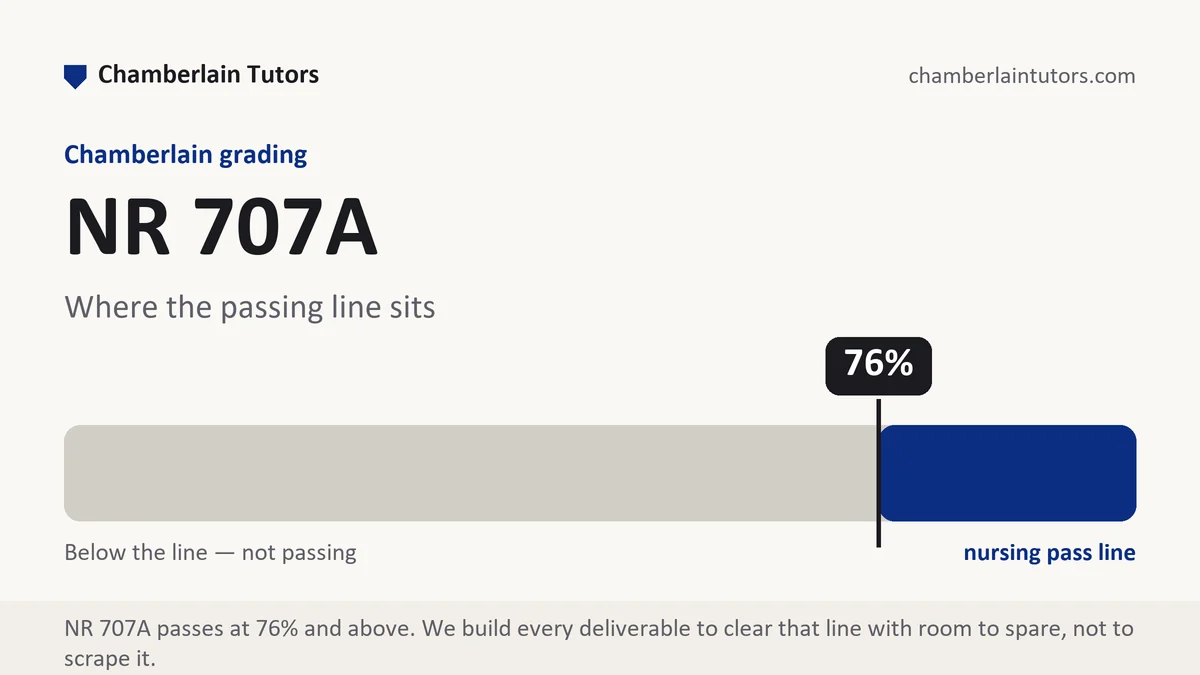
What NR-707A Week 8 asks for
A useful way to test a closing document is to imagine it read cold by a reviewer who was not present. Could that person say what changed in practice, on what evidence, with what reliability, and what would happen next Monday if nobody from the project team came to work. Most end-of-block reports fail the last question. The change is described, the data is presented, and the section on who owns the protocol from here consists of an assurance that the unit is committed to sustaining it. That sentence is where implementations go to die, and replacing it with names, dates and a review cycle is the highest-value writing in the whole block.
The boundary, in closing. Your practicum hours, hour log, encounter counts, site paperwork and every evaluation completed about you are your own record of your own work, verified by your school and your site, and are never drafted, reconstructed or estimated with anyone's help. Support extends only to the written and scholarly layer: how the report is structured, how the evidence is presented, how the sustainability argument is made. Everything drawn from real encounters is de-identified before it reaches the page.
Two things distinguish a doctoral closing report from a workplace one. The first is that unresolved questions are stated rather than smoothed over: what the data cannot yet establish, which component has not been tested at scale, which unit has not started. The second is that the report is written to be reused. Sections drafted properly here become chapters of the final project document with editing rather than rewriting, and the students who understand that in week eight save weeks later.
Expect a summative written product, sometimes a formal progress report, sometimes a presentation to faculty or to the site, and often a competency-linked self-assessment. Where a self-assessment is required, write it analytically: which competencies the block actually exercised, with the artifact that demonstrates each, rather than a paragraph of general growth.
The NR-707A Week 8 method, step by step
Six moves for closing a block so the next one begins from a document rather than from memory.
-
Open with the state of the change in three sentences
What is now in operation, where, and for whom. A closing report that begins with background rather than status makes every reader do the assembly work themselves.
-
Report reach and fidelity before results
The proportion of eligible cases receiving the change, and the extent to which it was delivered as designed. These two numbers determine how everything else in the report should be read.
-
Present the data as a series with its limits stated
Carry your annotated charts forward, restate the measure specifications compactly, and say in plain language what the series can and cannot support at this point in the project.
-
Write the open items as a list with owners and dates
Components not yet launched, data not yet obtained, decisions not yet made, units not yet included. Each with a name and a date, because an open item with neither will still be open a year from now.
-
Make the sustainability argument concrete
Who owns the protocol, where it lives as a document, who trains new staff, which forum reviews the measure, on what interval, and what triggers re-examination at the next system upgrade or policy revision.
-
Write the self-assessment against artifacts
For each competency the block exercised, name the specific written product or activity that demonstrates it. Claims of growth without artifacts are the weakest paragraphs in any doctoral portfolio.
A layout that makes a closing report reusable
Our frame for an end-of-block progress report, sized for roughly 1,600 to 2,000 words plus exhibits. It is our own outline rather than anything the university issues, and your week's rubric outranks it wherever the two disagree.
| Section | What belongs in it | Word target |
|---|---|---|
| Status of the change | What is operating, where, for which population, and since when, stated before any background. | 150 to 190 |
| Implementation summary | The block's events compressed to dates, counts and decisions, with deviations and their resolutions. | 300 to 360 |
| Reach, fidelity and results | Delivery figures with denominators, the annotated series, and a plain statement of what it supports. | 320 to 380 |
| Open items | Everything unfinished, each with a named owner, a date and the consequence of it slipping. | 220 to 270 |
| Sustainability and ownership | Protocol owner, document location, training route, reviewing forum, review interval and upgrade trigger. | 280 to 340 |
| Competency self-assessment | Each competency exercised, with the artifact that demonstrates it and one sentence of analysis. | 240 to 300 |
Evidence craft for a closing practicum document
Write for reuse. Full attributions, complete measure specifications and consistent terminology now save a rebuild later. A closing report with citations stripped for brevity has to be reconstructed when the final project document needs them.
Keep the translation claim exact. Your project moved published evidence into one setting and evaluated the move locally. It did not test whether the intervention works, and the closing report is the place that framing is most often lost under pressure to sound conclusive.
Numbers keep their provenance to the end. Each figure in the report should still carry its source, its period and its denominator. Provenance stripped in a summary is provenance that has to be rediscovered at the defense.
Say what did not work without softening it. A component that never launched, a unit that never started, a data source that never materialized. Naming these plainly is what makes the rest of the document believable.
Do not predict institutional outcomes. Whether a review body will require anything for future dissemination, whether the organization will adopt the change permanently, whether funding continues: describe the process and the request, not the result.
Close the loop on every earlier commitment. A closing report is read against the documents that preceded it, so each objective set in the opening stage, each trouble signal you pre-named, and each response you promised after an audit should be accounted for by name: delivered, modified, or not reached, with a reason in the third case. Reports that quietly drop a commitment made in week one are the ones committees remember, and the accounting itself costs perhaps 150 words while buying most of the document's credibility.
Five mistakes that cost points in this week's territory
- Sustainability by assurance. A statement that the unit is committed to maintaining the change is not a plan and names nobody.
- A conclusion the data cannot carry. Eight weeks rarely settles an outcome question, and a confident closing claim invites the hardest examination question.
- Open items without owners. Unfinished work listed without a name and a date is a list that will be identical at the start of the next block.
- Background before status. A closing report that opens with the problem statement wastes the position a reader actually reads.
- Self-assessment without artifacts. Growth claimed but not evidenced is the least persuasive paragraph available in a doctoral portfolio.
Before you submit
- The current state of the change appears in the opening paragraph
- Reach and fidelity figures precede any results, each with denominators
- Charts carry annotations and measure specifications travel with them
- Every open item has a named owner, a date and a consequence
- Sustainability names the owner, the document location, the reviewing forum and the interval
- Each competency claim is tied to a specific artifact from this block
Closing the NR-707A block?
Send the rubric and your own block materials out of Canvas. A premium original draft of the report comes back in 24 to 48 hours built for reuse in the final project document, with a sustainability section that names people and dates, while hours and evaluations remain yours.