NR-705B carries DNP Project and Practicum II at 3 credits and 192 clinical hours. With the site preparation underway, the writing that carries this block is usually the intervention protocol: the document that says exactly who does what, when, and what happens at each decision point. The test of a protocol is simple and unforgiving. Could a nurse on a night shift who has never met you follow it correctly without calling anyone? If not, the protocol is a description of an intention.
We take no part in the practicum itself: not the hours, not any approach to a preceptor or a site, not the placement forms, not the hour log, and not any proctored assessment. Documents are where we work: the protocol, its rationale, the evidence linkage for each step and the scholarly sections your rubric grades.
What NR-705B actually grades
The first row is operational specificity. Every step needs an actor, a trigger and a timeframe. Assess the patient is not a step; the admitting nurse completes the screening tool within four hours of arrival is a step. Vague verbs are where protocols fail in practice and where they lose marks on paper, because a grader can see immediately whether a sentence could be executed or only agreed with.
The second row is traceability to evidence. Each substantive step should be attributable to something: a study from your evidence set, a guideline recommendation, a regulatory requirement or a local constraint you name openly. Steps that come from none of those are your invention, which is allowed as long as it is labelled. What loses marks is a protocol that reads as though the whole sequence were evidence-based when only part of it is.
How we help in NR-705B
Our doctoral writers build protocols as executable sequences with an evidence column behind them, then write the rationale that explains why each choice was made and which elements cannot be altered without losing the mechanism. Drafts return version-stamped, because a protocol without version control causes problems later in the sequence.
Deliverables run the standard promise: a premium original draft in 24 to 48 hours, targeted at the A band of your course's actual scale, through the eight-person pipeline with both QA passes and the floor check, revised free until it lands.
In NR-705B right now?
Send your rubric, your plan and your evidence set. First premium sample free, floor-checked, back in 24 to 48 hours.
Read the rubric before the prompt
When the deliverable is a document plus a rationale, the rubric usually splits between them, and students routinely write one long essay that satisfies neither cleanly. Copy the rows into a blank file and label each as protocol or rationale. Rows about clarity, sequence and decision points belong to the document; rows about evidence, theory and justification belong to the narrative.
Then price the narrative. Take a protocol of about 800 words plus a 1,200-word rationale, with four rows at 42, 26, 18 and 14 percent across the combined 2,000. That hands you 840, 520, 360 and 280 words. The 840-word row is normally the protocol itself, which tells you that the document is the graded object and the rationale supports it. Padding the rationale while leaving the protocol vague inverts the guide.
Before drafting the steps, write the trigger and the eligibility rule. Who enters this pathway, decided by what criterion, checked by whom. Protocols that begin at the intervention and never define entry create ambiguity that shows up later as poor fidelity, because staff will apply it to different patients than you intended.
The shape of an intervention protocol
These are the parts that make a protocol usable and scoreable. Each removes one ambiguity, and a reader can tell whether it was removed.
| Part | What it has to prove | How a thin version looks |
|---|---|---|
| Purpose and scope line | What the protocol achieves and which patients or encounters it applies to, in two sentences. | A paragraph of background before any instruction. |
| Trigger and eligibility | The event that starts the pathway and the rule that decides who is in it. | Applies to appropriate patients. |
| Steps with actors and timing | Each step naming who acts, what they do and within what window. | Passive instructions with no owner. |
| Decision points | Branches written as conditions with an action on each side. | Clinical judgment invoked in place of a rule. |
| Tools and materials | The specific form, field, screen or resource used at each step, named as staff would see it. | A reference to appropriate documentation. |
| Documentation point | Where the action is recorded, in what field, so it can be measured later. | Documentation mentioned without location. |
| Exceptions and escalation | What to do when the pathway does not fit, and who to contact within what timeframe. | No exception route, leaving staff to improvise. |
| Version, date and owner | A version number, an effective date and the role accountable for the content. | An undated document circulating in several copies. |
Evidence craft in protocol writing
Four habits keep a protocol defensible in front of a committee.
Attribute each substantive step. Keep a column or a numbered note linking steps to their source: a trial, a guideline recommendation with its grade, a regulatory requirement or a local decision. Reviewers ask where a threshold came from, and an answer written into the document is worth more than a memory.
Name the elements that cannot be adapted. Every borrowed intervention has parts that carry the effect and parts that are packaging. Say which is which, because the next stage will adapt something under pressure and it should not be a core element. Cite the source that supports your judgment where one exists.
Match the verb to the evidence behind the step. Where a step comes from a controlled trial, you can say it reduced the outcome. Where it comes from a quality improvement report, it was followed by a change. Where it comes from local judgment, say that plainly. Where your guide sets no recency rule, sources past five years old need their justification stated in the sentence.
Build measurement into the steps, with denominators available. A protocol whose actions are recorded in a discrete field can be measured; one recorded in free text cannot, at least not without manual review. Write the documentation point so that the numerator and denominator for your fidelity and process measures will exist without extra work.
What separates a pass from a strong pass here
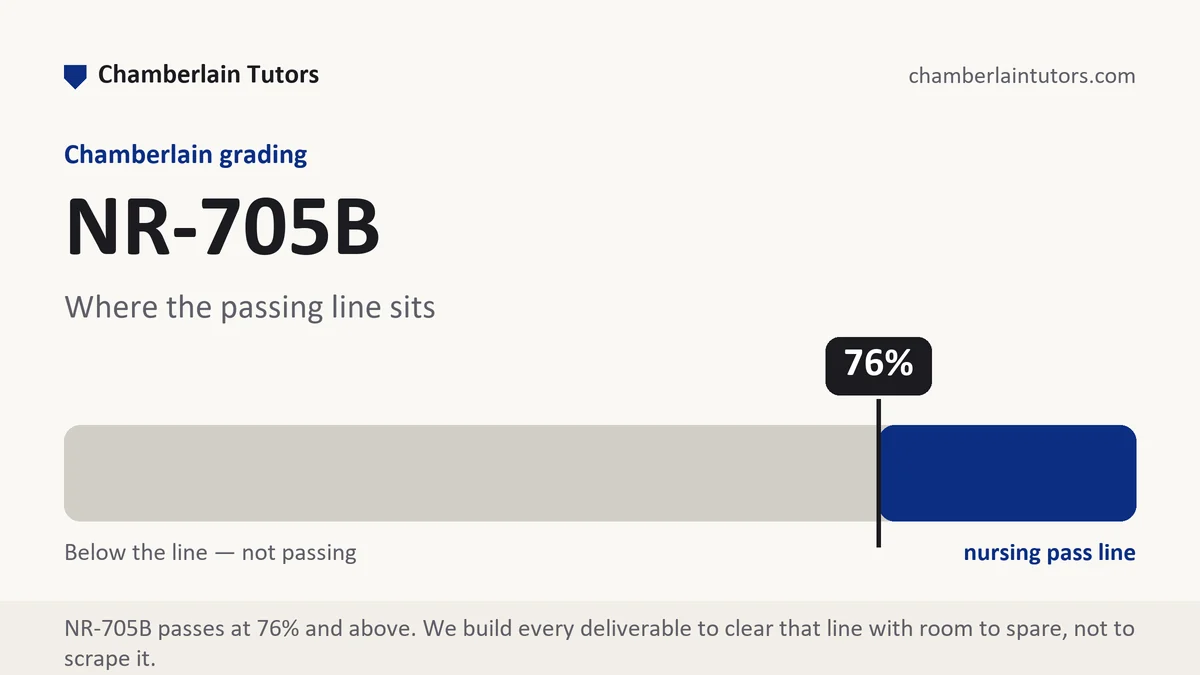
A passing NR-705B protocol is complete and reasonable, and it usually reads as prose about a process rather than as a document staff would follow. Chamberlain will not pass a core nursing course under 76 percent, and extra work cannot lift an average that has settled low, so a habit of writing about a process instead of writing the process costs marks repeatedly through this stage.
Strong protocols are tested on paper before they are graded. The writer has walked a real case through them and found the step where the shift changes, the point where a form is not available, the branch nobody wrote. Strong versions also account for the exception, because staff meet exceptions in the first week and a protocol with no exception route gets abandoned rather than followed. And they carry a version, a date and an owner, which sounds administrative and is in fact the difference between a document that survives the project and one that becomes three inconsistent copies.
Six mistakes that cost points in NR-705B
- Writing the protocol as an essay. Steps belong in a numbered sequence. Prose hides missing actors and missing timing.
- Steps with no owner. A passive instruction is a step nobody has agreed to perform.
- No eligibility rule. Without it, staff apply the pathway to a different population than you will measure.
- Borrowing a bundle without attribution. Adapted material must be cited, and the adaptations named.
- No version control. Undated documents multiply, and later fidelity data becomes impossible to interpret.
- Assuming training happens. If the protocol requires a skill or a login, say who trains, when, and how readiness to use it is confirmed.
Questions NR-705B students ask
How detailed should the protocol be before it becomes unusable?
Can I adapt a published protocol rather than writing one from scratch?
Who has to approve the protocol before it can be used?
Where NR-705B sits in Chamberlain's programs
Open the exact program map for sequence, credit, and option context. The current student schedule and syllabus remain authoritative after transfer evaluation, electives, state rules, and approved plan changes.
The weeks, one by one
Week 1
NR-705B opens the second practicum block, and the writing that starts it is a translation job: the document you defended as a plan has to become a document a site can run. Read the full Week 1 manual.
Week 2
The second stage of a 192-hour implementation block is where the change stops being a description and becomes a set of instructions. Read the full Week 2 manual.
Week 3
A protocol nobody has been prepared to run is a document, not a change. Read the full Week 3 manual.
Week 4
Midway through a 192-hour block the intervention starts running, and the writing shifts from planning documents to a record of what is actually happening. Read the full Week 4 manual.
Week 5
Halfway through the operating period the question stops being whether the change launched and becomes whether it is being delivered as designed, to whom, and how often. Read the full Week 5 manual.
Week 6
By the sixth stage of a 192-hour block the intervention has met the building, and the writing that matters is the account of what got in the way and what you changed in response. Read the full Week 6 manual.
Week 7
Late in a practicum block most programs ask for reflective writing tied to doctoral competencies, and it is the piece students underestimate most consistently. Read the full Week 7 manual.
Week 8
The final stage of a 192-hour block closes two things at once: the term's written record, and the state of the project as it passes to the next phase. Read the full Week 8 manual.