By the sixth stage of a 192-hour block the intervention has met the building, and the writing that matters is the account of what got in the way and what you changed in response. This is improvement-cycle writing: a barrier named at the level of the system, a change tested, a result observed, a decision to adopt, adapt or abandon. Doctoral readers score honesty and mechanism here, not smoothness. Your section may print this as NR 705B or NR705B; it is the same course. Chamberlain publishes no syllabi outside Canvas. The placement here is our teaching judgment from the course's catalog arc; your section's rubric decides what your week actually asks.
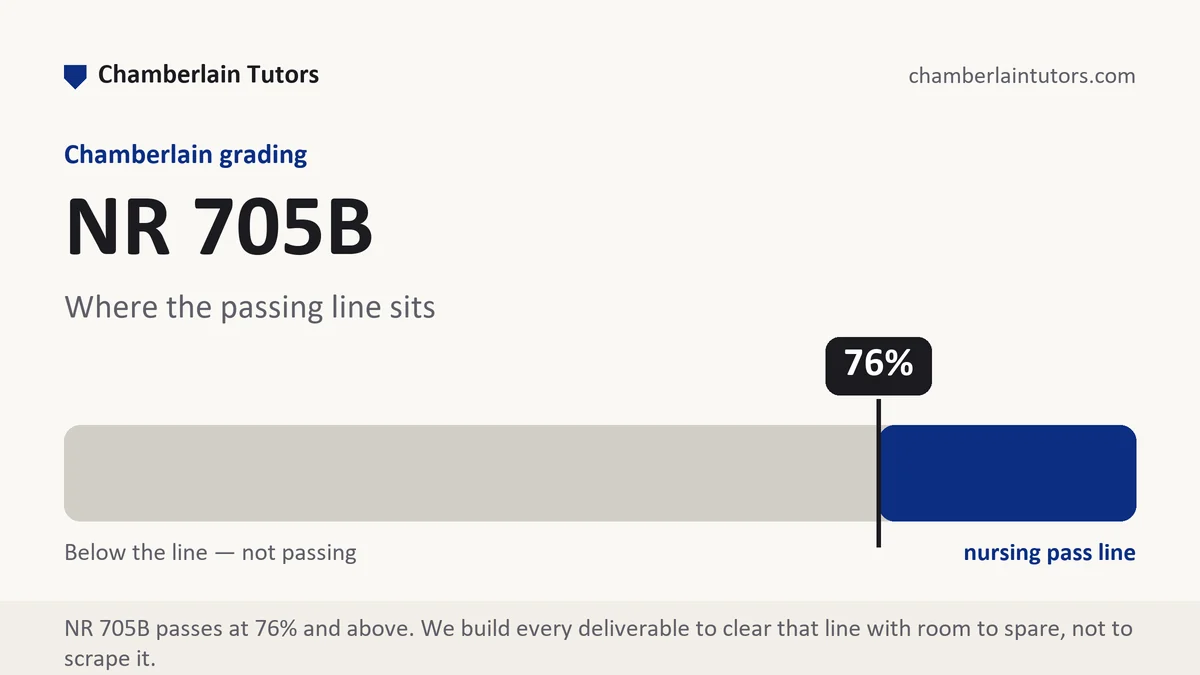
What NR-705B Week 6 asks for
A family practice running a new caregiver conversation at well-child visits discovers that the step disappears entirely on the two afternoons the clinic runs a walk-in block. Nobody decided this. The walk-in block simply runs fifteen minutes behind from the first patient and the rooming staff triage away anything that is not clinically required. That is a barrier with a structure: a resource constraint expressing itself as a workflow priority. Writing it as staff forget on busy afternoons throws away everything useful about it, and a committee reading that sentence learns that the student stopped at the symptom.
The framing that earns marks is barriers by level. Individual level covers knowledge, belief and habit. Workflow level covers sequence, timing and physical space. Organizational level covers staffing, priority and policy. External level covers payers, regulators and vendors. A barrier assigned to the wrong level attracts the wrong intervention, which is why so many projects respond to a workflow constraint with more education and then report that education did not work. Say which level each barrier sits at, and let the level dictate the response you propose.
Adaptation writing has its own discipline. Every change you make mid-implementation should be recorded with four things: what changed, when, why, and whether it touches the mechanism. Improvement science expects iteration - the whole point of testing a change on a small scale is that you learn and modify - but a project that cannot say which version ran in which week produces results nobody can interpret. Keep your protocol version history current as you write this section, and refer to versions by number in the prose.
Where the boundary sits. Nothing in the clinical practicum is delegable and nothing here pretends otherwise. Your 192 hours, the log recording them, any encounter or activity count, preceptor and mentor evaluations, site agreements and signatures are your own record and your own work - never written, reconstructed, back-dated or estimated with help from anyone. Written support is limited to the written layer: organizing a barriers analysis, writing an adaptation record in scholarly register, structuring reflection so that it analyzes instead of narrating. Where your writing uses real encounters or real staff interactions, de-identify them completely: roles rather than names, no dates of service, nothing that would identify a family or a colleague. The clinical experience cannot be shortened, and clearer written reasoning about work you genuinely did is all that is on offer.
The NR-705B Week 6 method, step by step
Six moves for writing barriers and adaptations at doctoral altitude.
-
Describe the barrier as an observation before you name it
The step was completed in one of eleven observed walk-in encounters and in most scheduled encounters. Start there. A barrier introduced as a conclusion invites disagreement; a barrier introduced as an observation invites the reader to reach your conclusion with you.
-
Assign every barrier to a level and justify the assignment
Individual, workflow, organizational or external. One sentence of justification each. This single discipline prevents the most common analytic error in implementation writing, which is treating a structural constraint as a knowledge deficit.
-
Match the response to the level
Knowledge barriers take teaching. Workflow barriers take sequence changes, prompts or physical relocation. Organizational barriers take negotiation with whoever controls the resource. External barriers usually take documentation and scope adjustment rather than a fix.
-
Write each change as a small test with a prediction
What you changed, what you expected to happen, over what period, and what you would look at. A prediction written before the result is what makes the cycle a test rather than a story, and committees notice when it is present.
-
Report the result against the prediction, including when it failed
A change that did not work, honestly reported with a reason, is worth more to a reader than three that did. It is also the only way the adopt, adapt or abandon decision at the end of the cycle reads as reasoned.
-
Update the protocol version and say what period each version covers
Version two took effect on the eleventh and applies to all subsequent encounters. That one sentence protects your evaluation stage from an entire class of interpretive problems.
A layout and word budget for a barriers and adaptation section
Our frame for the improvement-cycle write-up in this block, sized for roughly 1,600 to 2,000 words plus the cycle table. It is our own outline rather than anything the university issues, and your chair's direction and your week's rubric outrank it wherever they disagree.
| Section | What belongs in it | Word target |
|---|---|---|
| Method for identifying barriers | How barriers surfaced: observation, aggregate counts, staff feedback, or your own event record, with the period covered. | 170 to 210 |
| Barrier inventory by level | Each barrier as an observation, its assigned level, the justification, and the number of encounters or sessions behind it. | Table plus 180 |
| Prioritization | Which barriers you addressed first and why, in terms of mechanism impact and feasibility inside the remaining weeks. | 180 to 230 |
| Change cycles | For each cycle: the change, the prediction, the period, what was observed, and the adopt, adapt or abandon decision. | 400 to 500 |
| Adaptations and the mechanism | Which adaptations preserved the core and which altered it, with your reasoning stated rather than asserted. | 250 to 300 |
| Protocol version history | Version numbers, effective dates, and a one-line description of what each version changed. | 130 to 180 |
| Unresolved barriers | What remains, why it was not addressed in this term, and what it means for your later interpretation. | 180 to 230 |
Evidence craft for improvement-cycle writing
Use a determinants framework as a checklist rather than a decoration. Implementation frameworks that enumerate domains are most useful when you walk your project through the domains and report which are relevant and which are not. Two sentences saying a domain was examined and found not to apply is real analysis; a paragraph defining the framework is not.
Attach a denominator to every barrier claim. The step occurred in one of eleven observed walk-in encounters carries weight. The step often fails during walk-in clinic does not, and in a section built on identifying causes, unquantified claims undercut the ones you have quantified properly.
Write predictions in the past tense from the start. The change was expected to raise completion in walk-in encounters within two weeks. Recording the expectation before the result, in the document, is what distinguishes a tested change from a retrospective rationalization, and readers who work in improvement can tell the difference immediately.
Separate the barrier from the person who reported it. Feedback from a role is data about the system, not a complaint. Write it in system terms and keep the reporting role generic, particularly in a small practice where a described complaint is effectively a named one.
Cite when your barrier is a known phenomenon. Competing clinical priorities during unscheduled care is well described in the implementation literature, and one citation establishes that you recognize a general pattern rather than a local accident. That recognition is part of what makes a single-site project translatable.
Five mistakes that cost points in this week's territory
- Education as the answer to everything. A workflow barrier met with another in-service is the signature error of this stage, and it is visible from the level assignment onward.
- Barriers listed with no observation behind them. An inventory that reads as speculation about what might be hard is not an analysis of what was hard.
- Adaptations reported without dates. Undated changes make the whole operating period a single undifferentiated block and destroy your ability to interpret any later comparison.
- Only successful cycles reported. A section where every change worked reads as curated, and the failed cycle is usually the one with the most transferable lesson in it.
- Barrier language that blames. Resistance, non-compliance and buy-in problems are conclusions about people that substitute for analysis of systems, and they date a doctoral document badly.
Before you submit
- Every barrier is stated as an observation with a count or a session number behind it
- Each barrier carries an assigned level and one sentence of justification
- Responses match the level of the barrier they address
- Every change cycle records a prediction made before the result
- At least one cycle that did not work is reported honestly
- Protocol versions are numbered with effective dates
- No barrier is written as a characterization of an individual
Writing the NR-705B adaptation section?
Send the rubric, your protocol versions and your own event notes out of Canvas. A premium original draft comes back in 24 to 48 hours with barriers assigned to levels and each cycle written as a tested change, revised free until it lands. Your hours, logs and evaluations are never touched.