The second stage of a 192-hour implementation block is where the change stops being a description and becomes a set of instructions. The protocol is the document that says who performs each step, what triggers it, what the step produces, and what happens when the expected condition is not met. There is one test and it is unforgiving: could a medical assistant who has never met you follow this on a Monday morning without calling anyone. Your section may print this as NR 705B or NR705B; it is the same course. Chamberlain publishes no syllabi outside Canvas. The placement here is our teaching judgment from the course's catalog arc; your section's rubric decides what your week actually asks.
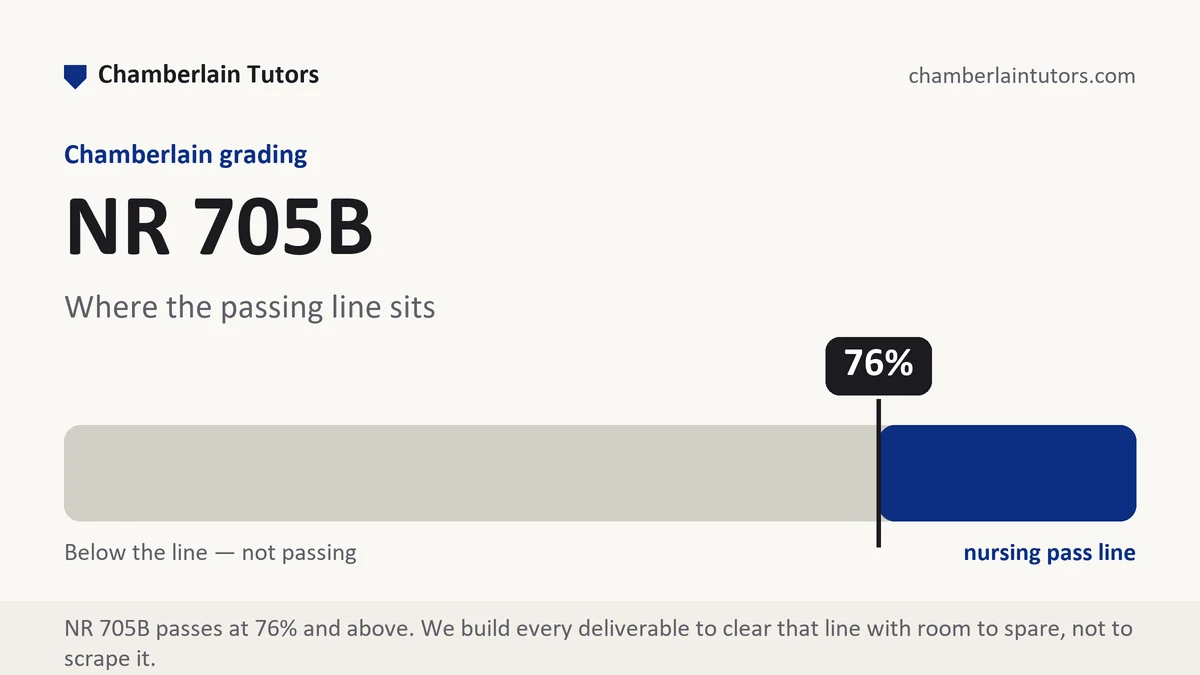
What NR-705B Week 2 asks for
Take a pediatric practice that has agreed to add a standardized developmental screening step at the eighteen-month visit. The proposal says the practice will implement structured screening. That sentence is a policy position. What the practice needs is a page that tells the front desk which visit types trigger a form, tells the rooming staff where the form goes and how long the family has to complete it, tells the provider what a positive result obliges them to do before the family leaves, and tells everyone what to do when the family speaks a language the form is not printed in. The distance between those two documents is the entire work of this stage.
Operational specificity is the first thing a doctoral reader scores. Assess the child is not a step. The rooming medical assistant hands the caregiver the screening form at the time of vitals and states that the provider will review it during the visit is a step, because it names an actor, a trigger, an action and a moment. Every verb in a protocol should be one that could be observed happening. Verbs like ensure, promote, facilitate and encourage are the reliable markers of a protocol that has not yet been thought through, because nobody can watch someone facilitate anything.
The second thing scored is traceability. Each substantive step should be attributable to something you can name: a recommendation from a professional body, a finding from your evidence set, a regulatory or billing constraint, or a local decision you made and are labelling as local. Steps that come from none of those are your own design choices, which is entirely allowed at the doctoral level as long as you say so. What loses marks is a protocol written as though every element were evidence-based when only some of it is, because a reader who checks one step and finds nothing behind it starts checking all of them.
Where the boundary sits. This manual teaches the written and preparatory layer only. Your 192 practicum hours, the log that records them, encounter or activity counts, preceptor and mentor evaluations, site agreements and signatures are your own record and your own work, and they are never drafted, reconstructed or estimated with help from anyone. Nobody should offer to build any part of that record for you, and the offer here is explicitly not that. What can be taught is how to write a protocol clearly, how to structure a rationale, how to prepare your reasoning before you walk into a clinic. Where your writing draws on real encounters, de-identify completely: no names, no service dates, no detail that would let a colleague recognize a family. The clinical work is not shortcutable and is not meant to be.
The NR-705B Week 2 method, step by step
Six moves for writing a protocol that survives contact with a clinic.
-
Write the trigger before you write the action
Every step begins with a condition: a visit type appears on the schedule, a form comes back scored above a threshold, a caregiver declines. Protocols written as a list of actions with no triggers are checklists, and checklists fail the moment a case is not typical.
-
Assign one actor per step by role, never by name
Rooming medical assistant, treating provider, front desk lead. Names leave with staff turnover and your protocol has to outlive the person who agreed to it. One step, one owner: shared ownership is how steps quietly stop happening.
-
Bound every step in time
Before the provider enters the room, within the same visit, by end of clinic day. A step without a time boundary cannot be measured for fidelity later, and week five of this block will ask you to measure exactly that.
-
Write the exception paths that clinics actually hit
Caregiver declines, language barrier, form not returned, positive result at the last appointment of the day, provider running an hour behind. Three or four exception paths convert a protocol from an ideal sequence into an operating document.
-
Attach an evidence or decision source to each substantive step
Run a right-hand column or a numbered rationale set: guideline recommendation, study finding, local constraint, or author decision. The labelled author decisions are not a weakness; they are what makes the rest credible.
-
Read it aloud to someone who will have to do it
Then write down every question they ask, because each question is a gap in the document rather than a gap in them. A protocol that generates four clarifying questions from a colleague will generate forty from a clinic.
A layout and word budget for an intervention protocol
Our frame for a protocol document with its rationale attached, sized for roughly 1,600 to 2,000 words plus the step table. It is our own outline rather than anything the university issues, and your chair's direction and your week's rubric outrank it wherever they disagree.
| Component | What belongs in it | Word target |
|---|---|---|
| Purpose and scope line | What the protocol governs, which visit types and which population it applies to, and what it explicitly does not cover. | 110 to 140 |
| Definitions | Every term that could be read two ways: eligible visit, completed screening, positive result, declined. Two lines each, no more. | 150 to 200 |
| Roles and authority | Each role touching the sequence, what that role decides, and what it must escalate rather than decide. | 180 to 230 |
| Step sequence | The numbered steps as a table: trigger, actor, action, time bound, output, evidence source. This is the heart of the document. | Table plus 120 of framing |
| Exception paths | Three to five named exceptions, each with its own short sequence rather than a sentence saying use clinical judgment. | 300 to 380 |
| Rationale narrative | Why the design is shaped this way, which elements are core to the mechanism, and which are locally adjustable. | 400 to 500 |
| Version and review block | Version number, date, who approved what and when, and how a change to the protocol gets recorded mid-implementation. | 90 to 130 |
Evidence craft for protocol writing
Separate the core mechanism from the local packaging in writing. Doctoral readers want to know which parts of your design carry the effect and which are convenience. Screening every eligible visit with a validated instrument is mechanism; printing the form on green paper is packaging. Say which is which, because it tells a future adopter what they can change without breaking the intervention.
Name instruments precisely and let their properties do the work. When your protocol uses a published screening tool, name it with its version, say what it produces, and cite the source describing its performance in a population like yours. Do not restate its psychometrics at length. One accurate sentence with a citation outranks a paragraph of borrowed detail.
Write thresholds as rules, not as guidance. A result at or above the published cut point obliges the provider to complete the referral conversation during the same visit. That is a rule. Providers should consider follow-up is guidance, and guidance is what your fidelity measure will later be unable to score.
Cite the constraint when the constraint drove the design. If the screening step sits at rooming rather than at check-in because the practice's waiting area cannot preserve privacy, write that. Constraint-driven choices, stated openly, read as implementation maturity. The same choices left unexplained read as arbitrary.
Version-stamp from the first draft. Protocols change during implementation, and a change you cannot date is a change you cannot analyze later. Put a version and a date on the document now, so that when week six asks you to describe an adaptation you can say which version it modified.
Five mistakes that cost points in this week's territory
- Abstract verbs throughout. Ensure, promote, facilitate and support cannot be observed, cannot be timed, and cannot be measured for fidelity. Every one of them is a step you have not finished writing.
- No exception paths. A protocol that only describes the typical case will be abandoned in week three, and the abandonment will look like staff resistance when it was a documentation failure.
- Steps assigned to the clinic rather than a role. The clinic will screen means nobody will screen. Diffuse ownership is the most common single cause of a null implementation result.
- Undifferentiated evidence claims. Presenting locally invented steps as evidence-based invites a reader to check, and one unsupported step found by a committee member casts doubt across the whole sequence.
- Confusing the protocol with the manuscript chapter. The protocol is an operating document written for staff; the rationale is scholarly prose written for your committee. Blending the two produces a document neither audience can use.
Before you submit
- Every step names a trigger, one role, an action, and a time bound
- No step uses ensure, facilitate, promote, encourage or support as its main verb
- At least three exception paths are written out as sequences
- Each substantive step carries a labelled source, including labelled author decisions
- Core mechanism and local packaging are distinguished explicitly in the rationale
- The document carries a version number and a date
- Nothing in the document predicts an approval, an outcome, or a review decision
Building the NR-705B protocol?
Send the rubric, your evidence set and your workflow notes out of Canvas. A premium original draft comes back in 24 to 48 hours with the step sequence written as executable actions and the rationale in doctoral register, revised free until it lands. Hours, logs and site paperwork remain entirely your own.