NR-705C carries DNP Project and Practicum II at 4 credits and 256 clinical hours. The largest preparation block usually ends with the piece most students underestimate: the data collection and measurement plan. Not what you hope to improve, but how each number will be produced, by whom, from which field, over what period, and against what baseline. A project with a strong intervention and a weak measurement plan produces a change nobody can demonstrate, which is the most disappointing way for doctoral work to end.
Hours worked, preceptors and sites approached, forms signed, logs filled and assessments taken are all yours, and none of them touch this service. We work only on paper: the measurement plan, the operational definitions, the collection procedures and the scholarly sections your rubric grades.
What NR-705C actually grades
The first row is operational definition. Every measure needs a numerator rule, a denominator rule, inclusions, exclusions and a source, written so that two people applying them to the same month would get the same number. Vague definitions are the most common reason a project's post-intervention figure cannot be compared to its baseline, because the two were counted differently without anyone noticing.
The second row is the measure set rather than the measure. Doctoral projects are expected to carry an outcome measure, at least one process measure and a balancing measure. The process measure is what tells you whether the intervention was actually delivered, which is what makes a null outcome interpretable. Without it, a project that shows no change cannot distinguish between an intervention that did not work and one that never happened.
How we help in NR-705C
Our doctoral writers build the measurement plan as a table with definitions attached, then write the collection procedure so that another person could run it. Drafts return with baselines described by length and variation, so the comparison you make later is one a committee will accept.
Deliverables run the standard promise: a premium original draft in 24 to 48 hours, targeted at the A band of your course's actual scale, through the eight-person pipeline with both QA passes and the floor check, revised free until it lands.
In NR-705C right now?
Send your rubric, your protocol and your baseline data. First premium sample free, floor-checked, back in 24 to 48 hours.
Read the rubric before the prompt
Measurement rubrics are among the most literal in the doctoral sequence, which makes them easy marks for a student who reads them early. Copy the criterion rows into a blank file and check which ones require a table, since a definitions table satisfies several rows at once and prose about the same content often satisfies none of them cleanly.
Then price the narrative. A 2,000-word plan with four rows at 35, 28, 22 and 15 percent gives 700, 560, 440 and 300 words. The 700-word row is usually the measures and their definitions, and the 560 the collection procedure. That leaves the restatement of the intervention at the short end, which is correct: this deliverable is about how you will know, not about what you will do.
Before drafting, run one test on each measure. Ask who would have to do something differently for this number to exist, and how long it takes them. A measure requiring a monthly manual audit of 100 charts is a measure requiring several hours of somebody's month, every month, for the length of the project. Finding that out during a 256-hour preparation block is a great deal cheaper than finding it out during implementation.
The shape of a measurement plan
These are the columns and elements a committee looks for. Each settles one question about how a number will be produced.
| Element | What it has to carry | How a thin version looks |
|---|---|---|
| Measure name and type | The measure identified as outcome, process or balancing, so the set can be read as a set. | A single measure described as the outcome. |
| Operational definition | Numerator, denominator, inclusions and exclusions, written as rules rather than as descriptions. | The percentage of patients who received the intervention. |
| Data source and extraction | The system and field, and whether the number comes from a report, a query or manual review. | Data pulled from the electronic record. |
| Frequency and period | How often it is collected and what interval each data point covers. | Data collected throughout the project. |
| Collector and time cost | Who gathers it and roughly how long it takes them each cycle. | Collection assumed to be automatic. |
| Baseline value and length | The starting number, the period it covers, and the variation seen across that period. | A single month presented as the baseline. |
| Target and its basis | The goal with a stated source: benchmark, comparable unit or evidence applied to your baseline. | A round number with no derivation. |
| Data handling and privacy | Where data is stored, in what form, de-identified how, and who has access. | Privacy addressed in a single closing sentence. |
Evidence craft in measurement planning
Four habits protect the numbers you will report at the end of the sequence.
Use a measure with published properties where one exists. If a validated instrument or a nationally defined measure covers your outcome, adopt its specification rather than inventing one, and cite it. Locally invented measures are sometimes necessary, and when you build one, say so and describe how you checked that it counts what you think it counts.
Plan the data quality check, not just the collection. Say how you will confirm the field is populated reliably before you depend on it: a small audit comparing the report to the record, a check for missing values, a rule for what happens when a case cannot be classified. Missing data handled by a stated rule is method; missing data discovered later is a limitation.
Keep the verb inside the design you are planning. A pre-post project with no control cannot demonstrate causation, and the measurement plan should say what it will be able to claim: an association between the change and the observed difference, with alternative explanations considered. Where your guide sets no recency rule, measurement literature past five years old needs its justification written into the sentence.
Every planned figure carries a denominator and a window. Write the intended reporting form now: the proportion of eligible admissions screened within 24 hours, reported monthly, with counts alongside percentages. Deciding the format in advance stops the end-of-project scramble where percentages exist but the counts behind them have to be reconstructed.
What separates a pass from a strong pass here
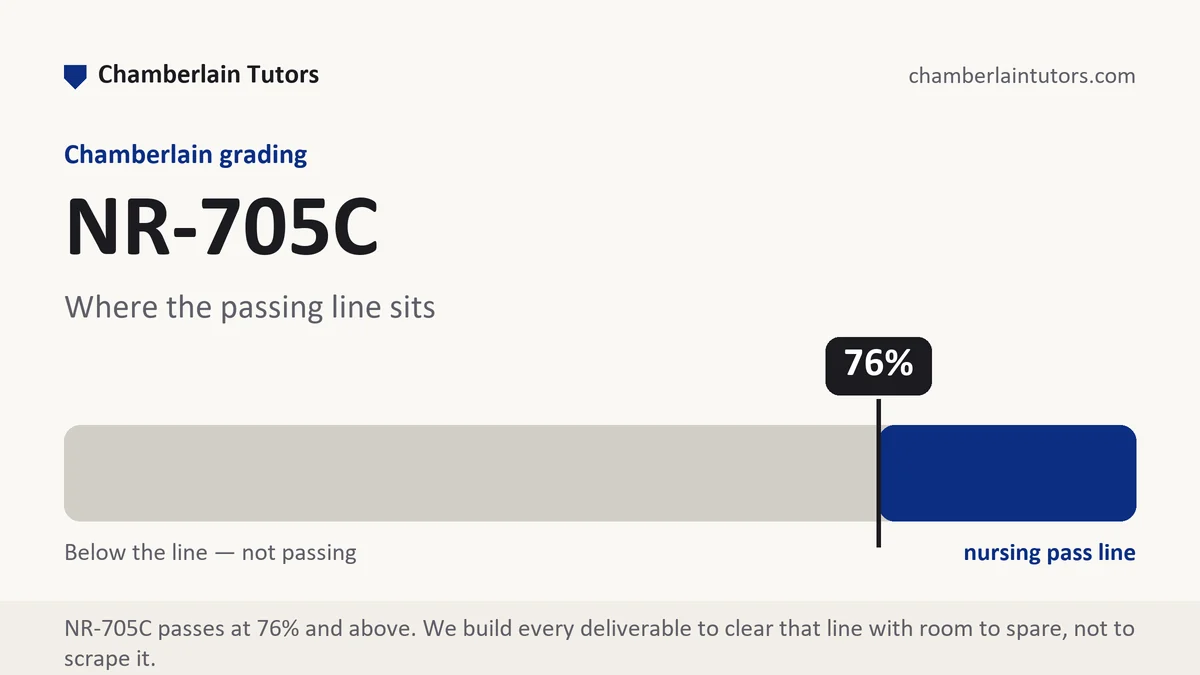
A passing NR-705C plan names measures and describes collection in general terms. Its usual weakness is that the definitions would not survive being handed to someone else. The 76 percent floor on Chamberlain's core nursing courses is fixed, and nothing added later rescues a weighted average that has weakened, so imprecision at the measurement stage costs marks now and credibility in the evaluation course later.
Strong plans are boring in the right way. Definitions are rules, sources are named down to the field, the collector is a person with an estimated time cost, and the baseline covers enough periods to show ordinary variation. Strong plans also state what will not be measured and why, since a project that promises to track everything will track nothing consistently. And they say in advance how much movement would count as signal instead of noise, which is the sentence that keeps the evaluation honest when the data arrives.
Six mistakes that cost points in NR-705C
- Measures without denominators. A numerator alone cannot show improvement, and the denominator rule is where most ambiguity hides.
- A baseline of one data point. Without variation, any later difference could be ordinary fluctuation.
- Chart review with no written rules. If the extraction rule is not written, it will drift between sessions and between people.
- Privacy handled as a sentence. Storage, de-identification and access are design decisions, and doctoral rubrics expect them specified.
- A target with no basis. A goal chosen because it sounds right cannot be defended when it is missed.
- Outcome measure only. Without a process measure, a null result is uninterpretable, and without a balancing measure the project cannot see the harm it caused elsewhere.
Questions NR-705C students ask
How long should the baseline period be?
Does my project need review board approval to collect this data?
What do I do if the data I need lives in free text?
Where NR-705C sits in Chamberlain's programs
Open the exact program map for sequence, credit, and option context. The current student schedule and syllabus remain authoritative after transfer evaluation, electives, state rules, and approved plan changes.
The weeks, one by one
Week 1
At 4 credits and 256 clinical hours this is the heaviest of the practicum blocks in its family, and the extra time is only an advantage if the written scope is drawn to use it. Read the full Week 1 manual.
Week 2
A project with a strong intervention and a weak measurement plan produces a change nobody can demonstrate, which is the most disappointing way for doctoral work to end. Read the full Week 2 manual.
Week 3
A measurement plan says what will be counted. Read the full Week 3 manual.
Week 4
By the middle of a 256-hour block the change is running and the written task is an account of how much of it is actually reaching people, where, and in what form. Read the full Week 4 manual.
Week 5
Midway through the operating period you have a series rather than a result, and the writing task is to display it correctly and describe what it does without overclaiming. Read the full Week 5 manual.
Week 6
Every change to a clinical workflow takes something from somewhere else, and the written work at this stage is the honest accounting of what. Read the full Week 6 manual.
Week 7
Late in a practicum block most programs ask for reflective writing tied to doctoral competencies, and in a term this size the material is largely about leading other people through a change you do not have formal authority over. Read the full Week 7 manual.
Week 8
The last stage of a 256-hour block closes the term and prepares the evaluation that follows. Read the full Week 8 manual.