NR-702B is the 3-credit, 192-hour variant of DNP Project and Practicum I. The extra hours over the 2-credit version buy depth rather than a different assignment, and where that depth usually goes is the evidence work: assembling the studies behind your proposed practice change and turning them into a synthesis matrix that a committee can audit. A matrix is not a reading list in a grid. Every row carries a judgment, and the judgments are what the rubric scores.
Nobody here logs an hour, speaks to a preceptor or a site, signs a placement form or takes an assessment for you. Those stay where they belong, with you and with Chamberlain. What we build is the written work: the evidence matrix, the synthesis narrative, the appraisal language and the scholarly sections your rubric grades.
What NR-702B actually grades
The first scoring demand is that the evidence set be assembled with a method rather than collected. A reader should be able to see which databases you searched, which terms you used, what you included and excluded and why. That does not need to be a full systematic review at this stage, but it does need to be reproducible enough that the set is defensible as the evidence for your project rather than as the articles you happened to find.
The second demand is synthesis rather than accumulation. Synthesis means the matrix has been read across its rows, so that the narrative says where the studies agree, where they disagree, what explains the disagreement and what none of them answer. A narrative that walks study by study through the matrix has transcribed it instead of interpreting it, and that is the most common reason a well-sourced submission lands mid-range.
How we help in NR-702B
Our doctoral writers build the matrix with an appraisal column that carries a verdict, then write the synthesis by claim rather than by article. Drafts come back showing which studies support each claim and which qualify it, so committee questions land on material you have already worked through.
Deliverables run the standard promise: a premium original draft in 24 to 48 hours, targeted at the A band of your course's actual scale, through the eight-person pipeline with both QA passes and the floor check, revised free until it lands.
In NR-702B right now?
Send your rubric and your current article set. First premium sample free, floor-checked, back in 24 to 48 hours.
Read the rubric before the prompt
Evidence deliverables are usually scored as two objects: the matrix and the narrative. Copy the criterion rows into a blank file and mark which apply to which, because a row about quality appraisal is often satisfied by a column rather than by a paragraph, and writing the paragraph instead of building the column loses the mark outright.
Then price the narrative. Take a synthesis of 1,500 words with four rows at 35, 35, 20 and 10 percent. That gives 525, 525, 300 and 150 words. The two 525-word rows are typically synthesis and appraisal, which leaves the description of the search at 300 and the restatement of the problem at 150. Students who arrive from the problem stage often want to re-argue the problem here; the budget says one short paragraph.
Before drafting, sort your studies into three piles: those testing the intervention you intend to use, those testing something adjacent, and those describing the problem without testing anything. Only the first pile can support an effect claim. Keeping the piles separate while you write prevents the most common structural error at this stage, which is a synthesis that implies more direct evidence than the set actually contains.
The shape of an evidence synthesis matrix
These are the columns a doctoral reader looks for, and the judgment each one has to carry. A matrix missing any of them is doing less work than the rubric expects.
| Column | What it has to carry | How a thin version looks |
|---|---|---|
| Citation and year | Full reference detail so the row can be traced without leaving the table. | Author surname only. |
| Design and level | The design named precisely, with a level assigned from one stated scheme. | Quantitative study, with no level given. |
| Sample and setting | Numbers enrolled and analyzed, plus the setting type, so transfer can be judged later. | An enrolled figure with no setting attached. |
| Intervention as delivered | What was actually done, at what intensity and for how long, not the label it was given. | An education intervention, unspecified. |
| Outcome and instrument | The outcome measured and the tool that measured it, since different tools are not interchangeable. | Improved outcomes recorded as the result. |
| Effect with precision | The size of the difference and its confidence interval, not only whether it was significant. | A p value entered as the finding. |
| Quality judgment | A verdict with a reason, separate from the design level, using a named appraisal approach. | Good quality, with no basis given. |
| Applicability note | One line on what in this study resembles your setting and what does not. | The column left blank or filled with relevant. |
Evidence craft in synthesis work
Four habits carry the synthesis rows.
Write the narrative by claim, not by article. Open each paragraph with the statement you want to defend, then bring two or three studies into it as support, qualification or disagreement. If a paragraph starts with an author's name, it is a summary paragraph and it belongs in the matrix instead.
Keep design attached to every effect you quote. Write that a randomized trial in two community hospitals found the difference, then give the estimate and its interval. Observational contributions buy was associated with; controlled evidence buys reduced. Where your guide sets no recency rule, studies past five years old need their justification stated in the sentence.
Separate quality from level, every time. A weak randomized trial is not automatically better evidence than a strong cohort study for your purposes, particularly when the cohort was run in a setting like yours. Say so explicitly when it happens; that judgment is exactly what an appraisal row is scoring.
Every rate carries a denominator and a window. Write that 38 of 214 patients in the intervention arm experienced the outcome over six months, then convert if a percentage helps. When two studies report the same outcome differently, note the mismatch rather than converting one into the other silently.
What separates a pass from a strong pass here
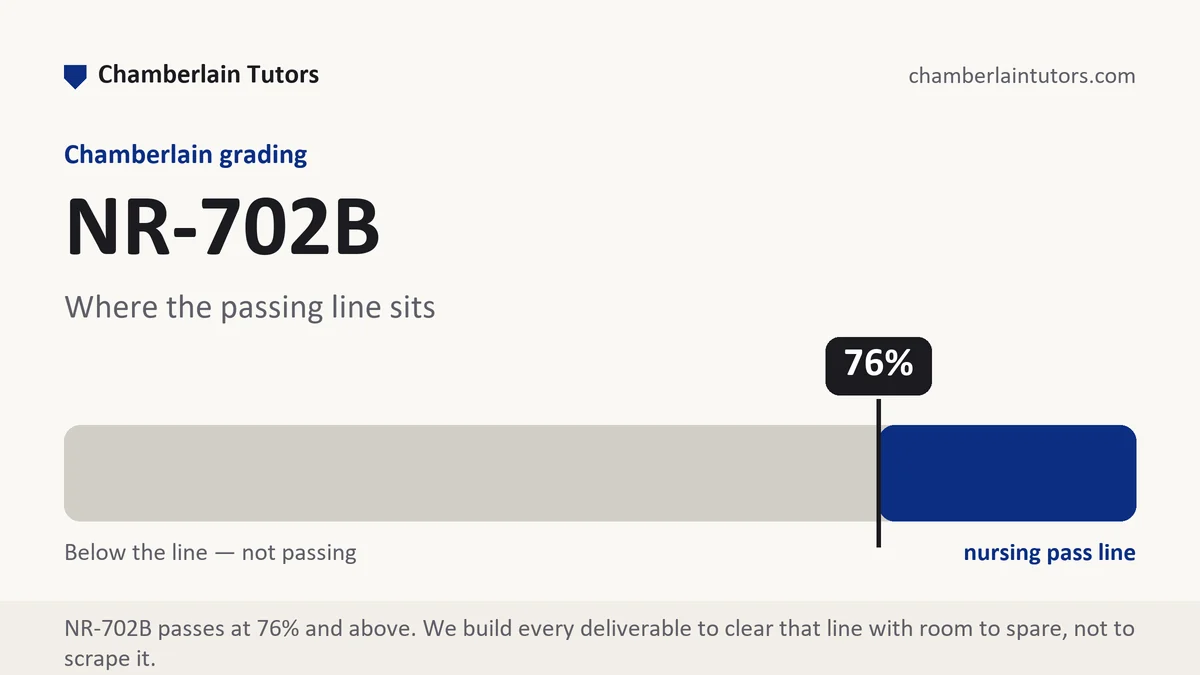
A passing NR-702B submission produces a full matrix and a readable narrative. Its usual weakness is that the narrative could have been written without the matrix, because it reports rather than interprets. A 76 percent floor governs the core nursing courses at Chamberlain, and a weak weighted average cannot be bought back with additional work, so a stage where the same interpretive gap repeats across several deliverables is worth fixing early.
Strong evidence work states what the evidence does not answer. Almost no doctoral project has direct evidence for exactly its population, its setting and its intensity, and saying so precisely, naming which part of your plan rests on extrapolation, is a doctoral move rather than an admission. Strong submissions also weight the set: if two of eleven studies are close matches to your setting and the rest are adjacent, say that in the narrative rather than letting eleven citations imply eleven equal contributions. And they end by naming what the project itself will measure to fill the gap the literature left.
Six mistakes that cost points in NR-702B
- An annotated bibliography wearing a table's clothes. Rows that summarize without judging leave the appraisal row unanswered.
- No quality column. Level alone is a description of design, not an assessment of how well it was executed.
- Effect sizes missing. Significance without magnitude cannot tell you whether the change is worth the work.
- A narrative that follows the table's order. Synthesis is organized by claim; transcription is organized by row.
- Leaning on one author or one research group. A set drawn largely from a single team is a set with one perspective, and reviewers notice.
- No statement of what is unanswered. Every evidence base has an edge, and the project usually lives near it.
Questions NR-702B students ask
How many studies belong in the matrix?
Can I include quality improvement reports and guidelines in the matrix?
My studies all use different outcome measures. How do I synthesize that?
Where NR-702B sits in Chamberlain's programs
Open the exact program map for sequence, credit, and option context. The current student schedule and syllabus remain authoritative after transfer evaluation, electives, state rules, and approved plan changes.
The weeks, one by one
Week 1
NR-702B carries 3 practicum credits and 192 clinical hours, and the opening written work in a stage like this is the definition of a practice problem that the rest of the sequence will be built on. Read the full Week 1 manual.
Week 2
Early in a three-credit project practicum the writing typically has to account for how the evidence was found, not only what it says. Read the full Week 2 manual.
Week 3
Once the search is documented, a three-credit practicum block usually turns to the evidence matrix: a structured table in which every retained source is reduced to the same fields and every row ends in a judgment. Read the full Week 3 manual.
Week 4
After a matrix is built, the writing that follows in a three-credit block is usually the synthesis, and synthesis has one defining rule: paragraphs are organized by claim rather than by article. Read the full Week 4 manual.
Week 5
Once a synthesis has said what the evidence supports, the next written task in a project practicum is usually to turn that into a specified change: not a concept, but a described action performed by defined roles at a defined point, with the elements you kept from the evidence and the adaptations. Read the full Week 5 manual.
Week 6
Later in a three-credit practicum block the writing usually has to explain how a specified change gets introduced and what keeps it running after the project ends. Read the full Week 6 manual.
Week 7
Near the end of a project practicum the plan has to say how anyone will know whether the change did what it was supposed to do. Read the full Week 7 manual.
Week 8
The final stage of a project practicum usually asks you to produce two things: a proposal narrative that reads as one continuous document written by one person, and a reflection that analyzes what 192 hours of practicum work taught you rather than recounting it. Read the full Week 8 manual.