NR-702A is the 2-credit, 128-hour variant of DNP Project and Practicum I at Chamberlain. The practicum hours belong to you and your site. What gets graded is the writing that comes out of them, and at this first stage the writing is a practice problem: a bounded setting, a current-state number, a benchmark with a source, and the gap between them stated so plainly that nobody can argue about what the project is for. Everything you write for the next three practicum courses will inherit whatever precision or vagueness you set here.
We do not complete clinical hours, contact preceptors or sites, sign placement paperwork, fill in hour logs or sit any assessment on your behalf. Those are yours and the university's. We work on the written deliverables: the problem statement, the gap analysis, the structured question, and the scholarly writing that surrounds them.
What NR-702A actually grades
Two things carry the score at this stage. The first is whether your problem is local and measured. A doctoral project problem is not a topic from the literature; it is a number in your setting that differs from a number it should be. Until you can write both numbers with their denominators, the project has no baseline, and every later course will keep asking for one.
The second is scope discipline against 128 hours. A 2-credit practicum block is not long, and the plan you sketch here has to be deliverable inside a sequence that continues in later courses. Faculty read early problem statements largely for whether the student has chosen something achievable, because the most common reason doctoral projects stall is that they were sized for an organization rather than for a unit.
How we help in NR-702A
Our doctoral bench works on the problem statement until it is short, sourced and unarguable, then builds the gap analysis and the structured question from it. Drafts come back with each number attached to where it would come from, so you can check availability with your site before the plan hardens.
Deliverables run the standard promise: a premium original draft in 24 to 48 hours, targeted at the A band of your course's actual scale, through the eight-person pipeline with both QA passes and the floor check, revised free until it lands.
In NR-702A right now?
Send your rubric from Canvas and whatever baseline data you have. First premium sample free, floor-checked, back in 24 to 48 hours.
Read the rubric before the prompt
Practicum rubrics separate the hours from the paper, and only one of those is something writing can help with. Copy the criterion rows into a blank file and set aside anything about hours, site agreements or supervision, since those are administrative and belong to you. What remains is the scholarly deliverable, and that is what the budget applies to.
Now price it. Take a 1,100-word problem paper with three rows at 50, 30 and 20 percent. That hands you 550, 330 and 220 words. The 550-word row at this stage is normally the problem and its evidence, which means the background about why the condition matters nationally, the section most students write first and longest, is a 220-word job. That inversion is the whole lesson of the first practicum course.
Keep a second document open while you draft, listing every number you use and where it would be pulled from: a report someone runs monthly, a registry, a chart audit you would have to perform yourself. Numbers with no retrieval path are the ones that fail later, and finding that out in week two of a 128-hour block is much cheaper than finding it out in the implementation course.
The shape of a practice problem statement
Whatever your week calls the deliverable, these parts are what a doctoral reader checks. Each carries a burden of proof, and a reader either finds it met or does not.
| Part | What it has to prove | How a thin version looks |
|---|---|---|
| Setting bounded | One unit, clinic or service, described by size and population rather than by name. | A health system named as the setting. |
| Current state measured | The number as it is now, with numerator, denominator and the period it covers. | A statement that performance is below expectation. |
| Desired state with a source | The benchmark, and where it comes from: a guideline, a regulatory requirement, a peer figure or your own past performance. | A target chosen because it sounds ambitious. |
| The gap, quantified | The difference expressed in patients or events, not only in percentage points. | A percentage gap with no sense of how many people it covers. |
| Consequence | What the gap costs in outcomes, harm, time or money, with evidence for the link. | An assertion that the gap is clinically significant. |
| Why now | What makes this the moment: a new requirement, a recent event, an available data source, a willing sponsor. | A general claim that the issue has always mattered. |
| The structured question | Population, intervention, comparison, outcome and timeframe, each answerable from data you can reach. | An outcome that nobody currently measures. |
| Scope boundary | What the project will not attempt, written explicitly so it cannot expand quietly. | No boundary stated, leaving the project open-ended. |
Evidence craft at the problem stage
Four habits protect the baseline that everything later depends on.
Say how the baseline number was produced. A figure from a standing report, a query someone ran for you and a chart review you performed yourself carry different confidence, and the difference matters when the same measure is used to judge the project later. Write the method in the sentence: a manual review of 60 consecutive charts, or a report generated from a discrete documentation field.
Check the benchmark is comparable before you adopt it. A national target set for a different case mix or a different setting is not automatically your target. Say why the comparison holds, or use your own historical performance as the benchmark and say that instead.
Match the verb to the design when you argue consequence. The link between your gap and patient harm usually comes from observational literature, which buys was associated with and occurred more often among. Reserve causes for controlled evidence. Where your guide sets no recency rule, sources past five years old need their justification written into the sentence.
One snapshot is not a baseline. A single month can be an outlier. Where you can, report several periods so the reader sees the ordinary variation: 14, 11 and 16 events across three consecutive months out of a stable denominator tells a much more honest story than one month reported alone.
What separates a pass from a strong pass here
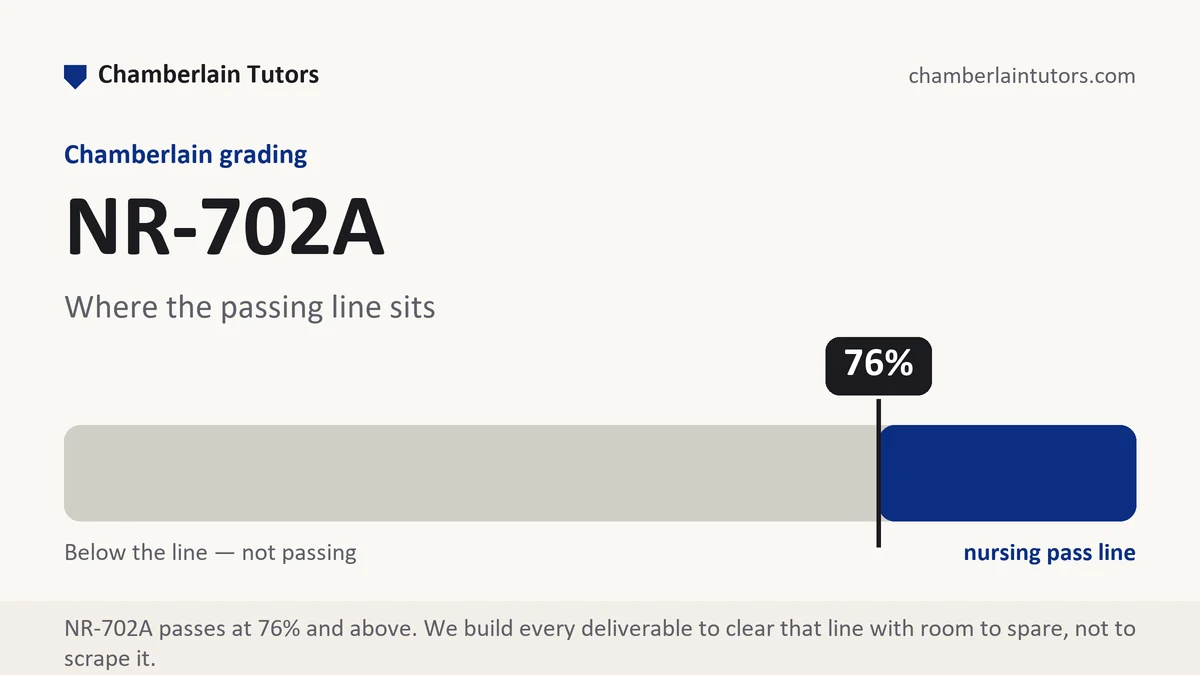
A passing NR-702A submission identifies a legitimate clinical problem and supports it with good literature. Its usual weakness is that the local number is missing or borrowed, which makes the whole project a national argument applied to an unnamed place. Chamberlain's core nursing courses do not pass below 76 percent, and nothing supplementary recovers a weighted average that has already slipped, so a vague start is expensive twice: once in the grade and again in every later course that has to work around it.
Strong first-stage writing is narrow to the point of feeling small. One unit, one measure, one population, one gap. It states what the project will not do, which stops the scope creep that consumes practicum hours. And it names the data source and the person who controls it, because a project whose measure depends on access nobody has agreed to is a project with a hidden dependency. Getting that dependency into writing during a 128-hour block is one of the most useful things this course can produce.
Six mistakes that cost points in NR-702A
- A national problem with no local number. The literature establishes that a problem exists somewhere. Your data establishes that it exists here.
- A problem that is really a solution. Writing that the unit lacks a screening protocol names an intervention, not a gap. State the outcome first and let the intervention come later.
- An outcome nobody measures. If the O in your structured question has no existing data source, you have committed to building one inside a 128-hour block.
- Scope sized for an organization. System-wide ambition in a first practicum course is the most common cause of a stalled project.
- A benchmark with no source. Targets have to come from somewhere defensible, otherwise the gap is an opinion about what good looks like.
- Writing the hours into the paper. The log is administrative. The scholarly deliverable is judged on the problem, not on how the time was spent.
Questions NR-702A students ask
My site will not give me baseline data. Can I still write the problem?
How narrow is too narrow for a doctoral project?
Does this stage need approval from a review board?
Where NR-702A sits in Chamberlain's programs
Open the exact program map for sequence, credit, and option context. The current student schedule and syllabus remain authoritative after transfer evaluation, electives, state rules, and approved plan changes.
The weeks, one by one
Week 1
NR-702A opens the practicum sequence at 2 credits and 128 clinical hours, and the first written work in a stage like this is almost always the act of naming a practice problem you can actually change. Read the full Week 1 manual.
Week 2
By the second stage of a 128-hour practicum block the writing usually turns from what the problem is to how big it is and how you know. Read the full Week 2 manual.
Week 3
Around the third stage of a project practicum the writing usually has to produce a structured practice question: population, intervention, comparison, outcome and a time frame, written as one sentence that governs everything that follows. Read the full Week 3 manual.
Week 4
Mid-session in a project practicum the written work usually turns to the evidence that justifies the change you intend to make. Read the full Week 4 manual.
Week 5
Somewhere in the middle of a project practicum the writing has to declare a framework: a model that structures how the change will be introduced, and often a second one describing the theory of why people will adopt it. Read the full Week 5 manual.
Week 6
Later in a project practicum the writing usually has to move up an altitude: from what the change is to whether this organization can absorb it. Read the full Week 6 manual.
Week 7
Near the end of a first project practicum the plan usually has to say how anyone will know whether the change worked. Read the full Week 7 manual.
Week 8
The closing stage of a first project practicum usually asks for two things at once: an assembled plan narrative that reads as one document rather than eight assignments stapled together, and a practicum reflection that analyzes what the hours taught you rather than recounting them. Read the full Week 8 manual.