NR-702C is the 4-credit, 256-hour variant of DNP Project and Practicum I, the largest block in the first stage. With that much practicum time the written deliverable usually reaches its full form: the complete plan for the practice change, with an aim statement carrying a number and a date, scope drawn in and out, stakeholders analyzed rather than listed, a phased timeline and the measurement the plan is promising to produce. This is the document later courses execute against, which is why vagueness here is expensive later.
The hours, the site conversations, the placement forms, the hour log and any proctored assessment are yours alone, and we take no part in them. What we build is the writing: the aim statement, the plan document, the stakeholder and timeline sections and the scholarly narrative your rubric grades.
What NR-702C actually grades
The first row is the aim statement, and it is graded harder than students expect because it compresses the whole project into one sentence. A doctoral aim names the population, the measure, the direction and size of change, and the date by which it will be achieved. Improve screening rates on the unit is not an aim. Increase the proportion of eligible patients screened within 24 hours of admission from 62 percent to 85 percent by a stated date is an aim, and everything else in the plan can be checked against it.
The second row is measurement design at the planning stage. A plan that promises to improve an outcome, while naming no measure for the outcome, none for the process that delivers it and none for what might worsen alongside, has not been thought through. The balancing measure matters most and is skipped most often: it is the thing that might get worse because you improved the target, such as time added to an admission process or a delay elsewhere in the pathway.
How we help in NR-702C
Our doctoral bench writes the plan as an executable document: aim first, scope drawn tightly, stakeholders analyzed by influence and decision, phases sequenced with dependencies, and a measurement set with definitions attached. Drafts return with the plan's internal logic checked, so a committee reading it does not find a promise the timeline cannot keep.
Deliverables run the standard promise: a premium original draft in 24 to 48 hours, targeted at the A band of your course's actual scale, through the eight-person pipeline with both QA passes and the floor check, revised free until it lands.
In NR-702C right now?
Send your rubric and your problem and evidence work so far. First premium sample free, floor-checked, back in 24 to 48 hours.
Read the rubric before the prompt
Plan documents are graded on completeness and specificity, so the rubric functions as a table of contents. Copy the criterion rows into a blank file and turn each into a heading, in the guide's own order. Any row you cannot immediately write a heading for is a row you have not yet decoded, and the opening week is the cheap time to ask faculty about it.
Then price the sections. A 2,500-word plan with four rows at 32, 24, 24 and 20 percent gives 800, 600, 600 and 500 words. The 800-word row at this stage is usually the intervention and its operational description, which is the section students most often compress because it feels like detail. It is not detail; it is the part someone else would have to follow, and later practicum courses depend on it existing.
One planning discipline pays for itself. For each phase in your timeline, write what must be finished before it can start. Training cannot precede build, measurement cannot precede a baseline, go-live should not land during a known peak or a holiday period. A timeline where nothing depends on anything is a timeline nobody has tested.
The shape of a practice-change plan
These are the parts a committee reads for. Each answers a question a committee would otherwise raise out loud.
| Part | What it has to prove | How a thin version looks |
|---|---|---|
| Aim statement | Population, measure, direction, magnitude and date, all in one sentence. | An intention to improve an outcome. |
| Scope, in and out | What the project covers and what it explicitly does not, so expansion cannot happen quietly. | Scope described only by what is included. |
| Stakeholders analyzed | Each party's influence, interest and the decision they control, with the approach that follows. | A list of roles with no analysis attached. |
| Intervention described operationally | Who does what, when, triggered by what, in enough detail that someone else could deliver it. | An education and reminder intervention, unspecified. |
| Phased timeline | Phases with dates, dependencies and a named owner for each. | A bar chart of activities with no owners. |
| Measurement set | Outcome, process and balancing measures, each defined with numerator, denominator and source. | One outcome measure named without a definition. |
| Resources | Time, materials, access and any cost, stated so the sponsor knows what is being asked. | An assumption that existing staff absorb the work. |
| Risks and mitigations | What could stop the project, how likely, and what you would do about each. | A general acknowledgment that barriers may arise. |
Evidence craft at the planning stage
Four habits keep a plan defensible.
Source the feasibility claims, not only the clinical ones. If your plan assumes a change can be delivered in a five-minute encounter, or that a documentation change takes a month to build, those are claims about the world and they deserve support: a published implementation report, a quoted timeline from the team who would build it, or your own observation described as such.
Define every measure before you promise a target. Write the numerator rule, the denominator rule, the inclusion and exclusion criteria and the data source. Two people applying your definition to the same month should get the same number. Without that, the improvement you report later cannot be compared to the baseline you set now.
Keep the verb inside the design you are planning. A pre-post project in one unit will not produce causal evidence, so the plan should promise an association with a change and an honest account of alternative explanations. Writing the aim as though the project will prove causation sets up a discussion section you cannot deliver. Where your guide sets no recency rule, feasibility and effect sources past five years old need their justification stated.
Baselines need length as well as a denominator. Write that the baseline covers 12 consecutive months, 148 events over 3,900 eligible encounters, so that ordinary variation is visible. A single-month baseline makes any later comparison unstable, and committees ask about it.
What separates a pass from a strong pass here
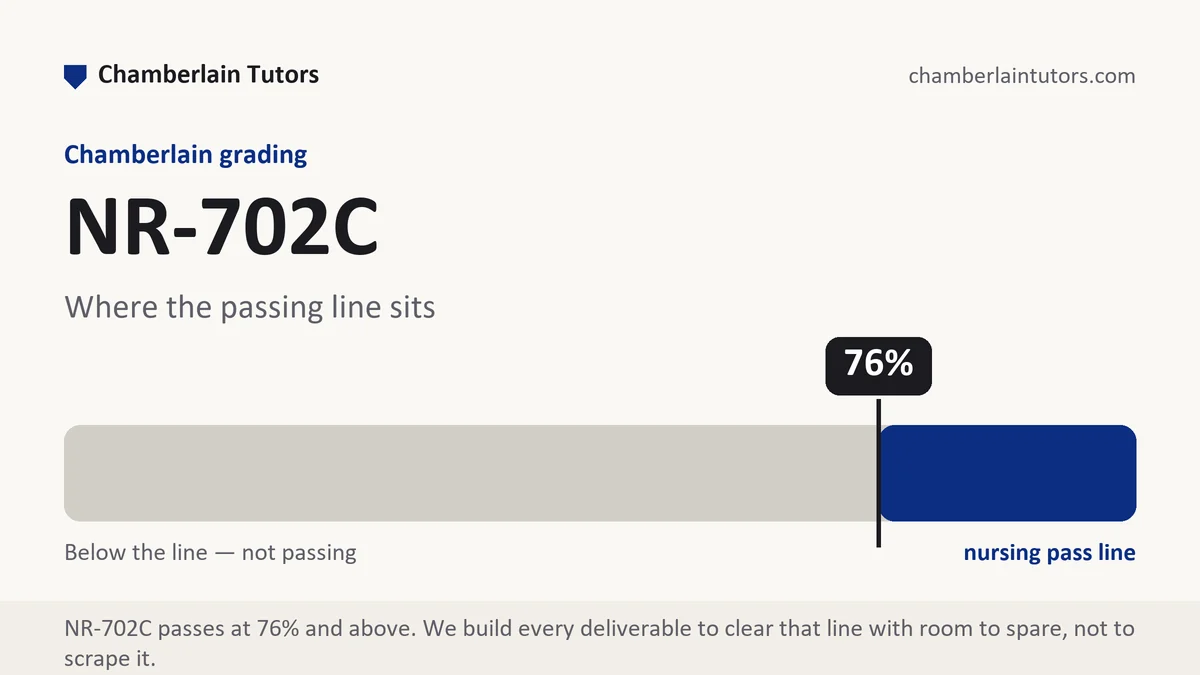
A passing NR-702C plan covers the required sections and reads sensibly. Its typical weakness is optimism: a timeline with no dependencies, measures with no definitions, and an aim that avoids committing to a number. Passing a core nursing course at Chamberlain starts at 76 percent, and extra submissions do not repair an average that has fallen under it, so a plan stage that leaves gaps costs marks now and rework across the rest of the sequence.
Strong plans are specific enough to be argued with. They name the number and the date, which invites challenge and is exactly why it scores. They analyze stakeholders by what each one can block rather than by how supportive they seem, since the person who can stop a project is often not the person who dislikes it. They include a balancing measure, which signals that the writer understands change has costs elsewhere. And they state what would trigger a change of course, so that the project has a decision rule rather than a hope.
Six mistakes that cost points in NR-702C
- An aim with no number or date. Without both, the project cannot succeed or fail, and every later evaluation section inherits the problem.
- Scope described only by inclusion. The out-of-scope list is what protects a 256-hour block from absorbing an entire department's wishes.
- Measures with no operational definition. A measure that two people would count differently cannot show a change.
- Stakeholders listed rather than analyzed. Influence, interest and decision rights are the columns that make the section useful.
- A timeline with no dependencies. Sequencing is the evidence that the plan has been thought through rather than assembled.
- No balancing measure. Every improvement moves work somewhere. A plan that does not look for the cost is a plan that will be surprised by it.
Questions NR-702C students ask
How do I choose a target number for the aim statement?
What belongs in scope exclusions?
My sponsor wants a bigger project than my plan allows. How do I handle that in writing?
Where NR-702C sits in Chamberlain's programs
Open the exact program map for sequence, credit, and option context. The current student schedule and syllabus remain authoritative after transfer evaluation, electives, state rules, and approved plan changes.
The weeks, one by one
Week 1
NR-702C opens the doctoral project stage at its heaviest hour load, and the opening week is where you convert a vague intention into a scoped, written practice problem your site would recognize. Read the full Week 1 manual.
Week 2
The second stage of NR-702C is where the problem stops being described and starts being measured. Read the full Week 2 manual.
Week 3
The middle of the first project stage is where the literature stops being a review and becomes a selection argument. Read the full Week 3 manual.
Week 4
Midway through NR-702C the project has to compress into a single sentence that everything else is checked against. Read the full Week 4 manual.
Week 5
By the fifth stage of NR-702C the plan has an aim, and the question becomes whether the organization can carry it. Read the full Week 5 manual.
Week 6
The sixth stage of NR-702C turns an approved idea into an executable sequence. Read the full Week 6 manual.
Week 7
The seventh stage of NR-702C is the measurement plan, and it is graded as a design rather than as a list. Read the full Week 7 manual.
Week 8
The closing stage of NR-702C assembles eight weeks of sections into one document that has to survive being read straight through by someone who was not there. Read the full Week 8 manual.