NR-670A is the lettered variant of the leadership concluding graduate experience, carrying the same catalog description as NR-670: 1 theory credit, 3 practicum credits and 144 practicum hours in a mentored leadership and care coordination role. Which code sits on your plan of study depends on your program version, and your advisor is the authority on that. This page takes the half of the writing that is not the project plan: the analysis of leadership decisions, teams and your own judgment, which is where most students find the grading hardest to predict.
What NR-670A actually grades
The first strand is judgment made visible. A leadership rubric cannot score a disposition, so it scores decisions: what the situation was, what could have been done, what you did, what it cost. Any sentence about being approachable or valuing teamwork is unscoreable, and the paragraph it occupies could have carried a decision instead.
The second is the team, analyzed rather than described. How work is actually distributed, where it piles up, which role absorbs the failures of another, what happens when someone is missing. Written concretely, that analysis is unmistakably yours. Written generally, it becomes an essay about teamwork that any student anywhere could submit.
The third is reflection with evidence attached. Graduate reflective writing is not a diary with citations bolted on. It moves from a specific event to a claim about practice, tests that claim against literature that may disagree, and ends with something you would do differently and how you would know it worked.
How we help in this course
The boundary is the same as everywhere in the practicum sequence. Your 144 hours, your mentor, your unit, your paperwork and your logs stay with you. We do not complete hours, contact anyone at your site, sign forms or fill logs.
The writing is where we work. Send the prompt and the scoring guide out of Canvas and a premium original draft returns in 24 to 48 hours: decisions written as analyses rather than anecdotes, team dynamics described in observable terms, leadership models appraised instead of name checked, and confidentiality handled properly throughout. Both quality passes and the floor check happen first, and revision continues free until the piece lands.
Writing this course's deliverables from the rubric
Chamberlain publishes no syllabus for NR-670A, and each scoring guide arrives attached to its assignment in Canvas, so no honest page can print a week by week grid. What transfers is method: how a decision analysis is built, how weight becomes word count, and how reflective writing stays scholarly. If your section is running the coordination project, the plan side of the work is set out on the NR-670 page.
Stuck on an NR-670A analysis?
Send the scoring guide and the situation you are writing about. First premium sample free, back in 24 to 48 hours.
The passing line, and a short runway
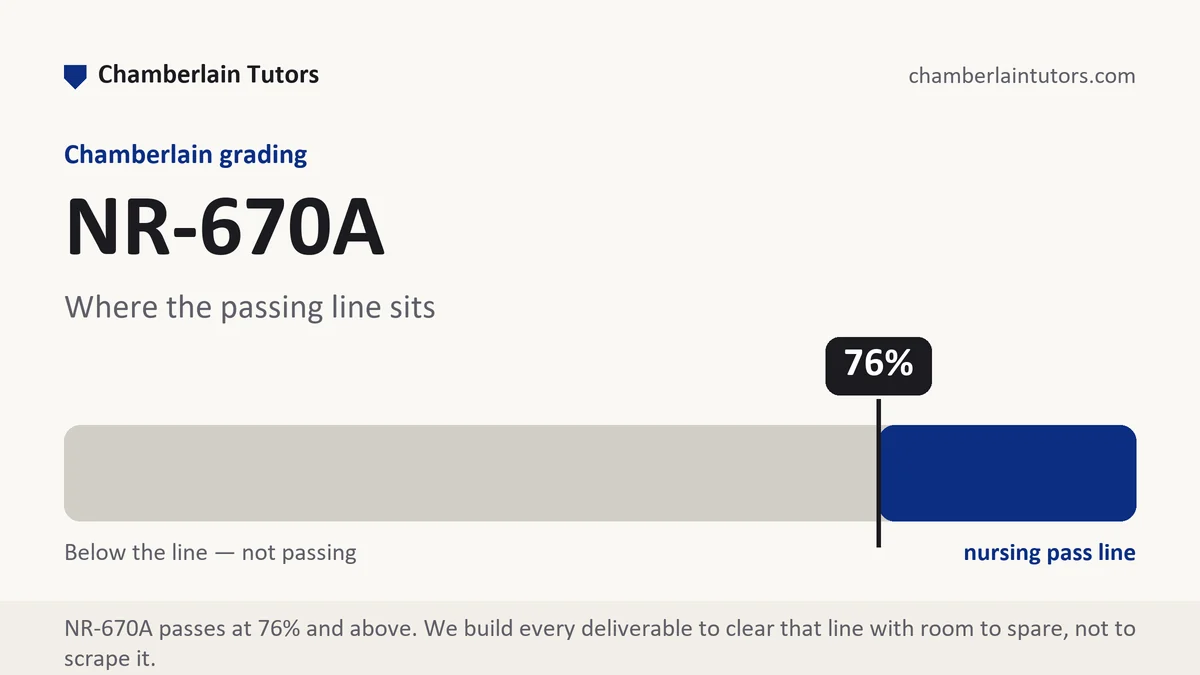
Core nursing courses pass at 76 percent, and the specialty scale with no C band belongs to nurse practitioner specialty courses rather than to this track. The grade is a weighted average that supplementary work cannot repair, which matters more than usual in a course where several deliverables are short. Short pieces feel low stakes and add up quickly.
The calendar is the usual one: two eight week sessions per sixteen week semester, up to six starts a year, work due most weeks. Leadership writing has a supply problem that catches people out: you cannot write a decision analysis about a week in which nothing happened. Keep a private running note of moments as they occur, dated and stripped of names, so that week six has material to draw on. Remember also that discussion posts lock the moment they are submitted at Chamberlain, and this is a course where posts describe colleagues. Draft elsewhere, read it back as if your charge nurse were reading it, then post once.
Turn the criterion rows into a section plan
Copy the rows in printed order, reduce each to its verb, and let those verbs be the headings. Then turn weights into words, which matters more in short pieces than long ones because there is nowhere to hide.
Say the paper is capped at 1,350 words with four rows weighted 35, 30, 25 and 10 percent. That is 472 words, 405, 337 and 135. Two predictable failures follow. The situation gets 600 words because storytelling is easy, and the row asking what you would change gets 90 because it is uncomfortable. Reverse that instinct. Describe the situation in the fewest words that let a reader judge it, usually four or five sentences, and spend the budget on analysis, evidence and revision of your own approach, which is where the scoreable thinking lives.
The shape of a leadership decision analysis
Whether your guide calls it a case, a reflection, an incident analysis or a leadership paper, the same parts have to be present.
| Part | What it has to establish | What the weak version does |
|---|---|---|
| The situation | Setting, roles, what was at stake, in four or five sentences. | A page of narrative with dialogue. |
| Authority and constraints | What you could actually decide, and what belonged to someone else. | Assumes unlimited authority, then blames the outcome on others. |
| Options available | Two or three real alternatives, including doing nothing, with their likely costs. | One option, presented as the only possibility. |
| What you did | The action, the words used if they mattered, and the timing. | A statement that you addressed the issue. |
| Immediate consequence | What changed for the patient, the shift or the person, that day. | A jump to the general lesson learned. |
| Evidence about the approach | What the literature says about this kind of response, including any disagreement. | A leadership theory named once and never used. |
| What you would change | A specific different action, not a resolution to communicate better. | An intention to grow as a leader. |
| How you would know | The signal that would tell you the different approach worked. | Nothing, leaving the analysis unfalsifiable. |
Draft the last two rows first if the piece is stuck. Knowing what you would do differently usually reveals which parts of the situation actually mattered.
Evidence craft in leadership writing
- Know what your source measured. Much leadership research reports perceptions collected by survey. Attitude, intention and outcome are three different things, and saying which one a study measured is half of good appraisal.
- Design and sample before the finding. Write that a cross sectional survey of 412 nurses at six hospitals reported an association, then report it. Setting matters, since findings from academic centers travel poorly to small community units.
- Verbs the design can pay for. Was associated with and predicted fit correlational work, which is most of this literature. Improved and caused need designs it rarely has.
- Denominator and window on every rate. Turnover of 7 of 42 positions over twelve months is a finding. A 17 percent turnover rate without the base or the year is a number without a meaning.
- Currency where the ground moves. Staffing figures, workforce projections and accreditation standards are revised, so name the year and check for a newer edition before you build an argument on one.
- Anonymity is a source rule too. Cite your own observations as observations, keep names, dates and identifying details out, and do not quote internal documents without permission.
What separates a passing analysis from a strong one
A passing analysis tells a workplace story, attaches a leadership theory and finishes with a promise to keep growing. Nothing in it is wrong. Nothing in it could be argued with either, and that is precisely what holds it mid band.
Strong analyses take a position. They name the option they rejected and say what rejecting it cost. They let the evidence complicate the story instead of confirming it, including studies that point the other way. And they end with something testable: a different action and the signal that would show it worked. Written that way the piece stops being a reflection about you and becomes an argument about practice, which is what a graduate leadership rubric is built to reward.
Six mistakes that cost points here
- A personality profile instead of an analysis. Adjectives about yourself cannot be scored against any row.
- Theory as a label. Naming a leadership model proves nothing unless the paper uses it to explain a choice.
- Identifiable colleagues. Roles and situations, never names, and be careful with details that identify someone as effectively as a name would.
- Unattributed workplace numbers. Vacancy, turnover and satisfaction figures need a source and a period, or they should not appear.
- Engagement scores treated as performance. How a team feels and how a team performs are related and not identical. Say which one you measured.
- Reflection with no decision in it. If nothing was chosen, there is nothing to analyze, and the paper drifts into description.
Questions NR-670A students ask
What is the difference between NR-670 and NR-670A?
How do I write a reflection that still counts as scholarly?
Can I write about a situation I handled badly?
Where NR-670A sits in Chamberlain's programs
Open the exact program map for sequence, credit, and option context. The current student schedule and syllabus remain authoritative after transfer evaluation, electives, state rules, and approved plan changes.
The weeks, one by one
Week 1
NR-670A closes the advanced nursing leadership sequence with a mentored practicum of 144 hours, and the opening stage is the one that decides whether the other seven have anything to stand on. Read the full Week 1 manual.
Week 2
Having fixed a boundary in the opening stage, NR-670A now asks you to describe the place the work will happen in terms a reader who has never been there could act on. Read the full Week 2 manual.
Week 3
With the setting described, NR-670A turns to the sharpest piece of writing in the session: a problem stated so precisely that its improvement could be detected. Read the full Week 3 manual.
Week 4
NR-670A now asks whether anything published supports the change you are about to propose, and the writing that answers it is synthesis rather than summary. Read the full Week 4 manual.
Week 5
NR-670A now asks you to turn a supported idea into a plan someone other than you could carry out. Read the full Week 5 manual.
Week 6
NR-670A now asks how anyone would know whether the change worked, and the answer has to be written before any data exists. Read the full Week 6 manual.
Week 7
The seventh stage of NR-670A asks a harder question than it looks: not what the practicum was like, but what it proves about your capability and where it exposed a limit you have not closed. Read the full Week 7 manual.
Week 8
The closing stage of NR-670A assembles a session of separate submissions into one document that argues a single result and hands the work to somebody who will still be there next quarter. Read the full Week 8 manual.