NR-670 is the leadership concluding graduate experience: 1 theory credit, 3 practicum credits and 144 practicum hours in a mentored leadership and care coordination role. Care coordination is the phrase that shapes the writing. Coordination problems live in the gaps between people and settings, so the graded work is about handoffs, and a handoff can only be analyzed if you can say who was supposed to do what, by when, and how anyone knew it happened.
What NR-670 actually grades
The first strand is precision about the transition. Care coordination is a large phrase, and papers that keep using it stay vague. The rubric rewards naming one crossing point and sizing it: discharges from two medical units to home health, roughly 60 a month, of which a quarter have no confirmed follow up within seven days. That sentence gives the rest of the paper something to hold.
The second is the design of the coordination itself. Not communication as a virtue, but a mechanism: who initiates, who receives, what information travels, in which format, by when, and how the loop is closed when the receiving end does not respond. A plan that cannot answer the closing question is describing a hope.
The third is leadership across boundaries. Most of the people you need in a coordination project do not report to you, and often not even to your department. The writing asks how influence was built without authority: what you traded, whose problem you solved first, which meeting mattered. Papers describing a leadership style score mid band. Papers analyzing specific attempts, including the ones that failed, score above it.
How we help in this course
Boundary first. The 144 practicum hours are yours, and so is every conversation with your mentor, your unit and the other settings involved. We do not complete hours, contact anyone at your organization, sign site paperwork or fill logs.
The writing is ours. Send the prompt and the scoring guide from Canvas and a premium original draft returns in 24 to 48 hours: the transition defined and quantified, the current state written as steps rather than impressions, measures with denominators and windows, and a leadership analysis built from what actually happened in the room. Two quality passes and the floor check run before delivery, and revision is free until it lands.
Writing this course's deliverables from the rubric
Chamberlain publishes no syllabus for NR-670, and each scoring guide reaches you attached to its assignment in Canvas, so an honest page cannot print a week by week grid. What transfers is craft: how a coordination plan is scoped, how weights become words, how cross setting evidence is cited without overclaiming. Have your own guide open when you draft.
Working through NR-670?
Send the scoring guide and the transition you are fixing. First premium sample free, back in 24 to 48 hours.
The passing line, and borrowed time
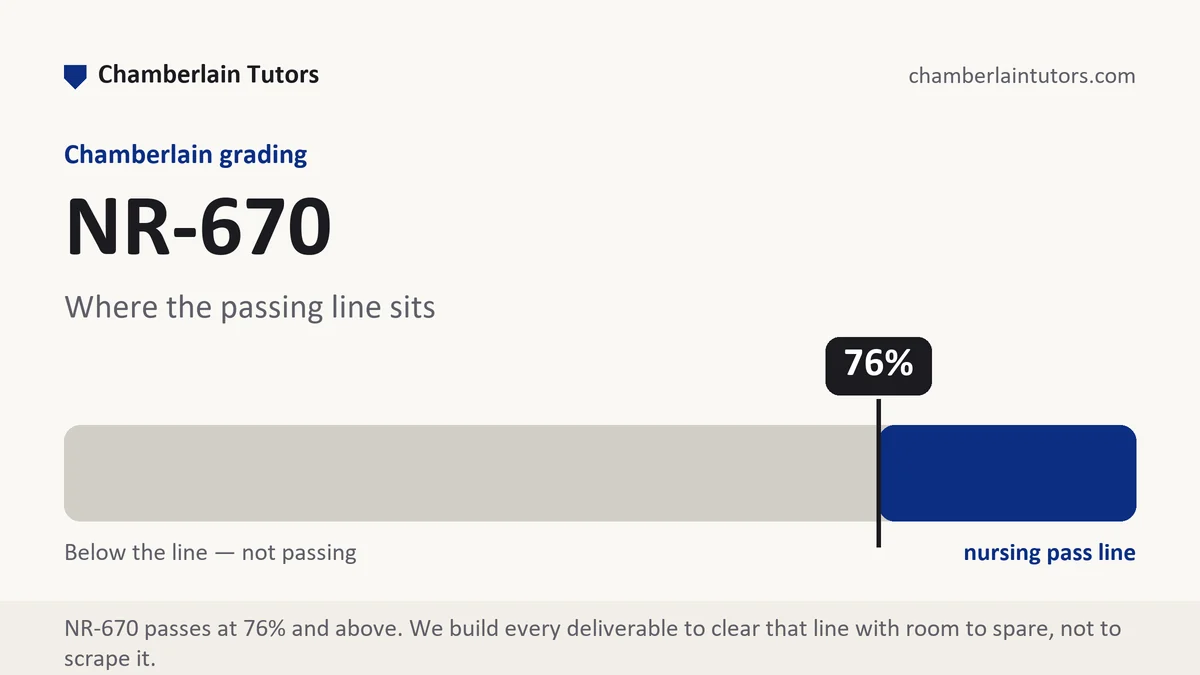
Core nursing courses pass at 76 percent. The specialty scale with no C band applies to nurse practitioner specialty courses rather than to this track, so 76 is the number you are protecting, and it is a weighted average that supplementary work cannot repair after the fact.
Sixteen week semesters split into two eight week sessions, up to six starts a year, deliverables most weeks. The specific difficulty in coordination work is that your project runs on other people's time. A clinic scheduler, a home health liaison, a case manager and a pharmacy lead all have their own priorities, and none of them is enrolled in your course. Ask early, ask in writing, and build the sections that need nobody while you wait. Since posts cannot be edited once submitted at Chamberlain, keep any description of another department in draft until you have read it back as if they were reading it.
Turn the criterion rows into a section plan
Copy the rows in printed order, strip each to its verb, and use those verbs as headings so nothing has to be searched for. Then convert the weights, which leadership guides often express as points rather than percentages.
Say the guide totals 150 points across rows worth 45, 35, 30, 25 and 15, and the paper is capped at 1,800 words. Divide the cap by the total: each point buys 12 words. That gives 540 words, then 420, 360, 300 and 180. The 540 word row is usually the current state analysis, which is the section students summarize in two paragraphs because they already know the process by heart. Familiarity is exactly the problem. Everything obvious to you has to be written down before the intervention can be argued, and 540 words is the guide telling you how much detail a stranger needs.
The shape of a care coordination improvement plan
Most graded writing here is a coordination plan wearing one costume or another: a process analysis, an improvement proposal, a leadership project paper, a board post defending your scope.
| Part | What it has to establish | What the weak version does |
|---|---|---|
| The transition, named | Which crossing point, between which settings, for which patients. | Care coordination across the continuum. |
| Volume and population | How many patients cross it in a month, and who they are. | Numbers only for the national problem. |
| Current state, step by step | Each action, its owner and its timing, as it happens rather than as policy describes it. | A flowchart copied from the policy manual. |
| Failure points | Where the handoff breaks, with evidence rather than impression. | Communication is poor between departments. |
| The coordination design | What information moves, in what form, by when, and who confirms receipt. | A new form, with no closing step. |
| Roles and accountability | Who owns each step, including on nights, weekends and during vacancies. | The team will be responsible. |
| Measures | Two or three, each with a denominator and a window you can actually obtain. | Readmission rates you have no access to. |
| Exception path | What happens when the patient cannot be reached or the receiving setting declines. | Nothing, so the plan works only for easy patients. |
| Sustainment | Who watches this after the course, and what signals a problem. | Ongoing monitoring by leadership. |
Build the current state from observation, not memory. Following five real patients through the transition will contradict at least one thing everybody believes about it, and that contradiction is usually where your project lives.
Evidence craft when care crosses settings
- Define the measure before you quote it. Readmission means little until you say all cause or related, within how many days, from which index admission, and whether transfers count. Two units using different definitions are not disagreeing, they are measuring different things.
- Denominator and window on every rate. Nineteen of 143 discharges within 30 days is a finding. A 13 percent rate with no base and no period cannot be checked or compared.
- Design and sample before the finding. Write that a randomized trial of a transitional care intervention in 1,100 older adults across three hospitals reported the effect, then report it. Transitional care has strong studies and weak ones, and the difference matters.
- Verbs the design can pay for. Observational work earns was associated with and occurred alongside. Prevented and reduced need controlled designs, and coordination literature is full of both kinds.
- Attribution is genuinely hard here. When several settings touch the same patient, no single unit owns the outcome. Say what your project can plausibly influence and measure that.
- Keep sources current and matched. Payment rules and care models change, so check the year and the setting before importing a result from a different system into your plan.
What separates a passing plan from a strong one
A passing plan identifies a coordination problem, proposes better communication and promises to monitor readmissions. It is agreeable, unfalsifiable and interchangeable, which is why it stays mid band.
Strong plans are specific where it costs something. They name the transition and its volume. They describe the current state in enough detail that a reader can see the gap for themselves rather than being told about it. They choose measures the student can actually obtain, and say so. And they treat leadership as work performed on other people's priorities, with real examples of what was negotiated. The 76 percent floor leaves room to be pleasant, but pleasant plans do not survive contact with a scheduler.
Six mistakes that cost points here
- Communication as the intervention. Better communication is an outcome of a mechanism, not a mechanism.
- A process map drawn from memory. The map of what people are supposed to do hides the workarounds that cause the failures.
- Choosing a measure another setting owns. If the data lives in a clinic system you cannot access, the evaluation will not happen.
- No exception path. Plans built for reachable, insured, English speaking patients fail the equity minded reader immediately.
- Writing about colleagues carelessly. Describe roles and steps, not personalities, and never name individuals in a paper that leaves your desk.
- Leadership sections about temperament. Approachable and collaborative are self descriptions. Say what you asked for, from whom, and what happened.
Questions NR-670 students ask
How do I map a process when I only see one end of it?
I cannot get readmission data. What else can I measure?
How do I write about another department's failures without it reading as a complaint?
Where NR-670 sits in Chamberlain's programs
Open the exact program map for sequence, credit, and option context. The current student schedule and syllabus remain authoritative after transfer evaluation, electives, state rules, and approved plan changes.
The weeks, one by one
Week 1
NR-670 is the concluding graduate experience in the leadership sequence, a mentored practicum of 144 hours in which advanced nursing competencies are put to work on real care coordination. Read the full Week 1 manual.
Week 2
The second stage of a concluding leadership practicum is where the setting stops being scenery and becomes data. Read the full Week 2 manual.
Week 3
By the third stage of a concluding leadership practicum the setting has been described and the pressure moves to precision. Read the full Week 3 manual.
Week 4
Around the midpoint of NR-670 the written work turns outward. Read the full Week 4 manual.
Week 5
The fifth stage of NR-670 usually turns the evidence into a plan. Read the full Week 5 manual.
Week 6
The sixth stage of NR-670 is where the project has to become checkable. Read the full Week 6 manual.
Week 7
Late in NR-670 the writing turns back on the practitioner. Read the full Week 7 manual.
Week 8
The closing stage of NR-670 is assembly and handoff. Read the full Week 8 manual.