NR-670 is the concluding graduate experience in the leadership sequence, a mentored practicum of 144 hours in which advanced nursing competencies are put to work on real care coordination. Week 1 is where that experience stops being an intention and becomes a written commitment: objectives another person could audit, a scope with edges, and a statement of what will exist at the end that does not exist now. Your section may print this as NR 670 or NR670; it is the same course. Chamberlain publishes no syllabi outside Canvas. The placement here is our teaching judgment from the course's catalog arc; your section's rubric decides what your week actually asks.
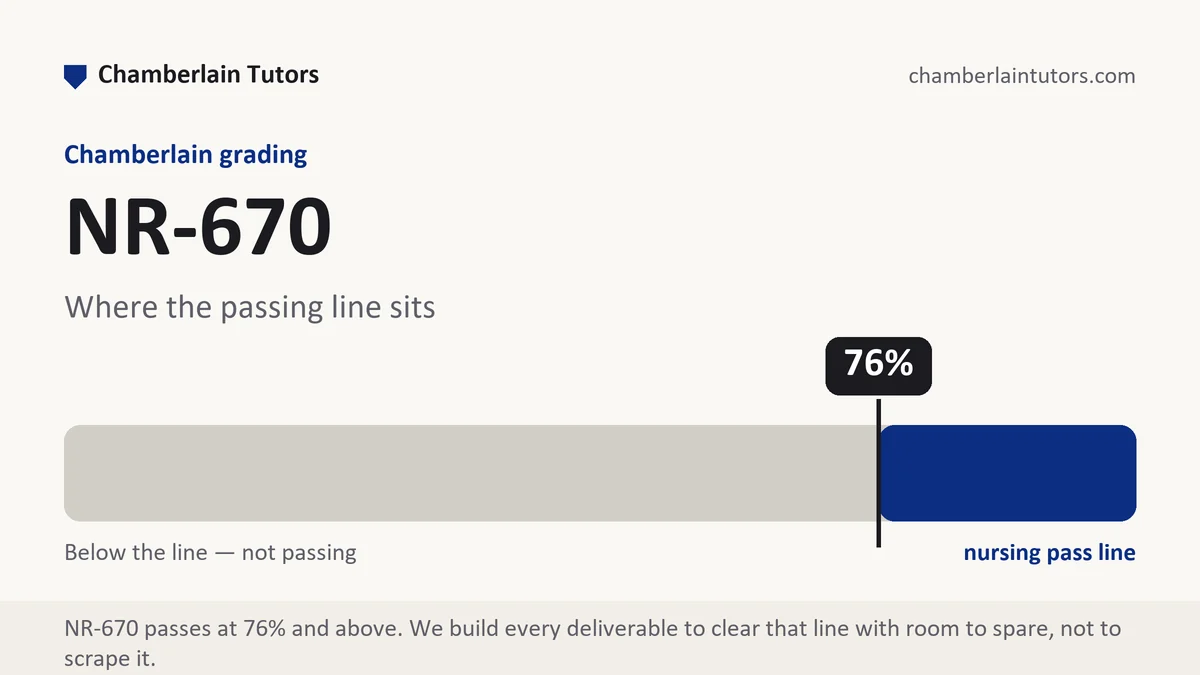
What a strong NR-670 opening produces
Picture the moment this course actually starts. A nurse manager sits down with a quality binder that a mentor slid across the desk, three quarters of run charts on readmissions, a folder of transfer handoff audits, and a sticky note that says pick something. Nothing in that pile tells her what to write. The opening stage of a concluding graduate experience exists to convert that pile into a scoped piece of leadership work with a written boundary around it, and the writing is the part that gets graded.
Opening deliverables at this stage are usually short and consequential: a statement of practicum objectives, a description of the setting and the mentored relationship, sometimes a posted introduction naming the population and the problem you expect to work on. The word count is small. The leverage is enormous, because everything you write in stages three through eight is measured against the objectives you fix here. An objective written loosely in week one produces a synthesis paper in week eight that cannot demonstrate anything, and there is no room in an eight-week session to restate the target halfway through.
The graduate move to install now is the shift from activity to outcome. A practicum objective that says participate in the discharge planning committee describes attendance. An objective that says produce an audited baseline of discharge instruction completeness across one unit and a revised documentation standard the committee adopts describes a result somebody else can verify. The first version can be satisfied by sitting in a room. The second forces evidence into existence, and evidence is what the concluding papers in this course are built out of.
One boundary runs under every page in this set, and it is worth stating in the first one. The 144 practicum hours, the hour log, the encounter or activity counts, the mentor's evaluation and every signature line are your own record of work you personally did. Those are never drafted, reconstructed or estimated with help, from us or from anyone else, because they are exactly the documents your site and your school verify. What a manual supports is the written layer around the practicum: how to phrase an objective so it can be assessed, how to build an assessment write-up out of what you observed, how to write a reflection that analyzes instead of narrating, and how to assemble the scholarly components at the end. Anything you write about real patients, staff or incidents gets de-identified before it reaches the page: no names, no dates of service, no unit-level details that would identify a person to a colleague.
The NR-670 Week 1 method, step by step
Six moves that turn a vague practicum intention into a scoped, assessable written plan.
-
Reduce each scoring row to the artifact it demands
Copy the week's rows into a blank document and, beside each one, write the object that would satisfy it: a paragraph, a table, a cited claim, a named framework. Rows in a capstone stage tend to ask for alignment with graduate competencies, and alignment means naming the competency and showing the match, not asserting it.
-
Describe the setting as a system, not as a workplace
Name the service line, the population it serves, the volume it carries in a stated period, the handoffs at its edges and the reporting line your mentor sits on. A reader who cannot picture where authority lives cannot judge whether your objectives are achievable in the hours available.
-
Anchor the target in an existing measurement, not a hunch
Quality dashboards, incident reviews, audit files and satisfaction reports already exist in your setting. Point at one of them in a sentence, describe what it shows in counts over a window, and let that be the reason your topic is worth 144 hours rather than your sense that the process feels broken.
-
Write objectives with a verb, a product and a check
Each objective needs an action you will take, an artifact it will produce, and the way somebody else would confirm it happened. Develop and enhance are not verbs a grader can score. Draft, audit, revise, present and pilot all end in something you can point at.
-
Fence the scope explicitly, in writing
Say what this practicum will not attempt. One unit rather than the division, one transition of care rather than the whole discharge process, a documentation standard rather than a staffing model. A written exclusion is not a retreat; it is the single strongest signal of leadership judgment available to you this early.
-
Set the register and the citation habit in the first paragraph
This is graduate leadership writing: declarative, evidenced, third person unless the rubric permits otherwise, and sourced even when the topic is your own plan. Claims about what care coordination requires or what a nurse leader does belong to published professional standards, and one cited sentence in the opening paragraph sets a habit that carries seven more stages.
A layout and word budget for a practicum scope statement
The frame our tutors keep beside a first capstone submission, sized for roughly 1,000 to 1,300 words. It is our own outline rather than anything the university issues, and your week's rubric outranks it wherever the two disagree. Scale each target proportionally if your assigned length differs.
| Section | What belongs in it | Word target |
|---|---|---|
| Purpose statement | The result this practicum will produce, written in one sentence before any description of your job or your site. | 60 to 80 |
| Setting and system | Service line, population, volume across a stated window, the handoffs at the edges, and where decision authority actually sits. | 180 to 220 |
| The measured opening | The dashboard, audit or review that shows the gap, reported as counts over a period with the source named. | 170 to 210 |
| Objectives | Three or four, each carrying a verb, an artifact and the check that would confirm completion. | 240 to 300 |
| Scope and exclusions | What is inside the boundary, what is deliberately outside it, and the reasoning behind each exclusion. | 160 to 200 |
| Mentorship and competency alignment | What the mentored relationship contributes, and which graduate leadership competencies the work is designed to demonstrate. | 150 to 190 |
Evidence craft for a scoped leadership plan
Cite the standard that makes your topic a leadership problem. Care coordination, transitions of care and quality oversight are described in published professional and regulatory documents. Naming one, with its issuing body and year inside the sentence, converts your topic from a personal irritation into an accountability the profession has already written down.
Every number arrives with a base and a window. Write that 14 of 96 discharges over one quarter returned within thirty days rather than reporting a percentage alone. In a capstone, the denominator is the argument; a proportion without one cannot be weighed, and a grader reading fast will treat it as decoration.
Attribute internal data as internal data. Unit dashboards and audit files are legitimate evidence and they are not literature. Say plainly that a figure comes from an internal quality report for a stated period, keep the organization unnamed if your program requires it, and never present an internal count in a way that implies it was published.
Keep your own observation as illustration, never as proof. The sequence that scores is claim, published support, then the scene from your setting that shows the claim operating. Reversed, a paragraph reads as an anecdote with a citation stapled to it, and capstone graders mark that ordering consistently because the whole course is about warranted judgment.
Write the objective and its check in the same sentence. Evidence craft at this stage is not only about sources. An objective that carries its own verification inside it, such as a revised standard reviewed and adopted by the practice council, gives the week eight paper something to report against and gives the grader a scoring row to fill.
Five mistakes that cost points in this week's territory
- Objectives that describe attendance. Shadow, attend and participate can all be satisfied without producing anything, so nothing in week eight can be measured against them.
- A topic chosen before any data was read. A gap named from memory is a hunch; the same gap named from a quarter of audit results is a leadership problem.
- Unbounded scope. Improving the discharge process across the hospital cannot be done in 144 hours, and promising it tells your grader that you have not sized work before.
- No cited standard anywhere. Capstone rows nearly always include support, and a scope statement that runs entirely on personal authority forfeits that row before the content is read.
- Identifiable detail in the write-up. A named patient, a dated incident or a uniquely identifying unit description is a professional problem long before it is a grading one.
Before you submit
- The purpose sentence names a result, not an activity
- The setting is described with population, volume and a stated window
- At least one existing measurement is cited as counts over a period
- Every objective carries a verb, an artifact and a check
- The scope statement names something you are deliberately not doing
- One published professional standard appears with its year in the sentence
- No patient, staff member or incident is identifiable anywhere on the page
Starting NR-670 this week?
Send the instructions and the rubric out of Canvas. A premium original draft of the written layer comes back in 24 to 48 hours in graduate leadership register, with objectives written so they can actually be assessed, and revisions run until the grade lands.