In the MSN-PMHNP sequence, NR-605 is PMHNP management sequence. Students search the code mid-panic more than any title, so this page answers the code: here is the honest read and the service behind it.
What NR-605 actually grades
Management didactics begin: psychiatric treatment argued in writing across adult populations, medication decisions through mechanism and monitoring, cases that expect provider-grade judgment on the page.
How we help in this course
Our drafts carry the treatment reasoning explicitly and cite current psychiatric references, in documentation register. Sequence continuity with the same team keeps 605 through 607 coherent.
The service terms match the whole site: 24 to 48 hour delivery, A-band targeting on your scale with the floor math shown, two independent QA passes, free revisions until the target is met.
Building a management case write-up
No week grid appears here, because Chamberlain does not publish its syllabi and a fabricated schedule would be worse than no schedule at all. Here is the thing worth knowing instead, and most students learn it late. The catalog description of NR-605 leads with psychosocial theory and psychotherapy modalities, individual and group, as the foundation for non-pharmacological and adjunct treatment, and it names the therapeutic alliance and use of self as objects of study in their own right. Prescribing appears in the list of care strategies alongside psychotherapy, education, follow-up and referral, not above them. A case write-up built as a prescription with a paragraph of therapy attached is therefore aimed at the wrong rows. One boundary: the course carries 125 supervised clinical hours in a precepted setting, and we work on written deliverables only. Hours, logs, preceptor forms and site paperwork stay entirely with you.
In NR-605 right now?
Send the week and the rubric from Canvas. First premium sample free, floor-checked, back in 24 to 48 hours.
Provider-grade judgment, graded weekly
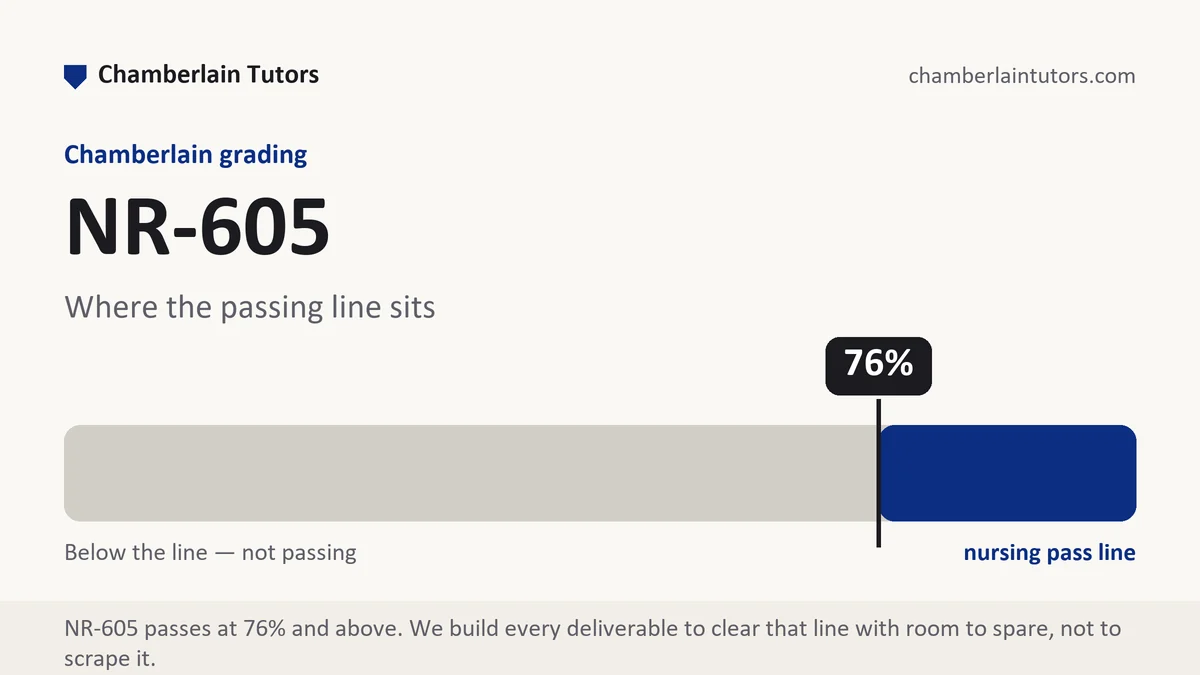
NR-605 begins the management sequence, and the writing standard steps up accordingly: treatment argued across adult populations, medication decisions defended through mechanism and monitoring, cases that expect a provider's judgment on the page. The specialty scale prices the step-up without sympathy, 84 or the course fails, so our drafts carry the treatment reasoning explicitly, cite current psychiatric references, and clear the floor check before delivery. The two-failure dismissal arithmetic is the quiet backdrop; the drafts exist so it never becomes foreground. Medication reasoning is defended through mechanism and monitoring rather than asserted, because assertion is what the rubric rows are built to catch.
Same-day scope, management-course edition
For this course a useful scope request includes the case materials themselves, not just the prompt, because the reply can then name the draft's clinical angle up front. Standard terms hold: 24 to 48 hour delivery through the eight-person pipeline, both QA passes, revisions free until the A-band target posts, everything landed ahead of the 11:59 p.m. Mountain-Time cutoff.
Can one team cover 605 through 607 without hand-offs?
Yes, and it is the recommended arrangement. The same psychiatric bench holds your voice and framework choices across the whole run, which keeps the sequence coherent to the faculty reading it.
How fast can a first order start?
Same day. Send the week and rubric in chat; if you want the audition first, the opening premium draft is free and floor-checked like every other. Most first orders are moving within the hour.
Let the heaviest rows decide the section lengths
Read the grading rows before you read the chart. A case pulls you toward whatever is clinically interesting about this client, while the rows say what is being paid for, and in a management course those two pulls point in different directions. Copy the rows out in weighting order, make them headings, then open the case.
Then size each section. Move each weight two decimal places and multiply by your body length, holding a tenth back for the synopsis and the close. On a 2,000-word case write-up with a six-row guide:
| Criterion row | Weight | Words | What fits in that space |
|---|---|---|---|
| Diagnostic justification | 20 | 400 | Criteria matched to this client's findings, plus the alternative you carried and set down. |
| Psychotherapeutic plan and its theory | 20 | 400 | The modality, the psychosocial theory underneath it, and what the early sessions target. |
| Pharmacologic and adjunct management | 20 | 400 | What the medication is for in this plan, and why it is adjunct rather than the plan itself. |
| Monitoring, follow-up and outcomes | 15 | 300 | The measure, the interval, the threshold, and the decision at the next visit. |
| Alliance, education, referral and safety | 15 | 300 | The relationship work, what the client and family were told, and who else is involved. |
| Scholarly writing and sources | 10 | 200 | Nothing visible. Spent across every section above. |
Run your own rows through the same arithmetic, then measure the draft against it. The section that overruns here is almost always the medication discussion, because it is the easiest to write from memory, and the sections that starve are the ones the course description leads with.
The shape of a management case write-up
A plan is a set of decisions with reasons attached. The parts below are the decisions faculty look for, and each maps to something the course says it teaches.
| Element | What it must settle | How it comes up short |
|---|---|---|
| Case synopsis | Who this client is and what problem the plan solves, in a tight paragraph. | A retelling of the whole encounter before any decision appears. |
| Diagnostic basis | Criteria matched to findings, with the alternative you considered named. | The diagnosis assumed from the referral and never argued. |
| Theoretical frame | Which psychosocial theory explains this presentation, and why it fits this person. | A theory named in one sentence and never used to make a decision. |
| Psychotherapeutic plan | Modality, individual or group, frequency, expected course, and what early sessions target. | Therapy recommended as a category, with no format, dose or focus. |
| Alliance and use of self | What you did to build the working relationship, what you noticed in your own responses, and what you adjusted. | A paragraph about rapport that could describe any clinician with any client. |
| Adjunct pharmacologic management | What the medication is for inside this plan, and how it supports the therapeutic work. | The medication written as the plan, with therapy appended as a courtesy. |
| Health promotion and prevention | The non-clinical levers: sleep, activity, substances, supports, relapse signals. | Omitted, though the course description names it. |
| Measurement and follow-up | Which rated measure, at what interval, and what change counts as progress. | Follow up in a few weeks, which nobody can evaluate. |
| Referral, consultation and safety | Who else is involved, what triggers escalation, and what the client does in a crisis. | Left implicit, which reads as a plan with no edges. |
| Client and family education | What was actually said, in language the client would use. | Educated on medication, a phrase that documents nothing. |
Guidelines, therapy evidence and honest claims
Management writing invites overclaiming, because a plan sounds better when its evidence sounds settled. Four habits keep the sources doing real work.
- Name the issuing body and the year for any guideline. A recommendation without a source and a date cannot be checked, and recommendations in this field are revised often enough that the year is part of the claim.
- Psychotherapy evidence has a dose. Modality alone is not a finding. Report the population, the number of sessions studied, the comparison condition, and the outcome measured. Individual and group results are not interchangeable, and a course built on both will notice the substitution.
- Keep the verb inside the design. Was associated with improvement, produced larger reductions than the comparison, and predicted better attendance are claims trials support. Cures, fixes and prevents relapse are not.
- Give every measurement its scale and window. Name the instrument, its range, the interval between administrations, and the change you would treat as meaningful. A plan that says symptoms will be monitored has no measurement in it at all.
The rewrite pattern, applied once: before, therapy is effective for this condition. After, in randomized trials of adults receiving twelve to sixteen weekly individual sessions, this modality produced larger reductions in rated symptoms than the comparison condition, which is the basis for the session count proposed below. The second sentence tells the grader where your plan's numbers came from, which is the row being scored.
What a strong plan does that a passing one does not
Passing plans list interventions. Strong plans contain decision points, which means the write-up says what happens next under each result: if the rated score falls by the threshold you named, this continues; if it does not move by the second review, this is what changes, and here is why that is the next step rather than a dose increase. Faculty in a management sequence are reading for exactly that branching, because it is the difference between a student who has learned a treatment and a clinician who can run one.
The second marker is the alliance section, where most write-ups thin out. A strong one reports something specific: the moment the client tested whether you would react, what you noticed in yourself, and what you did differently afterward. That is what use of self means in a graded document, while a paragraph asserting that rapport was established scores as an assertion. The scale gives this weight, since the NP specialty ladder has no C band and a plan that is generic in two heavy rows lands in the low 80s, which is a failure rather than a soft pass.
Five mistakes that cost points in NR-605
- Letting the medication crowd out the therapy. The course description puts psychosocial theory and psychotherapy first and prescribing among the adjuncts. A write-up weighted the other way is answering a different course.
- Naming a modality without its theory or its dose. Recommending therapy is not a plan until the format, the frequency, the expected course and the target of the early sessions are on the page.
- A use-of-self section with nothing adjusted. Reflection scores when something changed as a result. Feelings recorded and then set aside read as an exercise completed rather than a skill used.
- No follow-up interval and no measure. Without both, nothing in the plan can be evaluated, and the monitoring row has nothing to award.
- Client details that could identify someone. Strip names, dates, employers and site details when you write your notes, not the night the deliverable is due, and check your course's instructions on real cases first.
Three questions NR-605 students send us
My case is complicated. Do I cover everything or go deep on one problem?
How do I write the use-of-self section without it sounding like a diary?
The rubric says evidence-based. Is my course textbook enough?
The weeks, one by one
Week 1
NR-605 Week 1 opens the first psychiatric management practicum where the course catalog itself opens, on the working relationship. Read the full Week 1 manual.
Week 2
NR-605 Week 2 is where the course's second foundation goes down: the psychosocial theory that explains why a person's difficulty took the shape it did, and therefore why one treatment route is the right one for them rather than a route that works on average. Read the full Week 2 manual.
Week 3
NR-605 Week 3 is where the practicum turns from why to which. Read the full Week 3 manual.
Week 4
NR-605 Week 4 takes the practicum from one room to a circle of chairs. Read the full Week 4 manual.
Week 5
NR-605 Week 5 is where medication enters the plan without taking it over. Read the full Week 5 manual.
Week 6
NR-605 Week 6 puts two problems in one room. Read the full Week 6 manual.
Week 7
NR-605 Week 7 is where a plan learns to report on itself. Read the full Week 7 manual.
Week 8
NR-605 Week 8 closes the practicum where the clinical work also closes: on how care ends or moves. Read the full Week 8 manual.
Where NR-605 sits in Chamberlain's programs
Open the exact program map for sequence, credit, and option context. The current student schedule and syllabus remain authoritative after transfer evaluation, electives, state rules, and approved plan changes.