NR-605 Week 4 takes the practicum from one room to a circle of chairs. The catalog names group psychotherapy beside individual work, and the middle of an eight-week session is where that second format usually gets its own graded attention: what a group does that individual work cannot, how a session is structured, and what a leader tracks while the content is going by. Your section may print this as NR 605 or NR605; it is the same course. Chamberlain publishes no syllabi outside Canvas. The placement here is our teaching judgment from the course's catalog arc; your section's rubric decides what your week actually asks.
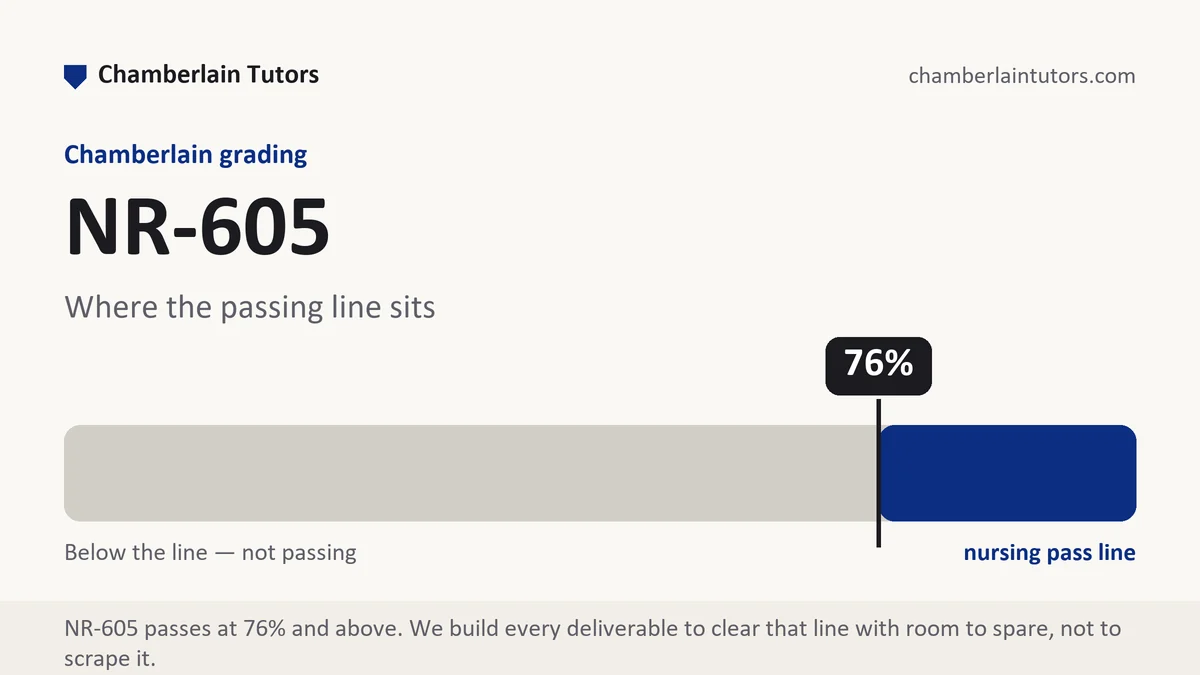
What NR-605 Week 4 asks for
The territory is process, and process is the thing students find hardest to write. Group content is what members say. Group process is what happens between them while they say it: who speaks after whom, what the silence follows, which member reliably rescues the group when a subject gets uncomfortable, how the group treats a newcomer, what the group does when the leader is late. A write-up that reports only content has described a meeting. A write-up that reports process has described a treatment.
The second demand is structural. Groups have a design, and the design is graded: purpose, closed or open membership, size, session length, number of sessions, screening and preparation of members, ground rules, confidentiality limits stated at the start, and how the group handles absence and exit. Writing about the group you observed without naming its structure leaves the reader unable to judge anything you say about how it behaved.
At this point in an eight-week session the deliverable is usually a group observation or group process write-up of three to four pages, sometimes with a posted response comparing observations. Whatever arrives, hold the practicum boundary: your hours, your log and any documentation carrying your signature stay yours. If your section runs a discussion this week, compose it elsewhere and read it twice, because a posted response cannot be edited once it is in.
The NR-605 Week 4 method, step by step
Six moves that turn ninety minutes in a circle into a document a grader can assess.
-
Record the structure before the story
Open with the design facts: purpose, membership type, approximate size, session length, where the session sat in the group's life. A reader cannot evaluate a silence in session two of a new closed group the way they would evaluate the same silence in an open group with rotating members.
-
Split your notes into content and process columns
Write two lists from the same session. On the left, what was discussed. On the right, what happened between people. Almost every weak group paper is a left column with an adjective or two thrown in from the right, and doing the split on purpose makes the imbalance visible while you can still fix it.
-
Name the therapeutic factors you actually saw
Universality, altruism, imitative behavior, interpersonal learning and instillation of hope are only useful if you can point at the moment. Quote the exchange in de-identified paraphrase, then name the factor it demonstrates. Named without a moment attached, the list is vocabulary.
-
Track one member's arc through the session
Choose a single member and follow them from entry to exit: how they came in, what shifted them, what they did when the group turned toward them, how they left. One followed arc teaches a reader more about process than five thumbnail sketches, and it gives the analysis somewhere to land.
-
Describe a leader intervention and its effect
Pick one thing the leader did, or that you did if you co-led, and report what happened in the next two minutes. Blocking an interruption, linking two members, redirecting a monologue to the group. The effect matters more than the technique name, because the effect is what shows you were watching.
-
Close with what you would do next session
State one specific move for the next meeting and the reason drawn from what you observed. That converts an observation paper into clinical planning, which is the register the course is training and the register the higher bands reward.
A layout and word budget for a group process write-up
Below is the drafting frame our tutors use for a group observation paper, sized for roughly 1,200 to 1,400 words. It is our own outline rather than anything the university issues, and your week's rubric outranks it wherever the two disagree. Scale each target proportionally if your assigned length differs.
| Section | What belongs in it | Word target |
|---|---|---|
| Group design | Purpose, membership type, size, length, session number, and the ground rules in force, all de-identified. | 130 to 160 |
| Session content in brief | What the group talked about, compressed hard, because this is the section that wants to eat the paper. | 120 to 150 |
| Process observations | Sequence, alliances, silences, interruptions, roles, and the group's response to conflict or to a newcomer. | 300 to 350 |
| Therapeutic factors, evidenced | Two or three factors, each tied to a specific de-identified moment rather than asserted. | 200 to 240 |
| Leadership and intervention | One intervention, its intent, its effect in the following minutes, and what it cost or opened. | 200 to 240 |
| Next session plan | One concrete move and the observation that justifies it. | 110 to 140 |
Evidence craft for group writing
Group findings do not transfer from individual studies. If a claim about effectiveness came from individual therapy trials, it cannot underwrite a sentence about your group without an explicit bridge. The reverse holds too. This is the single most common evidence error in this genre and the easiest for a grader in a psychotherapy course to catch.
Report the group's parameters when you report its result. Session count, group size, closed or open membership and leader training all move outcomes. A finding quoted without them is a headline, and a headline cannot justify a design decision in your own write-up.
Keep the therapeutic factor literature as description, not proof. Naming a factor explains what you saw; it does not demonstrate that the group worked. Effectiveness claims need outcome sources, and separating the two literatures in your citations keeps the analysis honest.
De-identify harder in group work than anywhere else. A group has multiple people in it, and the details that identify one member often identify the others by association. Change or omit roles, occupations, timelines and any distinguishing circumstance, and confirm your course instructions on writing about real sessions before you build a paper on one.
Five mistakes that cost points in this week's territory
- Content written as though it were process. A summary of topics discussed leaves the process rows with nothing to score, no matter how detailed the summary is.
- Therapeutic factors listed without moments. A row of factor names is a glossary. The score sits in the exchange you can point at.
- Silence treated as nothing happening. Silences are among the most informative events in a group, and a paper that skips them has skipped the data.
- The leader's move reported with no aftermath. An intervention without its effect proves technique recall, not observation.
- Members made identifiable by accumulation. Three harmless details can name a person. Strip them at the note stage rather than at submission.
Before you submit
- The group's design facts appear before any interpretation of its behavior
- The process section is longer than the content section
- Every therapeutic factor named is anchored to a de-identified moment
- One member's arc is followed from entry to exit
- One leader intervention has its effect reported in the minutes that followed
- Every reference appears in the text and every in-text citation appears in the list
Writing a group process paper for NR-605?
Send your de-identified notes and the rubric from Canvas. A premium original draft comes back in 24 to 48 hours with process separated from content and the factors evidenced, and revisions run until the grade lands.