NR-605 Week 6 puts two problems in one room. Adult psychiatric practice runs into co-occurring substance use constantly, and the later weeks of a management practicum are where the writing has to hold both at once: a psychiatric presentation and a substance pattern that shapes it, is shaped by it, and cannot be treated by taking turns. Your section may print this as NR 605 or NR605; it is the same course. Chamberlain publishes no syllabi outside Canvas. The placement here is our teaching judgment from the course's catalog arc; your section's rubric decides what your week actually asks.
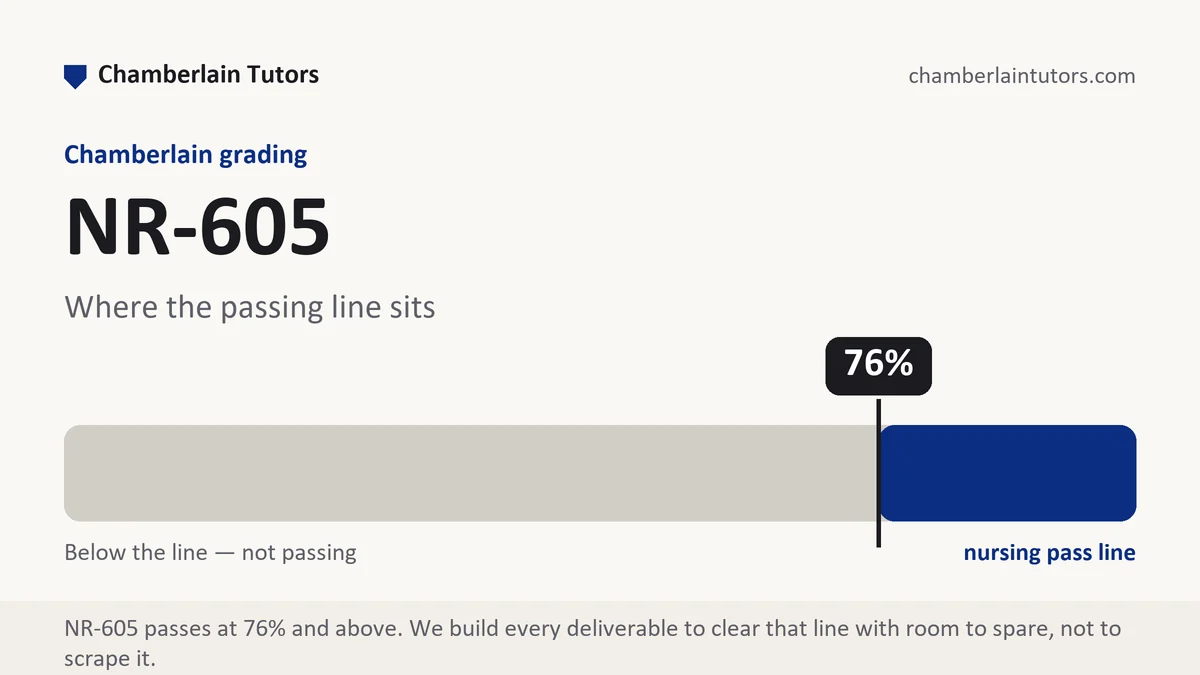
What NR-605 Week 6 asks for
The territory is integration under uncertainty. The reasoning a management course wants is not a decision about which condition is primary, because that decision usually cannot be made honestly at a first or second contact. It is an account of how the two presentations interact, what the timeline suggests, what would have to be observed to sort them, and how the plan proceeds while the sorting is still incomplete. Sequential treatment, where one problem waits for the other to be handled, is the position the field has largely moved away from, and a paper that adopts it without argument is answering an older question.
Assessment craft carries a lot of the weight here. Quantity, frequency, route, the last use, the pattern across a week rather than an average, what the person is trying to get from the substance, what happens when they stop, and what has happened in past attempts. Those specifics are what allow a reader to judge everything downstream, and they are also what separates a graduate write-up from an intake summary.
At this point in an eight-week session the deliverable is usually an integrated case analysis of three to five pages, sometimes with a posted response. The practicum boundary holds: clinical hours, logs and any signed documentation remain entirely yours. Write in a stance that a reader can respect, which means describing use without moral vocabulary. If your section runs a discussion this week, write it outside the classroom first, since a posted response cannot be edited once it is submitted.
The NR-605 Week 6 method, step by step
Six moves that let one write-up hold a psychiatric presentation and a substance pattern together.
-
Build one timeline, not two
Put psychiatric symptoms and substance use on a single line with dates or intervals. Which came first, what happened during the longest period of abstinence, what changed when use escalated. The timeline is the single most persuasive object in this genre and the one most drafts never draw.
-
Quantify the use in usable units
Amount, frequency, route, time of last use, and the shape of a typical week rather than a monthly average. Heavy use tells a reader nothing. Numbers let them evaluate withdrawal risk, medication interactions and the plausibility of your plan.
-
Write the function the substance serves
Say what the person gets from it in their own account: sleep, quiet, relief from a specific symptom, social access, a way to stop thinking about something. A plan that removes a function without replacing it is a plan that ends early, and the higher bands are looking for the replacement.
-
Hold the differential open in writing
State the two readings that are still live, name the observation that would separate them, and say when you would expect to make it. Substance induced and independent presentations can look identical at one visit, and a paper that declares confidently at week one has claimed something the data cannot support.
-
Plan both arms in parallel with safety first
Address withdrawal risk and any acute medical concern before anything else, then set out the psychiatric and substance work as one plan with shared appointments and a single set of goals. Say who does what and where the two arms would collide if they were run separately.
-
Define what progress looks like without requiring perfection
Name the measures and the intervals, and say what a partial result would mean for the plan. Reduced days of use, a longer interval between episodes, an attended appointment after a lapse. A plan whose only success condition is total abstinence has no way to record the change that usually comes first.
A layout and word budget for an integrated case analysis
Below is the drafting frame our tutors use for a co-occurring case, sized for roughly 1,300 to 1,500 words. It is our own outline rather than anything the university issues, and your week's rubric outranks it wherever the two disagree. Scale each target proportionally if your assigned length differs.
| Section | What belongs in it | Word target |
|---|---|---|
| Presentation and single timeline | A de-identified sketch plus the combined chronology of symptoms and use, including abstinence periods. | 200 to 240 |
| Substance history in units | Amount, frequency, route, last use, weekly pattern, prior attempts and what ended them. | 180 to 220 |
| Function and consequences | What the use provides, what it costs, and how the person weighs the two right now. | 170 to 200 |
| Open differential | The live readings, the discriminating observation, and the point at which it becomes available. | 230 to 270 |
| Integrated plan | Safety first, then both arms as one plan with named providers, intervals and shared goals. | 280 to 330 |
| Progress definition | Measures, intervals, and what a partial result changes about the plan. | 140 to 170 |
Evidence craft for co-occurring presentations
Check who was excluded from the trial. Many psychiatric treatment studies exclude active substance use, which means their results transfer to your patient only with a stated caveat. Reading the exclusion criteria and reporting the gap is a small move that graders in an applied course notice immediately.
Screening tools need their properties. If you cite a screening instrument, give its item count, its scoring, the cutoff you used and what that cutoff is meant to detect. A score reported without the cutoff and the population it was validated in cannot support the conclusion you drew from it.
Keep the vocabulary clinical. Terms carrying moral weight change what the reader believes about the writer as much as about the patient. Person first, behavior described, judgment left to the criteria. This is also a scored feature in many practicum guides, usually under professionalism or therapeutic communication.
Date anything about availability or policy. Treatment access, medication options and service structures shift, so a claim about what is available or covered needs a year and a source. Mechanism and physiology can rest on older work when the sentence says why.
Five mistakes that cost points in this week's territory
- Two separate plans presented as one. If the psychiatric plan and the substance plan never reference each other, the integration the week is built on has not happened.
- Use described without numbers. Heavy, occasional and social are impressions. Withdrawal risk, interaction risk and progress measurement all need quantities.
- Primary diagnosis declared too early. Confidence the data cannot support is scored as a reasoning error, not as decisiveness.
- Abstinence set as the only success. A plan with one all-or-nothing outcome cannot record the intermediate change that most often arrives first.
- Moral language leaking into the assessment. Words that judge rather than describe cost the professionalism row and undermine everything clinical around them.
Before you submit
- A single timeline carries both the psychiatric symptoms and the substance history
- Use is quantified in amount, frequency, route and time since last use
- The function the substance serves is stated in the person's own terms
- At least two readings remain open with a discriminating observation named
- The plan treats both arms together, with safety addressed before anything else
- Every reference appears in the text and every in-text citation appears in the list
Writing a co-occurring case for NR-605?
Send the case and the rubric from Canvas. A premium original draft comes back in 24 to 48 hours with one timeline, an open differential and an integrated plan, and revisions run until the grade lands.