NR-605 Week 3 is where the practicum turns from why to which. The catalog lists individual psychotherapy among the core care strategies of this course, so the middle of the session is the natural place to argue a modality choice: which individual therapy, at what frequency, for how long, aimed at which target, and why this one rather than the obvious alternative. Your section may print this as NR 605 or NR605; it is the same course. Chamberlain publishes no syllabi outside Canvas. The placement here is our teaching judgment from the course's catalog arc; your section's rubric decides what your week actually asks.
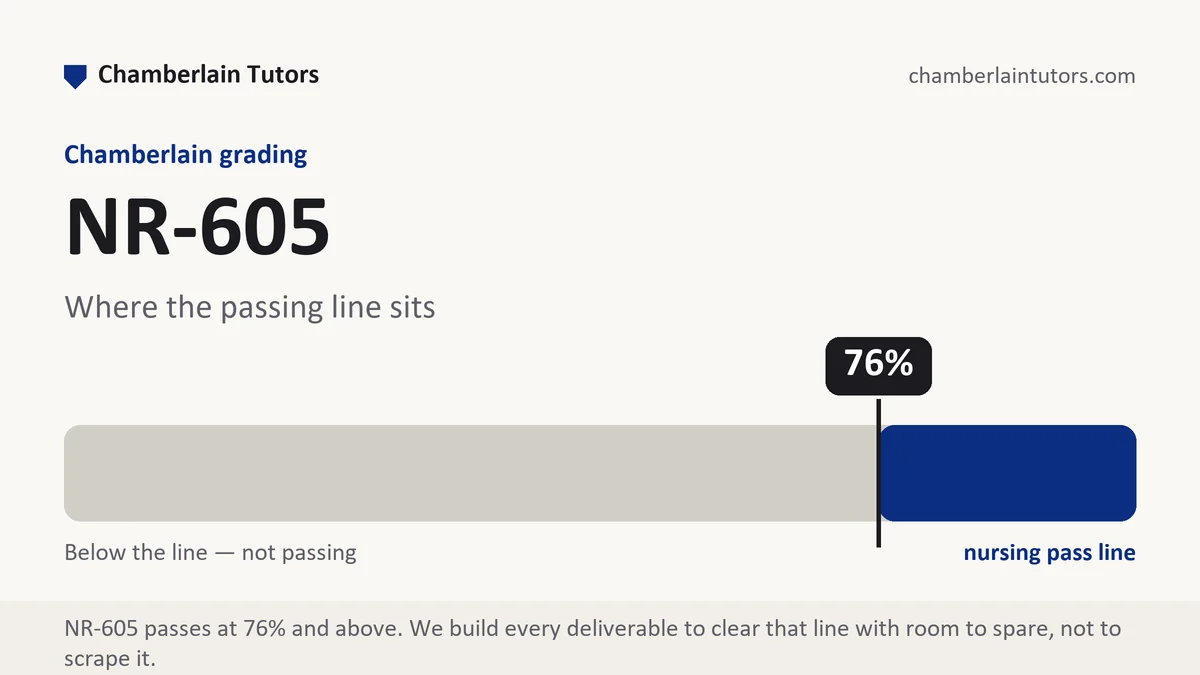
What NR-605 Week 3 asks for
The territory is selection under constraint. A modality recommendation that names a therapy and stops has answered a multiple choice question, not a clinical one. What a management course wants is the full specification: the approach, the format, the session length and frequency, the expected number of sessions, the target the early sessions work on, and the marker that would tell you the choice was right. Every one of those elements is a place where a grader can see whether you understand the treatment or have only heard of it.
Constraint is the second half. Real selection happens inside limits: what the setting offers, what the person is willing to do, what their week can hold, what their insurance or transport allows, what your preceptor's caseload can absorb. A paper that recommends a structured twelve to sixteen session course of therapy for a patient who is unlikely to return after two visits has produced a correct answer to the wrong question, and the higher bands notice.
At this point in an eight-week session the deliverable is usually a case-based treatment plan of three to five pages, or a shorter analysis with a posted response beside it. Whatever shape arrives, keep the boundary intact: the clinical hours, the log and any paperwork that carries your signature stay with you, and the writing sits alongside them. If your section runs a discussion this week, draft it outside the classroom first, because a posted response cannot be reopened once it is submitted.
The NR-605 Week 3 method, step by step
Six moves that turn a modality name into a defended prescription for therapy.
-
Write the target before the treatment
State in one sentence what has to change, in terms a person could confirm or deny. Sleeps through the night four nights of seven. Attends the shift without leaving early. A target written that way makes the modality choice checkable; a target written as improved mood makes it a matter of taste.
-
List what the setting can actually deliver
Name the format available where you are placed: session length, who provides therapy, waiting time, group availability, whether the work is delivered in person or by video. Selection that ignores supply is a wish, and the rows scoring feasibility are reading for exactly this paragraph.
-
Shortlist two modalities, then argue one
Put the strongest alternative on the page and say what it would do well for this person. Then defend your choice against it using the target from step one. The comparison is where the evaluation row lives, and a paper without one has nothing for that row to score.
-
Attach a dose to the choice
Sessions per week, minutes per session, expected total, and the point at which you would reassess. Therapy without a dose is not a plan, and the number itself has to be defensible, which means it should come from the evidence you cite rather than from habit.
-
Write the first three sessions
Say what the opening sessions do: what is assessed, what is taught, what homework is set, what the person leaves the first session holding. This is where a modality choice stops being abstract, and it is the section most drafts leave out entirely.
-
State the switch rule
Name the review point, the measure you will read at it, and the change that would move you to a different approach. A plan that cannot fail cannot be evaluated, and faculty in a management sequence read the switch rule as proof that you understand the treatment as a process rather than a recommendation.
A layout and word budget for a modality selection plan
Below is the drafting frame our tutors use for an individual therapy selection paper, sized for roughly 1,300 to 1,500 words. It is our own outline rather than anything the university issues, and your week's rubric outranks it wherever the two disagree. Scale each target proportionally if your assigned length differs.
| Section | What belongs in it | Word target |
|---|---|---|
| Case synopsis and target | A tight de-identified sketch and the single change the treatment is meant to produce, written so it could be confirmed or denied. | 150 to 180 |
| Constraints of the setting and the person | Availability, willingness, schedule, transport, format, and anything that rules an option out before evidence is consulted. | 140 to 170 |
| Candidate modalities | Two approaches, each described by what it does mechanically rather than by its reputation. | 220 to 260 |
| The argued choice | Why this one for this target and this person, with the alternative answered rather than ignored. | 280 to 330 |
| Dose and early sessions | Frequency, length, expected course, and what the first three sessions do in practice. | 250 to 300 |
| Review point and switch rule | When you look, what you read, and what result changes the plan. | 150 to 180 |
Evidence craft for modality claims
Psychotherapy evidence has a dose, so report it. A modality name is not a finding. The usable unit is the population studied, the number of sessions delivered, the comparison condition, and the outcome measured. Those four items are what let you defend the frequency and the total in your own plan, and a citation without them cannot support the number you wrote.
Say what the comparison was. Better than a waiting list and better than an active treatment are different claims with different weight, and using the first to justify a choice over the second is the quiet overreach that costs the evidence row. One clause fixes it.
Do not let format substitute for format. Individual and group findings are not interchangeable, and neither are in person and remote delivery. If your evidence studied one and your plan proposes the other, say so and say what you did about it. Naming the gap almost always scores better than hoping the reader misses it.
Match the verb to the design. Randomized work licenses produced and reduced. Naturalistic and observational work licenses was associated with and tracked alongside. In a selection paper the pull runs toward strong verbs, because the plan feels more decisive that way, and that is precisely why graders watch for them here.
Five mistakes that cost points in this week's territory
- A modality named without a dose. Recommending an approach with no frequency, length or expected course leaves the plan unimplementable and the management rows unpaid.
- No alternative considered. A single option presented as obvious removes the comparison the evaluation row exists to score.
- Evidence borrowed from a different population. A finding from a sample that does not resemble your patient can still be used, but only with the gap stated in the sentence that uses it.
- Constraints ignored. A plan that cannot be delivered where you are placed reads as coursework rather than clinical judgment, and feasibility rows are common in practicum guides.
- No stopping or switching condition. Without a review point and a threshold, nothing about the plan can be judged later, including by you.
Before you submit
- The treatment target is written so it could be confirmed or denied
- Two modalities appear and one is chosen in an argued paragraph
- Frequency, session length and expected course all appear as numbers
- The first three sessions are described in concrete terms
- A review point, a measure and a switch rule are all present
- Every reference appears in the text and every in-text citation appears in the list
Building a therapy plan for NR-605?
Send the case materials and the rubric from Canvas. A premium original draft comes back in 24 to 48 hours with the modality argued, dosed and given a switch rule, and revisions run until the grade lands.