NR-585 is three theory credits covering research design, data collection, analysis, dissemination and research ethics. Unlike courses that ask you to appraise other people's studies, this one asks you to specify one of your own. The graded question is whether your plan could actually be carried out by somebody who has never spoken to you.
What NR-585 actually grades
Design writing is unforgiving in a useful way. A vague sentence in a discussion post survives; a vague sentence in a methods section does not, because the reader is trying to picture the study running and stops the moment a detail is missing. Rubric rows in this course tend to reward exactly that pictureability: who would be recruited, how, what would be measured, with what instrument, analyzed how.
The second thing being graded is fit. A design is not good or bad in the abstract, it is appropriate or inappropriate to a question. Students lose points less often for choosing the wrong design than for never explaining why they chose it, which leaves the grader unable to award the justification row.
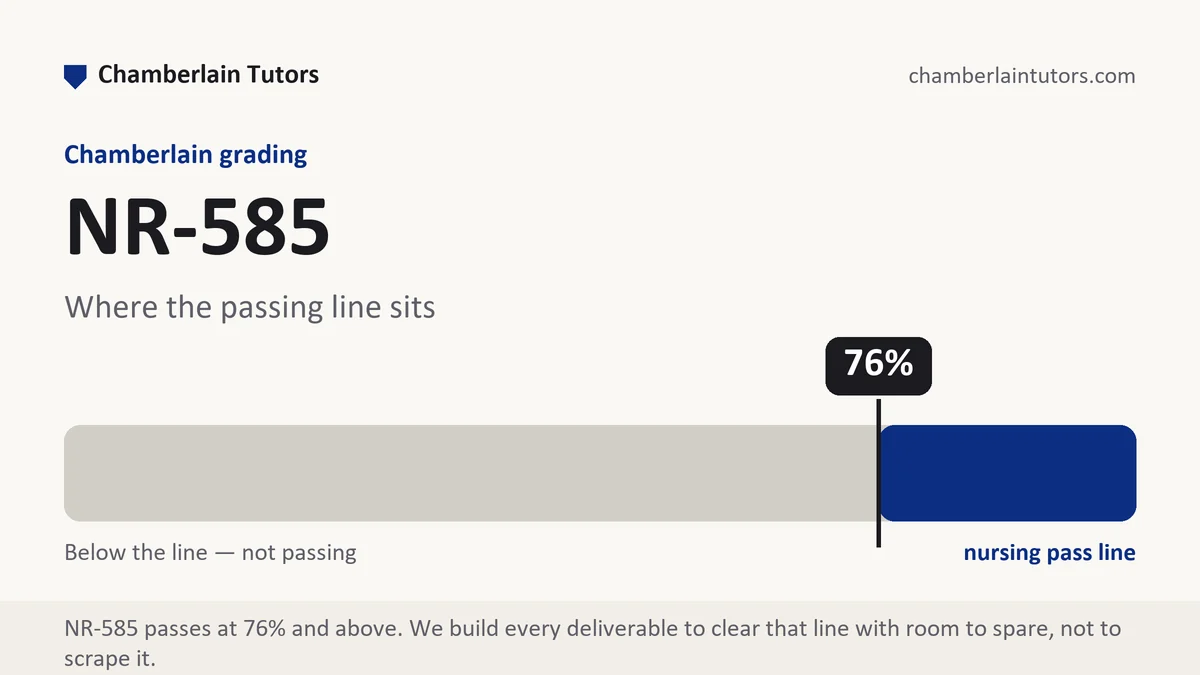
Research ethics is graded as reasoning, not as procedure. Naming a review process is a sentence. What earns marks is identifying which participants carry risk, what that risk is, how consent is genuinely voluntary when the researcher is also a clinician, and what happens to the data afterwards. Chamberlain's passing floor in core nursing courses is 76, and students taking this inside a nurse practitioner specialty run a scale with no C where 84 is the last passing number.
How we help in this course
Send the prompt and rubric from Canvas with your question in whatever rough form it currently exists. Half the work in this course is narrowing, and a question that names a population, an exposure or intervention, a comparison and an outcome is a design that has half written itself. We build the plan with a defensible design, operational definitions, and an analysis section that matches the data you would actually have.
We are also glad to work the other way: give us the design your instructor suggested and we will build the question that fits it, which is sometimes the faster route out of a stuck week.
Designing a study this week?
Send the rubric and your draft question. We will narrow it and scope the methods section today.
Read the rubric before the prompt
Methods rubrics list components, which makes them easier to plan against than most. Copy the rows into a blank file and check each against a simple test: could a stranger execute this section as written. Rows that pass are done. Rows that fail usually fail on one missing noun, such as the instrument, the interval, the comparison group or the statistical approach.
Then price the rows. Assume a 2,000-word cap with five rows weighted 25, 25, 20, 20 and 10 percent. That gives 500, 500, 400, 400 and 200 words. In this course the two 500-word rows are usually design and methods, which means the background section is competing for what is left, not the other way round. Most first drafts arrive with 700 words of literature review and a 300-word methods section, and the weights say that paper cannot score well no matter how good the review is.
Keep a running total per section while drafting. Methods writing expands quietly, and finding the overrun at 1,900 words means cutting the part you understood best.
The components of a study plan
The dominant deliverable here is a plan somebody else could run. Each component closes a question a reader will otherwise ask.
| Component | What it must specify | The version that cannot be run |
|---|---|---|
| The question | Population, the exposure or intervention, the comparison, the outcome and the time frame, in one sentence. | A topic area with an outcome implied rather than named. |
| Design, with a reason | The design chosen and the alternative rejected, with the reason resting on the question rather than on convenience. | A design named in a heading and never justified. |
| Sample and recruitment | Who is eligible, who is excluded, where they would be found, and how many you would need. | A convenience sample of interested participants, undefined. |
| Variables, operationalized | Each concept turned into something measurable, with the instrument and its known performance named. | An outcome such as satisfaction or adherence left as a word. |
| Procedure | What happens in order, by whom, at what interval, from first contact to last data point. | A promise that data will be collected over the study period. |
| Analysis plan | What will be compared to what, and the approach appropriate to that data type and design. | A statement that data will be analyzed using appropriate statistics. |
| Ethics and protection | Risk to participants, consent conditions, privacy handling, and the dual-role problem if you also treat them. | A single line saying approval would be obtained. |
| Dissemination | Who needs the finding, in what form, and what they could do with it. | An intention to publish, audience unspecified. |
Evidence craft in methods writing
In a design course, your sources do double duty: they justify the question and they model the methods.
Read the methods sections, not the abstracts. When you cite a study to support your design choice, the useful content is how they recruited, what they measured and what went wrong. Abstract-level citation is visible to a grader because the detail never arrives.
Instruments carry evidence about themselves. If you name a scale or a tool, say something about how it performs and in which population it was validated. Borrowing an instrument developed in a different population without noting it is a methods error, not a citation error.
Verbs the design can pay for. Observational sources support "was associated with" and "predicted". Controlled designs support "reduced" and "increased". In this course of all courses, using a causal verb for correlational evidence is scored as a conceptual failure rather than a slip of style.
Every rate needs a denominator and a window. "Thirty-one of the 240 participants enrolled withdrew before the six-month visit" tells the reader about attrition. "Retention was reasonable" does not, and attrition is exactly the kind of detail a methods reader is hunting for.
Passing and strong in a methods course
A passing plan is coherent. The design has a name, the sample exists in principle, and the ethics paragraph mentions consent. It reads as though it was assembled from a textbook chapter, which it usually was, and it stops short of specifying anything that could go wrong.
A useful test before submitting is to hand the methods section to someone outside the course and ask them to tell you back what would happen to a participant on day one. Where they hesitate, a noun is missing, and the missing noun is almost always the instrument, the interval or the comparison group.
A strong plan is operational. Every abstract noun in it has been converted into something countable, the analysis matches the data type rather than sounding impressive, and the limitations section names the weakness the reader had already spotted rather than a generic one. It also handles the awkward part of practitioner research honestly: if you would be recruiting your own patients, say what that does to voluntariness and what you would do about it. That paragraph is often the difference between the middle band and the top, and supplementary work cannot rescue a weak weighted average later in the program.
Six habits that cost marks in NR-585
- A question that will not fit a study. If the outcome could be measured five different ways, the design section has nothing to attach to.
- Design chosen without a rival. Naming what you rejected and why is usually the whole justification row.
- Concepts left unmeasured. Adherence, satisfaction and readiness are ideas until an instrument and an interval are attached.
- Ethics reduced to approval. The graded content is risk, consent, privacy and the dual-role problem, not the name of a review process.
- An analysis plan that says appropriate statistics. Say what is compared with what, and let the approach follow from the data type.
- Posting a discussion before it is finished. Posts do not reopen once submitted at Chamberlain, so draft in a document and paste once.
Questions NR-585 students ask
Do I have to actually collect data for this?
How do I choose between a qualitative and a quantitative design?
What does the ethics section need beyond mentioning review and consent?
Where NR-585 sits in Chamberlain's programs
Open the exact program map for sequence, credit, and option context. The current student schedule and syllabus remain authoritative after transfer evaluation, electives, state rules, and approved plan changes.
The weeks, one by one
Week 1
A charge nurse on a 32-bed medical-surgical unit can tell you within ten seconds which patients had a sepsis screen documented late last night, and she can tell you why. Read the full Week 1 manual.
Week 2
Forty-one articles sit in a folder on the desktop, eleven of them opened once, and the draft is still a blank page. Read the full Week 2 manual.
Week 3
Two nurses propose studies about the same thing on the same medical-surgical floor: whether a structured mobility round changes how far patients walk before discharge. Read the full Week 3 manual.
Week 4
A remote monitoring service enrolls adults with heart failure and calls them weekly. Read the full Week 4 manual.
Week 5
Ask ten nurses on a medical-surgical floor what counts as a pain reassessment and you will get at least three answers: a documented numeric score, a note that the patient reports relief, or a verbal check that never reaches the chart at all. Read the full Week 5 manual.
Week 6
A telehealth service wants to know whether a scheduled reminder call reduces no-shows. Read the full Week 6 manual.
Week 7
Consider the moment a study actually asks something of a patient. Read the full Week 7 manual.
Week 8
The last stage of a research methods session usually has two faces and students prepare for only one of them. Read the full Week 8 manual.