A charge nurse on a 32-bed medical-surgical unit can tell you within ten seconds which patients had a sepsis screen documented late last night, and she can tell you why. What she cannot yet do is write that knowledge in the form a research methods course grades: a gap in what is known, a purpose sentence that says what a study would find out, and a question narrow enough that somebody else could go and answer it. NR-585 Week 1 is where that translation starts. This course does not ask you mainly to critique other people's studies; it asks you to specify one of your own, and the specification begins with a gap and a purpose.
Your section may print this as NR 585 or NR585; it is the same course. Chamberlain publishes no syllabi outside Canvas. The placement here is our teaching judgment from the course's catalog arc; your section's rubric decides what your week actually asks.
What NR-585 Week 1 asks for
An opening stage in a graduate research methods course usually has two jobs running side by side. The first is vocabulary discipline: research, evidence-based practice and quality improvement are three different activities with three different approval routes, and a course that will eventually ask you to design a study needs you to know which of the three you are inside. Research generates knowledge that did not exist and requires review before anyone acts on it with human participants. Evidence-based practice takes knowledge that already exists, judges it, and applies it to a decision. Improvement work tests a local change against a local target. Advanced practice nurses do all three, often in the same month, and the written work in this course is scored on whether you can say which one you are doing.
The second job is the gap. A gap is not a topic you find interesting and it is not a problem on your unit. It is a specific piece of missing knowledge that the published literature does not yet supply, and locating one is the intellectual move that separates a research proposal from a practice essay. On the medical-surgical unit above, the problem is late sepsis screening. The gap might be that screening tools have been validated in emergency departments and intensive care units but studied far less on general medical floors where the ratio is different and the patient is often already admitted for something else. That sentence, if you can support it, is the beginning of a study.
The third demand is proportion. Early written work in an eight-week session tends to be short and diagnostic: a scholarly paper of roughly 1,000 to 1,200 words, a posted introduction of your proposed area, or the two together. Faculty use it to see how you write before the heavier design and methods stages arrive. If your section runs a discussion this week, draft it in a document first. Canvas boards do not reopen once a post is live, and an opening thread frequently fixes the topic you carry through to the final stage of the session.
Expect the writing to feel unnaturally flat at first. Purpose statements are deliberately plain sentences with almost no rhetorical energy in them, and nurses who write well in a clinical register often overwrite them. The purpose of this study is to examine the association between a documented sepsis screening interval and time to first antibiotic among adults admitted to general medical units is not elegant prose. It is, however, checkable, and checkability is the property this course grades from the first page.
The NR-585 Week 1 method, step by step
Six moves that take a practice irritation and turn it into a researchable gap with a purpose attached.
-
Read the scoring rows before you fall in love with a topic
Open your week's rubric in Canvas and paste each row into a blank file as its own heading, then reduce each to its verb. Distinguish, describe, justify and formulate demand different amounts of writing, and a row that says justify is telling you a paragraph of reasoning is expected where you were planning a sentence of assertion. Choosing your topic first is the standard route to strong writing landing in the wrong place.
-
Classify the activity before you name the subject
Ask what would settle the matter. If nobody knows the answer and finding out would require collecting data from people, you are in research. If the answer exists in the literature and your job is to apply it here, you are in evidence-based practice. If a local process is missing a local target and you want to test a fix, you are in improvement. Write your classification into the draft explicitly rather than leaving a grader to infer it from context.
-
Locate the gap in the literature rather than on your unit
Spend an hour in CINAHL or PubMed reading the discussion and limitations sections of four or five recent papers close to your area. Authors name the gap for you: they write that the finding needs replication in another population, or that the instrument has not been tested in an outpatient setting. A gap you can attribute to published authors is far more defensible than one you assert on your own authority.
-
Write the purpose sentence in one line with no clauses of praise
The purpose of this study is to, followed by a verb of inquiry, followed by the variables or phenomenon, followed by the population and setting. Examine, describe, compare, explore. Nothing about importance, nothing about passion, nothing about improving care. Importance belongs in the significance paragraph and putting it in the purpose sentence is what makes the sentence unmeasurable.
-
Test the question against a five-minute search
Take the population and the main variable into a database and read the result count. Zero returns usually means your wording is idiosyncratic rather than that the gap is enormous. Several thousand returns with nothing on point usually means your outcome is not written as anything anybody measures. Adjust the words before you adjust the ambition.
-
Draft the significance paragraph last and source every number in it
Once the purpose is fixed, go and find the prevalence, the cost, the complication rate, the mortality difference, whatever your area reports. Significance written first is decoration written from memory. Significance written last is aimed at the exact question you ended up asking, and it can carry citations that a grader can follow.
A layout and word budget for an opening gap and purpose paper
The frame below is how this desk sizes a first-stage paper of roughly 1,100 words in a research methods course. It is our own outline rather than anything the university issues, and your week's rubric outranks it wherever the two disagree. Scale the targets proportionally if your assigned length is different.
| Section | What belongs in it | Word target |
|---|---|---|
| Opening context | The clinical territory in two or three sentences, ending with the fact that makes it worth studying rather than merely worth discussing. | 110 to 140 |
| Research, practice and improvement distinguished | Your own definitions of the three activities and a plain statement of which one this proposal sits inside. | 180 to 210 |
| What the literature already establishes | Three or four settled findings, each attributed, written as the floor your study will stand on. | 200 to 240 |
| The gap, stated as missing knowledge | What has not been studied, in which population or setting, with at least one author who says so in a limitations section. | 180 to 220 |
| Purpose and preliminary question | The plain purpose sentence, then the variables or phenomenon named individually so a reader can see all the moving parts. | 170 to 200 |
| Significance and close | Sourced numbers showing scale and consequence, then one sentence on what would be different if the answer were known. | 150 to 180 |
Evidence craft for a first proposal stage
Separate what is known from what is claimed. A literature paragraph that reads as a list of article summaries has not done graduate work. Group the findings by what they establish, then write one sentence per group with two or three citations behind it. The reader should be able to see the shape of the field, not a queue of authors.
Attribute the gap to somebody. The strongest gap sentence in a first proposal names published authors who called for the work you are proposing. Prior investigators recommended replication in non-critical-care settings is a supported claim. No research exists on this topic is almost never true and is the sentence most likely to be challenged in feedback.
Give every statistic a base, a population and a collection year. Eleven of 214 admissions over one quarter tells a reader something. Five percent tells them nothing they can weigh. Publication year and data collection year are different facts, and health statistics routinely lag two or three years behind the article that reports them, so name the collection year in the clause.
Size your verbs to the designs behind them. Descriptive and survey work supports occurred in, was reported by, was associated with. Reduced, prevented and improved belong to studies where something was assigned and compared. This is the week the habit of oversized verbs either forms or does not, and it gets graded harder in every later stage of the course.
Retrieve the primary study rather than citing its echo. If a review reports a trial result you want, find the trial. Numbers mutate as they pass through secondary sources, and a research methods course is precisely the setting where a grader is likely to check one.
Record your search as you run it. Database, terms, limits, date searched, result counts. You will be asked to defend and extend that search in the next stage of the session, and rebuilding it from memory costs an evening you would rather spend writing.
Five mistakes that cost points in this week's territory
- A topic standing where a gap should be. Sepsis is a subject area. Screening tools validated in critical care but untested on general medical floors is a gap, and only the second gives a study something to find out.
- A purpose sentence carrying advocacy. The purpose of this study is to improve patient safety by reducing delays states an intention, not an inquiry. Improvement is the hoped-for consequence; the purpose is what you would learn.
- Blurring the three activities. If a rubric row asks you to distinguish research from evidence-based practice and your draft only implies the distinction, that row scores as unaddressed even when the writing around it is strong.
- Significance with nothing behind it. A sentence saying the problem is widespread carries no weight at graduate level. Attach a number, the population it came from, and where it was published.
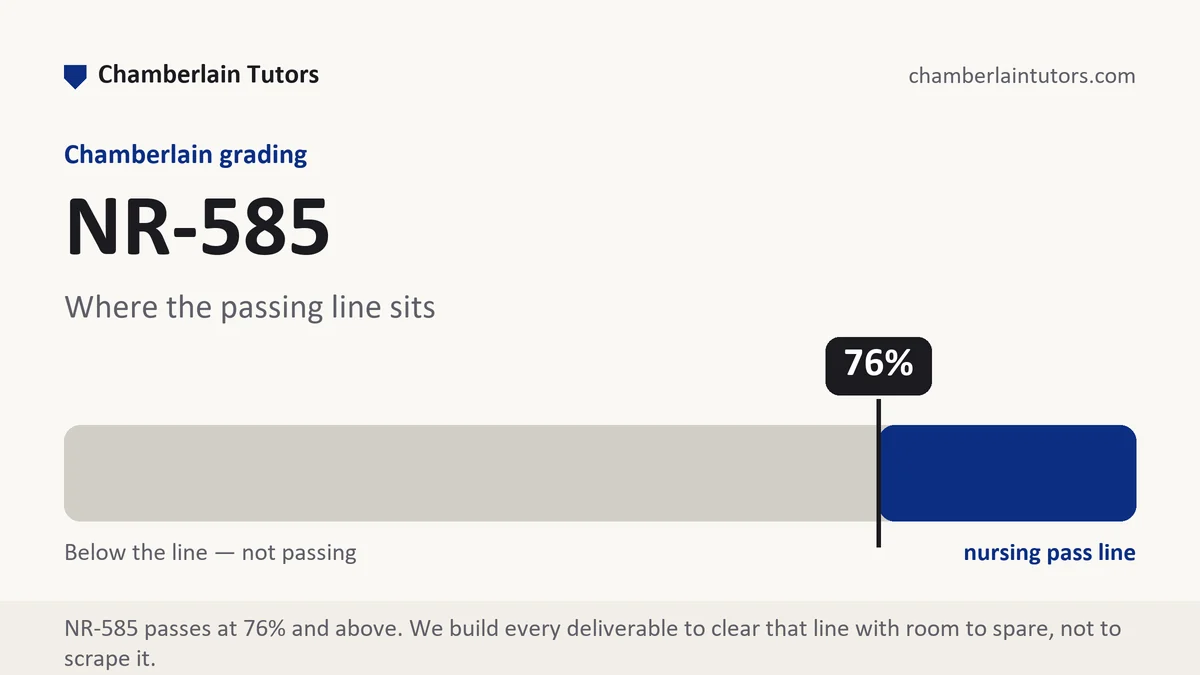
- Treating the first submission as a warm-up. Eight stages means one submission is roughly an eighth of the gradebook, and it lands before you have learned how your grader reads. Core nursing courses pass at 76, and early points are the cheapest points in the session.
Before you submit
- Research, evidence-based practice and improvement are defined in your own words and one is claimed
- The gap is attributed to published authors rather than asserted
- The purpose sentence contains a verb of inquiry, the variables and the population
- Every number in the significance section carries a base and a collection year
- Verbs match the strength of the designs they describe
- The search behind the gap is written down and repeatable by a stranger
- The draft was scored against your week's rubric row by row before upload
Starting NR-585 this week?
Send the prompt and the rubric out of Canvas with two sentences about the practice area you are circling. A premium original draft comes back in 24 to 48 hours with the gap attributed and the purpose sentence built to be checkable, and revisions run until the grade lands.