The last stage of a research methods session usually has two faces and students prepare for only one of them. The first is dissemination: who needs to hear what you would find, in what format, and why a poster at a nursing research day, a manuscript, a unit huddle and a written brief to a nursing council are four genuinely different pieces of writing. The second is assembly, which means taking seven stages written on seven different evenings and making them read as one document with a single argument running through it. NR-585 Week 8 grades both, and the second is where most of the recoverable points sit.
Your section may print this as NR 585 or NR585; it is the same course. Chamberlain publishes no syllabi outside Canvas. The placement here is our teaching judgment from the course's catalog arc; your section's rubric decides what your week actually asks.
What NR-585 Week 8 asks for
Dissemination is not an afterthought bolted to the end of a proposal; it is an argument about audience. A finding about ambulation frequency after abdominal surgery has at least four audiences with different needs. Bedside nurses need what changes on their shift, in one page, phrased as actions. Unit leadership needs the resource implication and the measure that would show whether it worked. A professional audience at a conference needs methods and numbers in a format that fits on a board and can be discussed standing up. Readers of a journal need the full methodological account so that others can judge and replicate it. A dissemination section that names one route and stops has answered a quarter of the question.
Format literacy is part of the grade. A poster is a visual abstract: a small number of words, one or two figures, and enough method to make the result interpretable. A podium presentation is a spoken argument with a strict time budget, usually built around three points a listener could repeat afterwards. A manuscript follows a structured order, and target journals publish author guidelines that specify length, structure and reference style, so naming a plausible target journal and describing its scope is a concrete, checkable sentence. An internal brief is the shortest and hardest: what we found, what we recommend, what it would take, and what we would measure.
Assembly is the other half and it is mechanical work that pays disproportionately. Terminology drift is the usual problem: a variable called early mobility in the design section becomes ambulation frequency in the measurement section and mobility protocol adherence in the analysis plan. A reader cannot tell whether those are one thing or three. The same drift affects your population, your setting description and your framework concepts, and a single pass with a find command catches nearly all of it.
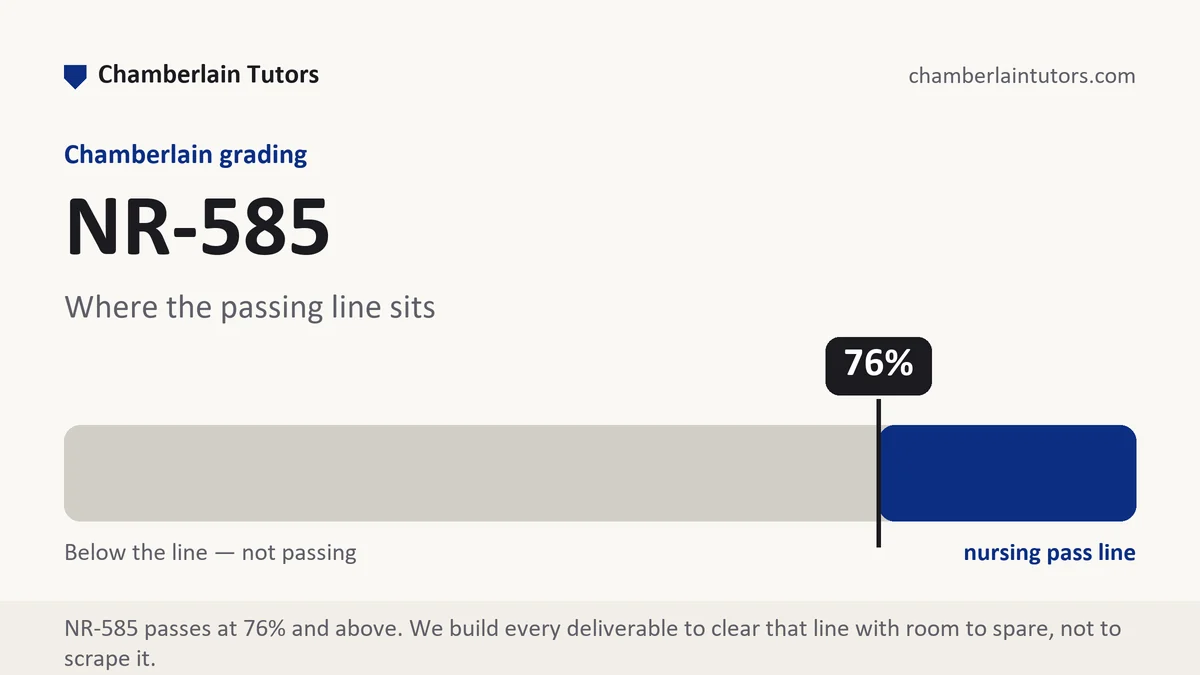
Expect a final deliverable of roughly 2,000 to 3,000 words if the whole proposal is assembled, or a shorter dissemination section if the stages are submitted separately. Either way, the final stage of an eight-week session is worth reserving a full evening for, and in a course where core nursing passing sits at 76, it is the last opportunity to move an average that has been forming since week two.
The NR-585 Week 8 method, step by step
Six moves for finishing a proposal and planning its dissemination.
-
List your audiences before you choose any format
Write down every group whose behaviour or decisions would change if your question were answered, then say for each what they would need to know and what they would do differently. Format follows from that list; choosing the format first is how a dissemination plan becomes a list of formats with no reasoning attached.
-
Match each audience to a route with a stated reason
Pair audience with vehicle and say why that vehicle reaches them. Staff who never read journals do read a laminated one-page summary at the nurses' station. Executives read a brief with a resource line. Say so rather than listing conference, journal and in-service in a sentence.
-
Name a plausible target outlet and describe its scope
For a manuscript, name a nursing journal whose readership matches your topic and say in one clause what it publishes. For a conference, name the type of meeting and the kind of abstract it accepts. Concrete targets are checkable and read as planning rather than as intention.
-
Write limitations as consequences with directions
Each limitation should say what it would do to your findings and which way. A convenience sample drawn from one unit would over-represent patients whose stay was long enough to be approached, which would likely inflate the observed adherence rate. That is analysis; a list of the word limitations is not.
-
Run a terminology and consistency pass across all sections
Search the assembled document for your main variables, your population, your setting and your framework concepts, and force each into one form of words. Check that the design named in the methods matches the tests named in the analysis and that your sample size is the same number everywhere it appears.
-
Score the whole document against every rubric row before uploading
Open the rubric one final time and mark, for each row, the paragraph that answers it. Any row without a paragraph is a row you can still fix, and this is the last stage where fixing it is possible.
A layout and word budget for a dissemination section and final pass
Our frame for a dissemination and conclusion section of roughly 1,200 words within an assembled proposal. It is our own outline rather than anything the university issues, and your week's rubric outranks it wherever they disagree.
| Section | What belongs in it | Word target |
|---|---|---|
| Anticipated findings | What the study would plausibly show, written conditionally, with the alternative outcome also considered. | 170 to 210 |
| Audiences and their needs | Three or four groups, each with what they would need to know and what they could act on. | 200 to 250 |
| Routes and formats | Each audience paired with a vehicle, a named or described outlet, and the reason that route reaches them. | 230 to 280 |
| Barriers to uptake | Why findings often fail to change practice in your setting and the specific step planned against it. | 170 to 210 |
| Limitations | Three limitations specific to your design, each with the direction it would bias the result. | 200 to 240 |
| Contribution and close | What would be known after this study that is not known now, in one paragraph with no new claims. | 140 to 180 |
Evidence craft for the final stage
Cite the literature on dissemination and uptake. The gap between publication and practice change is itself a studied phenomenon with a substantial literature, and one or two citations turn a paragraph of common sense into a supported argument.
Keep every anticipated finding conditional. Would show, would suggest, may indicate. A proposal that slips into reporting results it has not collected is the error graders remember, and it usually appears in the final paragraphs when fatigue sets in.
Verify the reference list line by line. Across eight stages, sources get cited, dropped and renamed. Confirm that every in-text citation appears in the list, that every listed source appears in the text, and that authors, years and titles match the papers you actually read.
Attribute practical claims about outlets. If you say a journal publishes work in your area, that claim can be checked in its published scope statement. Name the outlet accurately or describe the type of outlet generically rather than inventing detail about it.
Write limitations that a defender would concede. The most credible limitations paragraph names the weakness a critical reader would raise first and addresses it before they can. Anticipating the objection is a stronger position than listing three safe ones.
Hold the register through the last paragraph. Final sections attract inspirational closers about the future of nursing. A graduate conclusion states what would be known, for whom, and what should happen next, and stops there.
Five mistakes that cost points in this week's territory
- One audience for every route. A dissemination plan that sends the same content to nurses, executives and a journal has not thought about what any of them needs.
- Results reported before they exist. Conditional language holds everywhere in a proposal, and losing it in the final section undermines the methodological care of the seven stages before.
- Terminology drift across sections. When one variable carries three names, a reader cannot follow the argument and the coherence row suffers even where each section is individually sound.
- Limitations without direction. Naming a weakness without saying what it would do to the findings is the same generic move that costs points in every methods stage.
- Leaving the last stage until the last night. Assembly is mechanical, it takes longer than students expect, and it is where a competent proposal either becomes a coherent one or does not.
Before you submit
- Three or four distinct audiences appear, each with a stated need
- Each audience is paired with a route and a reason that route reaches them
- A plausible outlet is named or described accurately
- Every limitation carries the direction of its likely effect
- Each variable, the population and the setting use one consistent form of words throughout
- Design, sample size and analysis are consistent everywhere they appear
- Every rubric row has a paragraph you can point to
Assembling the final NR-585 proposal?
Send the rubric out of Canvas with whatever stages you already have. A premium original draft comes back in 24 to 48 hours with the dissemination plan built by audience, limitations given direction and the whole document made consistent section to section, and revisions run until the grade lands.