Two nurses propose studies about the same thing on the same medical-surgical floor: whether a structured mobility round changes how far patients walk before discharge. One writes a randomized design and cannot explain how randomization would survive on a unit where nurses share hallways and hear each other's handoffs. The other writes a comparison between two similar units and cannot rule out that the units differ in ways nobody measured. Neither answer is wrong. The graded difference is whether the writer named the tradeoff and defended the choice. NR-585 Week 3 is the stage where a design gets chosen on paper and, more importantly, argued for.
Your section may print this as NR 585 or NR585; it is the same course. Chamberlain publishes no syllabi outside Canvas. The placement here is our teaching judgment from the course's catalog arc; your section's rubric decides what your week actually asks.
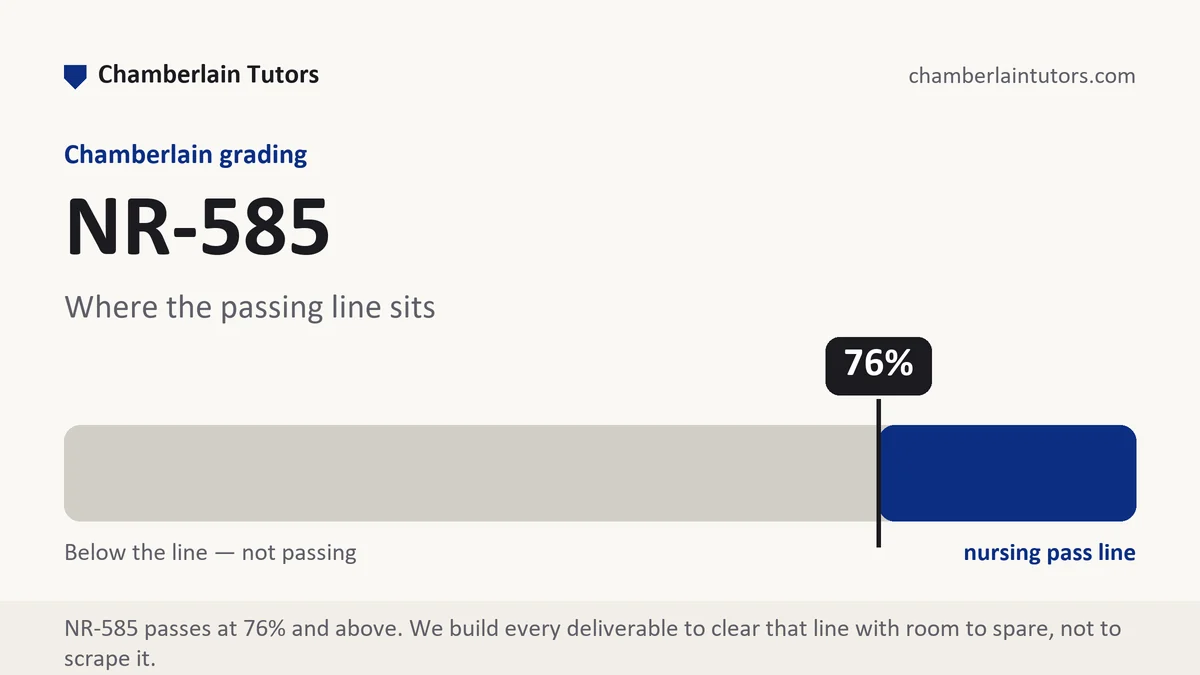
What NR-585 Week 3 asks for
Students lose points in this stage far more often for a missing justification than for a wrong design. A design is not good or bad in the abstract; it is appropriate or inappropriate to a question, in a setting, with the resources somebody would actually have. The writing task is therefore comparative: name the design, say what class of question it answers, say what it controls and what it leaves uncontrolled, and say why the alternative you rejected would have cost you more than it bought.
Know the map before you argue from it. Quantitative designs sort roughly into experimental work where an intervention is assigned and compared with randomization, quasi-experimental work where the intervention is assigned without randomization, and non-experimental work where nothing is assigned and you observe what is already happening. Non-experimental splits again into descriptive, correlational, cohort, case control and cross-sectional. Qualitative designs answer a different class of question altogether: not how much or how often, but what the experience is, how a process unfolds, or what meaning participants attach to something. Mixed methods combines the two on purpose, with a stated reason for the combination and a stated sequence.
The matching rule is simple to state and hard to apply. Questions containing the word effect or the phrase difference between groups point to experimental or quasi-experimental designs. Questions about association or prediction point to correlational and cohort designs. Questions about how common something is point to descriptive and cross-sectional designs. Questions about experience, meaning or process point to qualitative designs. If your purpose sentence from the opening stage says explore and your methods section describes random assignment, one of the two is in the wrong place, and the mismatch is visible to a grader in ten seconds.
The deliverable at this stage is usually a design and rationale section of roughly 1,000 to 1,400 words, sometimes with a comparison table, occasionally with a posted thread defending the choice. Write it as if a reader who has never spoken to you has to picture the study running, because that is precisely the standard the scoring rows are built around.
The NR-585 Week 3 method, step by step
Six moves for choosing a design and writing the defence that goes with it.
-
Diagram your question before you name any design
Write the population, what would be assigned or observed, what it would be compared with, the outcome, and the time window on five separate lines. If a line is empty, the design decision is premature. The empty line is usually the comparison, and a question with no comparison cannot support an experimental design at all.
-
Classify the verb in your purpose sentence
Examine an effect, describe a level, explore an experience, compare two groups, predict an outcome. Each verb licenses a family of designs and forbids others. Write the family down before you write the design, so the paragraph you produce shows reasoning rather than preference.
-
Test feasibility against the setting you actually described
Ask who would deliver the intervention, whether the unit could keep two conditions separate across shifts, how long recruitment would take at the volume you named, and whether the data you need is already captured. A design that cannot survive a real medical-surgical schedule is a paper design, and the feasibility row exists to catch it.
-
Name the threats your design leaves open, one by one
History, maturation, selection, attrition, instrumentation, contamination between groups. Take the three most likely in your setting and say, for each, which direction it would push your result. Naming direction is what turns a limitations list into analysis.
-
Write the rejected alternative and price it
One paragraph on the design you did not choose, what it would have bought in control, and what it would have cost in feasibility, ethics or time. This paragraph is the single most reliable way to earn a justification row, and most drafts leave it out entirely.
-
Draft the procedure as a sequence a stranger could follow
What happens first, to whom, delivered by whom, measured when. Numbered steps if that helps. If a reader has to guess when the second measurement occurs, the design row is being scored on a study nobody can picture.
A layout and word budget for a design and rationale section
Our frame for a design section of roughly 1,200 words. It is our own outline rather than anything the university issues, and your week's rubric outranks it wherever they disagree.
| Section | What belongs in it | Word target |
|---|---|---|
| Question restated in design terms | The question rewritten so that the assigned or observed element, the comparison and the outcome are each visible in the sentence. | 110 to 140 |
| Design named and classified | The specific design, its family, and the class of question it is built to answer, cited to a methods source. | 170 to 200 |
| Rationale | Why this design fits this question in this setting, written as reasoning rather than as a definition of the design. | 230 to 280 |
| The alternative considered and rejected | One competing design, what it would have controlled, and the specific cost that ruled it out here. | 180 to 220 |
| Procedure | The sequence of events in order, including who delivers what and when each measurement occurs. | 250 to 300 |
| Threats and controls | Three threats your design leaves open, the direction each would bias the result, and any design feature that limits it. | 200 to 250 |
Evidence craft for design writing
Cite a methods text when you name a design. Design definitions belong to the methodological literature, not to your own authority. One citation to a nursing research methods source when you first name the design converts an assertion into a supported claim and costs you six words.
Borrow design decisions from studies in your literature set. The papers you synthesized in the previous stage made these same choices, and saying that two prior investigators used a pre and post design in comparable units, with the limitation they reported, is a stronger rationale than reasoning from first principles alone.
Keep causal language locked to assignment. If nothing is assigned, nothing can be said to cause anything. Observational designs support associated with, predicted, occurred more frequently among. This is the stage where a grader in a research course will mark an overreaching verb without hesitation.
Write contamination as a real risk in unit-based studies. On a shared medical-surgical floor, nurses learn each other's practice within days, so a design comparing two groups on one unit is at risk of the intervention leaking into the control condition. Naming that risk and proposing a plausible control, such as comparing across units or across time periods, is the kind of practical methodological thinking these rows reward.
Distinguish research design from improvement methodology. Plan-do-study-act cycles and similar improvement approaches are legitimate and are not research designs. If your proposal is genuinely improvement work, say so and follow whatever route your rubric sets. Mislabelling one as the other is a definitional error that costs more than any weakness in the design itself.
Keep the framework from the previous stage visible. The concepts you named as doing the causal work should be the things your design manipulates or observes. A framework that disappears the moment the methods begin is the most common structural incoherence in a graduate proposal.
Five mistakes that cost points in this week's territory
- Defining the design instead of defending it. Three paragraphs explaining what a quasi-experimental design is do not answer the question of why yours is one.
- A design that outruns the question. Proposing a randomized trial for a question that asks what an experience is like signals that the design was chosen for prestige rather than fit.
- No comparison anywhere. If nothing is being compared with anything, most of the designs students name in these drafts are unavailable, and the mismatch usually traces back to a purpose sentence written too loosely.
- Feasibility left unexamined. A plan requiring 300 participants from a unit that admits 40 patients a month has an arithmetic problem visible to any grader who does the division.
- Generic limitations. Small sample size and further research is needed appear in every weak methods section and demonstrate nothing about the design you actually chose.
Before you submit
- The design is named specifically rather than described as quantitative or qualitative alone
- The verb in your purpose sentence matches the family of the design you chose
- A rejected alternative appears with the reason it was rejected
- The procedure is written in sequence and a stranger could follow it
- Three threats are named with the direction each would bias the result
- Causal verbs appear only where something is assigned and compared
Stuck choosing a design for NR-585?
Send the rubric out of Canvas with your question in whatever form it exists. A premium original draft comes back in 24 to 48 hours with the design justified, the rejected alternative priced and the procedure written in sequence, and revisions run until the grade lands.