NR-583NP Week 1 opens Chamberlain's Informatics for Advanced Nursing Practice course, and in an 8-week session the opening week sets habits the other seven inherit. The first stretch of an informatics course belongs to foundations: what the discipline is at the provider level, and how raw data climbs to information, knowledge, and finally a decision about a patient. This manual walks that likely territory step by step. Your section may print this as NR 583NP or NR583NP; it is the same course. Chamberlain publishes no syllabi outside Canvas. The placement here is our teaching judgment from the course's catalog arc; your section's rubric decides what your week actually asks.
What NR-583NP Week 1 asks for
The catalog frames this course around healthcare informatics, emerging technologies, and the ethical and legal side of information management. Courses built that way almost always spend their first week on definitions and stakes: nursing informatics as a discipline, the data-to-wisdom ladder, and why a nurse practitioner should care about structures that once belonged to analysts. Expect the shapes an opening week usually takes: an introduction discussion if your section runs one, and often a short foundational piece that asks you to define the field and apply one framework to a clinical moment you know.
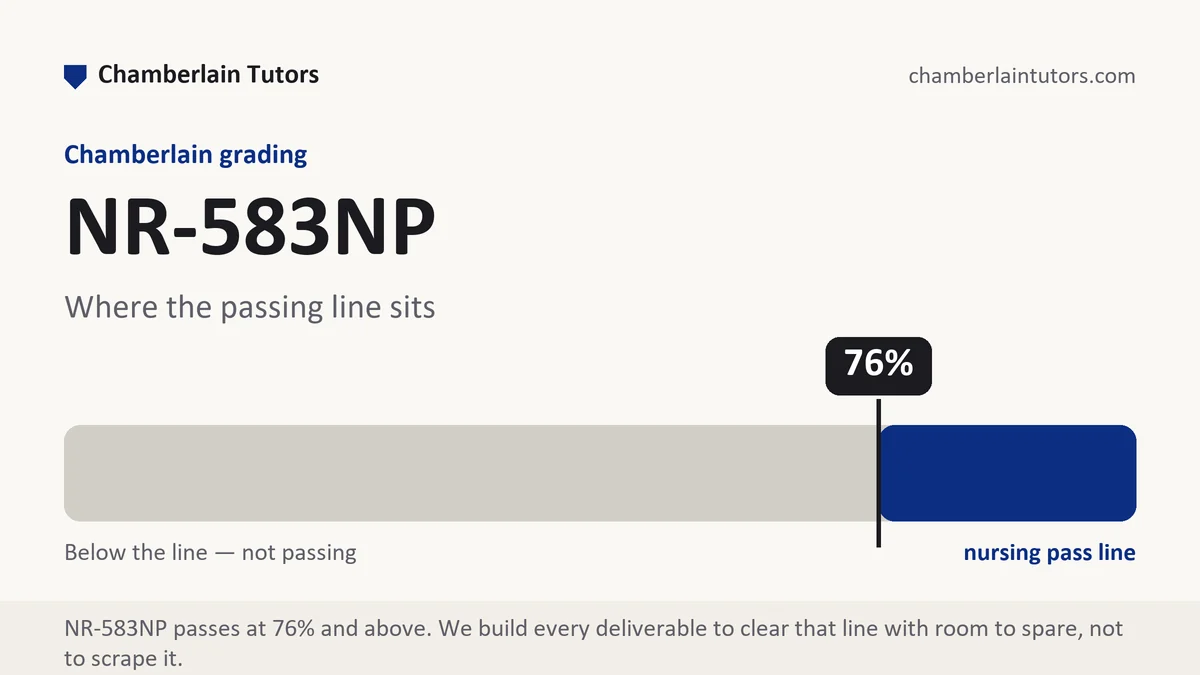
Treat the week as fully graded, because at this level it is. The NP specialty scale has no C band, anything below 84 fails, and the writing you post in Week 1 sits in the same gradebook as the finale. A discussion post here is also permanent the moment it goes up, so the proofing discipline this manual ends with is not optional furniture.
The NR-583NP Week 1 method, step by step
-
Decode the rubric before the readings
Open your week's rubric in Canvas and underline the graded verbs: define, describe, apply, examine. The verbs are the assignment. Readings answer the verbs; they do not replace them, and a first post that ignores the verbs reads like it was written for a different course.
-
Choose one clinical moment as your anchor
Pick a single encounter you know well, stripped of identifiers: one lab result arriving on one patient. Foundations writing dies when it stays abstract, and one concrete moment lets every framework rung you discuss touch ground in the same example.
-
Climb the ladder one rung at a time
Take the data-information-knowledge-wisdom progression and write one short block per rung: the cited definition, then your anchor moment at that rung. A potassium value is data; trended against the last three draws it becomes information; read against the drug list it becomes knowledge; the call to hold the diuretic and recheck is the wisdom rung.
-
Write to the provider role, not the bedside
The NP variant of this course is asking how information behaves when you are the one diagnosing and prescribing. Frame consequences at that altitude: the differential you trimmed, the prescription you changed, the referral you decided against.
-
Budget words by the rubric's weights
Whatever your section's word window is, split it in proportion to the rubric's points before drafting. Definitions usually carry less weight than application, and the common Week 1 error is the reverse split, a page of definitions and two lines of applying them.
-
Proof outside Canvas, then post once
Draft in a document, run a read-aloud pass, check citations in both directions, and only then paste. Chamberlain discussion boards cannot be edited after the click, so the paste is the submission.
First week of NR-583NP on your desk?
Send the rubric before you post anything. A floor-checked draft for the exact prompt comes back in 24 to 48 hours, first premium sample free.
A structure for the foundations deliverable
Sized here for a 450-word discussion post; if your week runs a short paper instead, multiply each row by the same factor and keep the proportions.
| Block | What it does | Words |
|---|---|---|
| The position | One claim about what informatics changes for an NP, stated in your own words before any citation appears. | 60 |
| The definition block | The discipline defined once, attributed to the source your readings use, not to a dictionary. | 80 |
| The ladder, applied | Your anchor moment carried up all four rungs, one or two sentences per rung. | 170 |
| The role implication | What changes at the prescribing and diagnosing level because the ladder exists. | 90 |
| The close | The one question this week leaves you holding, which is also your reply hook. | 50 |
If a rubric row your section grades is missing from that map, add a block for it and take the words from the ladder section, which compresses best.
Evidence and citation craft for foundations week
Define from the literature, not the dictionary. A dictionary can define information; it cannot define nursing informatics as the discipline uses it. Attribute the definition you use to the body that wrote it, and quote it exactly or not at all.
The course text is a source, not the source. Week 1 tolerates textbook citation better than any later week, but pair it with at least one peer-reviewed article so the habit starts now.
Frameworks have authors. The data-to-wisdom progression came from somewhere. Citing the framework's origin, or the review your readings assign for it, is the difference between using an idea and appearing to invent it.
Check the window. If your rubric names a currency window for sources, treat it as a floor. A foundations week forgives an older framework citation; it does not forgive a fifteen-year-old article standing in for current practice.
Reconcile both directions. Every in-text citation appears in the reference list, and every reference is cited in the body. It takes four minutes and protects a row you have already earned.
Five mistakes that cost points in Week 1
- Writing from the bedside. Task-level examples answer a BSN prompt. This rubric wants the provider's altitude, and graders read for it from the first line.
- A definition stack. Four cited definitions and no worked example fills the word count and leaves the application rows empty.
- Data and information used as synonyms. The whole week exists to separate the rungs; blurring them in sentence two undercuts everything after.
- The uncited claim of consensus. Phrases like it is widely accepted invite a margin note. Name who accepts it, in a citation.
- Posting the first draft. The board is permanent. A typo in a definition sits all session in front of the same grader.
Pre-submission checklist
- Every graded verb from your week's rubric appears in a heading or topic sentence
- One clinical moment, stripped of identifiers, anchors all four rungs of the ladder
- Each definition is attributed, and the example beside it is yours
- The consequences named are prescribing, diagnosing, or referral consequences
- Word counts match your section's window, split by rubric weight
- The draft was proofed outside Canvas and pasted exactly once