NR-583NP Week 2 usually moves from definitions to the machine every provider lives inside: the electronic health record. After a foundations week, an informatics course for advanced practice turns to how the record shapes clinical work, where structured fields help a prescriber and where they quietly fail one. The writing this week tends to be analytical, an encounter traced through a system rather than a system described from a brochure. Your section may print this as NR 583NP or NR583NP; it is the same course. Chamberlain publishes no syllabi outside Canvas. The placement here is our teaching judgment from the course's catalog arc; your section's rubric decides what your week actually asks.
What NR-583NP Week 2 asks for
This is where the course's information-management thread gets a concrete object. The likely territory is the EHR as the instrument of advanced practice: documentation quality, structured data against narrative text, the workflow between chief complaint and closed chart, and the habits, copy-forward among them, that put a license at risk. If your section runs a discussion this week, expect it to ask for your own experience of a record system read through the assigned concepts. When a paper anchors the week, it usually wants one system or one workflow analyzed, not the whole technology market surveyed.
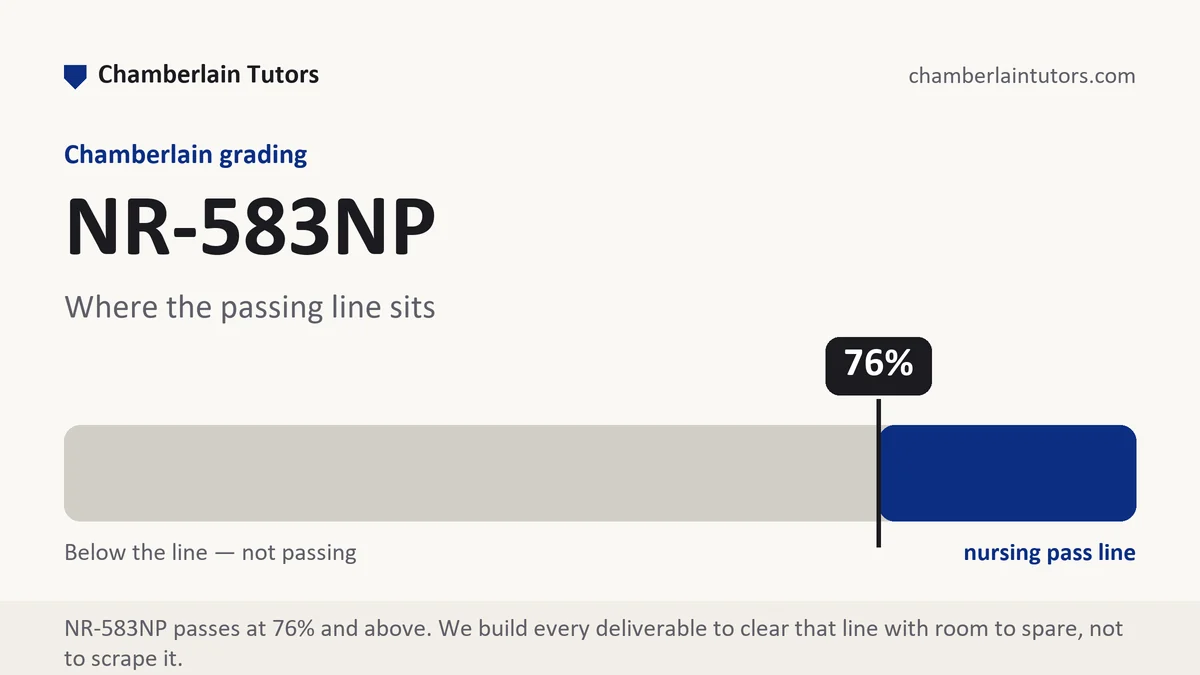
The graders' bar moves this week too. A foundations post can survive on clean definitions; an analysis deliverable has to make a judgment and defend it. On the specialty scale, where 83 already fails, the difference between describing a system and analyzing one is the difference between banked points and a slide you spend the rest of the session correcting.
The NR-583NP Week 2 method, step by step
-
Trace one encounter end to end
Before writing, walk a single visit through the record on paper: intake, history, orders, the note, the close. Every claim you make later should point at one station of that walk. Papers that skip this step describe features; papers built on it describe work.
-
Separate the field from the prose
For each station, note what the system captures as structured data and what lives in free text. This single distinction powers most of the analysis a Week 2 rubric rewards, because nearly every strength and every hazard of an EHR sits on one side of that line.
-
Pick one strength and one failure you can evidence
Choose a point where structure genuinely protects the provider, an allergy field that blocks an order, and a point where it fails, a template that buries the one abnormal finding in normal boilerplate. Two well-argued points beat six listed ones.
-
Attach the literature to the failure
Find current studies on the failure you chose: note bloat, copied text, alert overrides in documentation. The analysis rows want your observation and the published record agreeing in the same paragraph.
-
Write the implication at license level
Close the analysis with what the finding means for the person who signs the note. Documentation is testimony; say what the system makes easier to get wrong and what the prescriber must do manually because of it.
-
Sweep for identifiers, then submit against the Mountain clock
Workplace material makes this week's writing better and riskier. Do a dedicated pass for names, dates, and facility tells before submission, and land the upload with hours to spare, not minutes.
An EHR analysis due and no time to trace workflows?
Send the prompt and your rubric rows. We return a premium draft built on a real workflow walk, floor-checked, in 24 to 48 hours.
A structure for the EHR analysis
Sized for a paper of about 1,100 words; if your section sets a different window, keep the proportions and rescale.
| Section | What a grader is checking | Words |
|---|---|---|
| The system, in one paragraph | That you can situate a record system without marketing language: setting, scale, the work it hosts. | 120 |
| The encounter traced | That the analysis rests on actual workflow, station by station, not on features recalled at random. | 250 |
| Where structure protects | One strength argued with a mechanism: what the field prevents, and for whom. | 200 |
| Where structure fails | One hazard argued the same way, with the literature standing beside your observation. | 250 |
| The provider implication | What the signer of the note must now do differently, stated as practice, not as complaint. | 180 |
| The close | The judgment restated once, and the single change you would argue for. | 100 |
Notice what the map has no room for: a history of electronic records. If your rubric does not grade history, the paper should not spend words on it.
Evidence and citation craft for the record week
Vendor documents are marketing until proven otherwise. A white paper from a system's maker can describe intended function; it cannot evidence outcomes. Label it for what it is and put a peer-reviewed evaluation next to it.
Government sources carry the standards. Federal health-IT material is fine evidence for what certified systems must do, cited as the agency publication it is, with the year, because requirements shift.
Usability findings need their setting. A documentation-burden study from inpatient medicine may not transfer to a primary care clinic. Name the setting of every study you lean on, and say in a clause whether it matches yours.
Your observation is data, labeled honestly. What you saw in practice can appear as your observation, in first person, unreferenced. What it cannot do is wear a citation it did not come from.
No screenshots, no fragments of charts. Describe interfaces in prose. A pasted screen is a privacy incident waiting for a grader to notice, even when you believe it is clean.
Five mistakes that cost points in Week 2
- The user manual voice. Clicking here opens the medication list. Description of navigation is not analysis of practice, and rubrics this week grade the second.
- The grievance essay. Every clinician has EHR complaints. A paper organized around frustration reads as venting; the same material organized around a mechanism reads as analysis.
- Billing as the only lens. Coding pressure is real, but a paper that reduces documentation to reimbursement misses the safety and testimony threads the week exists to teach.
- A facility identifiable from details. Bed counts, go-live dates, and named modules can triangulate your employer. Blur the specifics that do no analytic work.
- Literature from the wrong decade. Record systems change fast. A pre-2015 usability study describes software your grader knows is gone.
Pre-submission checklist
- The paper rests on one traced encounter, and every claim points at a station of it
- Structured capture and free text are separated explicitly at least once
- One strength and one failure are each argued with a mechanism and a source
- Every study cited names its setting, matched or contrasted with yours
- No screenshots, no names, no facility details that could identify the site
- The upload landed early against the 11:59 p.m. Mountain Time deadline