NR-582NP Week 8 usually closes the course by turning its four strands on their author: a leadership development plan, your honest position now, goals with dates and measures, and the resources that will move you, submitted while you run the final gradebook arithmetic of the second core course. Plans fail by being written from virtues instead of artifacts, and this manual is built to prevent exactly that. Your section may print this as NR 582NP or NR582NP; it is the same course. Chamberlain publishes no syllabi outside Canvas. The placement here is our teaching judgment from the course's catalog arc; your section's rubric decides what your week actually asks.
What NR-582NP Week 8 asks for
A course that taught leadership frameworks, role passage, team behavior, change machinery, and policy voice ends by asking what you will do with them, and the development plan is that answer in gradeable form. The genre demands three honesty tests at once: a self-assessment argued from documented evidence rather than modest guesses, goals concrete enough that a stranger could verify them, and a connection back to the course's own material, so the plan reads as the course's product rather than a generic resolution list.
The shape is typically the course's final paper, often beside a closing discussion. If your section runs a discussion this week, it will likely ask what you carry forward; write it after drafting the plan, because the plan's specifics turn a farewell post into an easy top-band item.
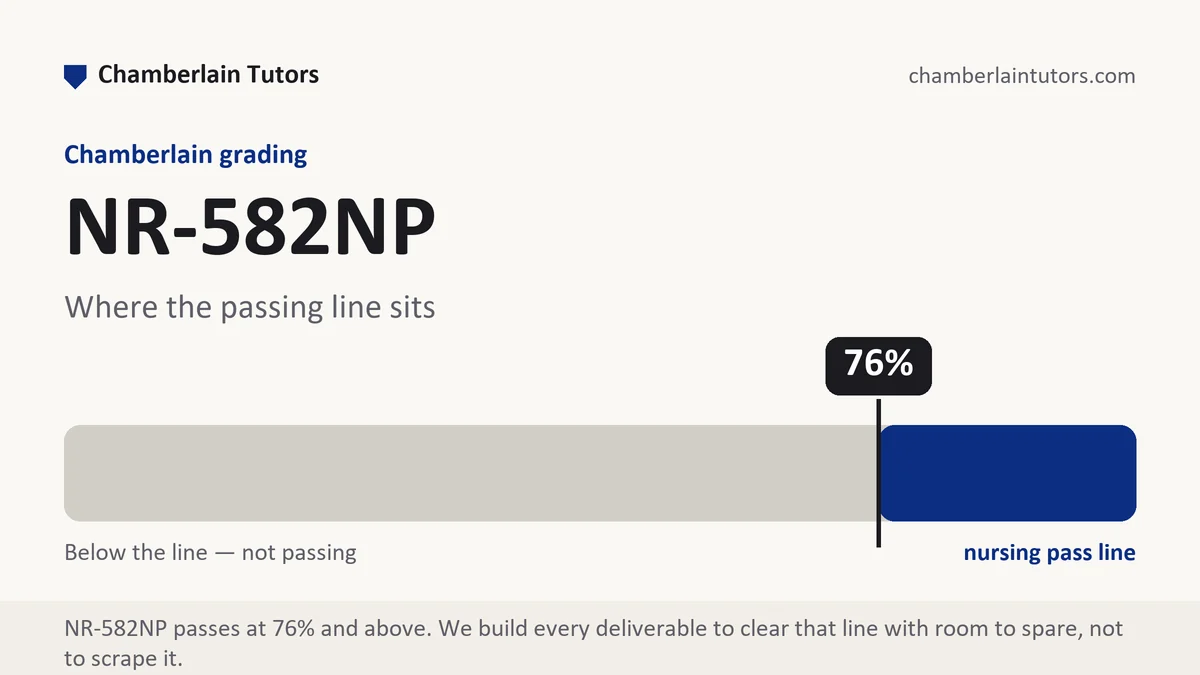
Meanwhile the second core course is ending on the same scale it ran on: 84 is still the last passing number, nothing curves, and a failing outcome would spend one of the two failures the dismissal rule allows across the program. The final week's writing and the final week's math deserve equal attention, and the method below schedules both.
The NR-582NP Week 8 method, step by step
-
Assemble your evidence file before the rubric skeleton
Gather the artifacts that testify about your leadership now: faculty feedback from this course's papers, a performance evaluation, the team case you analyzed, the change proposal's reception. Set the rubric rows as headings, then write the plan out of the file, not out of memory.
-
Assess yourself in claims a stranger could check
Write your current position as evidence-backed statements: which strand of this course exposed a gap, where a documented pattern shows a strength. My change proposal handled resistance thinly, and here is the feedback that says so, is assessment; I struggle with confidence is weather.
-
Choose two or three goals, each tied to a course strand
Pull each goal from something this course actually surfaced: a leadership behavior to practice, a policy mechanism to enter, a team skill to build. Goals that could have been written before week 1 announce that the course changed nothing, and graders read for exactly that.
-
Give every goal a measure, a date, and a first step
Convert each goal to something checkable: the action, how often, verified how, by when, and the step you take in the first month. The strong-verb test applies: continue, strive, and focus on cannot be measured and do not survive revision.
-
Attach resources and one accountable witness
Name what each goal costs and draws on, a mentor relationship, an association membership, protected time, and one person who will see the evidence and tell you the truth on the checkpoint date. Plans with witnesses happen; plans without them are essays.
-
Run the closing math, then submit everything early
Before the last uploads, compute what each remaining item needs for your target band, remembering there is no C and no curve. Then submit with hours of margin, because the last night of a session is the most expensive possible time to meet a technical problem.
A structure for the development plan
Targets fit a plan of roughly 950 words of body; your section's rubric replaces them wherever it specifies.
| Section | What it has to do | Target |
|---|---|---|
| Opening position | One honest sentence on where your leadership stands after this course, previewing the evidence that follows. | ~90 words |
| Self-assessment, evidenced | Strengths and gaps argued from artifacts, feedback, evaluations, this course's own assignments, not from adjectives. | ~200 words |
| Goal one, fully built | The goal, its course-strand origin, measure, date, first step, and resource, as one coherent block. | ~170 words |
| Goal two, fully built | A second goal from a different strand, built to the same standard, not a variation of the first. | ~170 words |
| Resources and accountability | What the plan draws on and who verifies it, with checkpoint dates a witness could keep. | ~150 words |
| Evaluation and close | How the plan itself gets reviewed and revised, and the position restated as a commitment with a horizon. | ~120 words |
Evidence for a paper about your future
A development plan cites in two directions. Backward, at the assessment: your artifacts are the data, described concretely enough to function as evidence, and this course's frameworks supply the vocabulary that makes the assessment analytic, the leadership theory that names the behavior you lack, the role literature that predicts your next friction. Cite the frameworks as you use them, once each, exactly as you would in any analysis.
Forward, at the goals: each development strategy carries its own literature, what mentorship arrangements are documented to do, how deliberate practice builds specific skills, what professional engagement changes in early careers, and one citation per strategy is the difference between a plan and a wish list. Where that literature is observational, and most of it is, the verbs stay modest: mentored clinicians report, engagement is associated with.
The register rule from the course's reflective work applies at full strength: feelings are admissible in one clause, artifacts carry everything else, and the smaller, checkable claim always beats the grand one. A grader finishing eight weeks of your writing knows your register; the plan should sound like the best of it.
Five mistakes that cost points in week 8
- Virtue goals. Become more confident and grow as a leader cannot be measured, witnessed, or graded. Behavior, frequency, evidence, date.
- Assessment without artifacts. Modesty and self-praise are equally unscoreable. The rows want documented ground under every claim about yourself.
- A plan the course never touched. Goals disconnected from the course's strands read as recycled from somewhere else, and the synthesis rows score the disconnect.
- No witness, no date. A plan only you could verify, on no particular schedule, is structurally unfalsifiable, and graders in this genre look first for the checkpoints.
- Final-week autopilot. Submitting the closing items at the deadline with the average near the line converts a passing course into a gamble the dismissal rule prices brutally.
Six checks before the course closes out
- Every rubric row is answered, verified in a final pass of rows against draft.
- Each self-assessment claim stands on a named artifact.
- Every goal traces to a course strand and carries measure, date, first step, and resource.
- One accountable person and real checkpoint dates appear in the plan.
- Development strategies are cited, with verbs sized to their observational literature.
- The gradebook math is computed, the target confirmed, and all closing items upload with hours to spare.
Closing week of the second core course?
Send the final rubric and your gradebook standing; we compute the target and return a floor-checked plan that holds your band, in 24 to 48 hours.