NR-582NP Week 1 opens the second core course on its first catalog strand: leadership theory for advanced nursing practice, the frameworks that describe how leaders actually move people, and the question of which one fits the provider role you are building. Leadership writing has its own failure mode, slogans where analysis should be, and this manual is arranged to keep you out of it. Your section may print this as NR 582NP or NR582NP; it is the same course. Chamberlain publishes no syllabi outside Canvas. The placement here is our teaching judgment from the course's catalog arc; your section's rubric decides what your week actually asks.
What NR-582NP Week 1 asks for
The catalog gives this course three jobs, leadership theory, role development, and policy, and courses open where their titles do. Opening territory here is the theory shelf: the named frameworks of leading, transformational, transactional, servant, authentic, situational, what each claims about how influence works, and which of them describes the kind of leader an NP in a clinical setting can actually be.
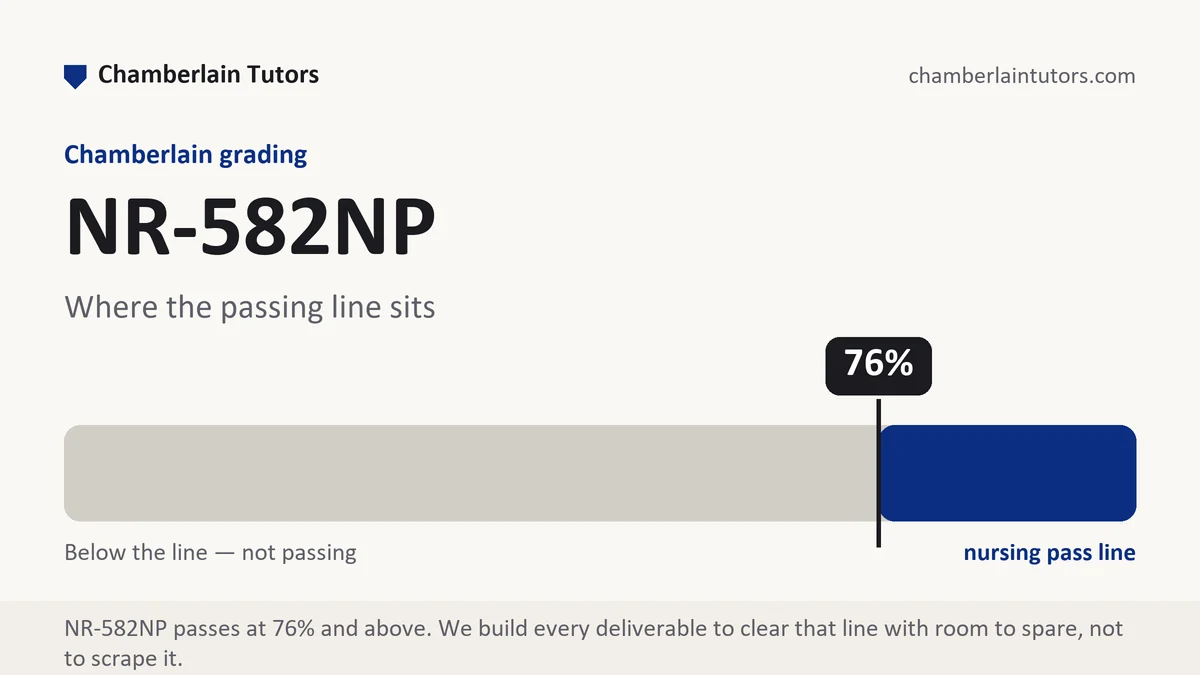
The likely shapes are light but graded: an introduction thread, and, if your section runs a discussion this week, an initial post that stakes a claim about one leadership framework's fit for advanced practice, with sourced replies behind it. Momentum matters more than length here, because this is the course where students arriving from the first core class either consolidate their register or start paying interest on it, and the specialty scale, with 84 as the last passing number, charges from the first post.
The rows in this territory want a theory treated as a theory: components named, mechanism explained, evidence of results in nursing settings cited. What they do not want is a personality endorsement, a post that admires a style the way one admires a colleague. The difference is checkable claims, and building them is what the method below is for.
The NR-582NP Week 1 method, step by step
-
Set the rubric rows as your outline before reading further
Copy your week's rubric rows into a blank document as headings and note what each demands. Leadership prompts invite breadth; the rows will show you the grade wants one framework held to account, not five admired in passing.
-
Choose one primary theory and one deliberate contrast
Commit to a main framework and pick a second whose logic genuinely differs, exchange-based against change-based, directive against serving, so the comparison has an edge. Contrast is what forces definitions to sharpen, and sharpened definitions are what the rows pay.
-
Define the theory by its machinery, in your own words
Say what the framework claims actually moves people: which behaviors, producing which follower responses, in which conditions. Cite the theory's originating literature, and keep its buzzwords inside quotation marks or out of the post entirely.
-
Bring nursing evidence, not business anecdotes
Find at least one study linking your framework to outcomes in health care settings, staff retention, safety climate, team performance, and report it with design and sample visible. One nursing study outweighs any number of corporate success stories.
-
Fit the theory to one concrete NP situation
Apply the framework to a single scene an NP actually occupies, leading a morning huddle, working a nonadherent panel with medical assistants, and show what the theory tells you to do in it. Application at scene level is what makes fit arguable rather than asserted.
-
Draft outside Canvas and post with time to reply well
Compose in a document, hold the draft against the rows, and paste once, early in the week, because boards do not reopen and replies written at the deadline read like they were. Budget real words for replies; they are graded work under the same rows.
A structure for the leadership comparison post
Targets fit a post of roughly 600 words. Your section's rubric governs wherever it differs.
| Part | What it has to do | Target |
|---|---|---|
| Position | One sentence claiming which framework best fits NP practice and on what grounds, so the post argues instead of tours. | ~60 words |
| Primary theory, defined | The framework's components and mechanism in your own words, originating source cited. | ~140 words |
| The contrast | The second framework's differing logic, presented fairly and briefly, so the choice between them means something. | ~100 words |
| Evidence of results | At least one health care study connecting the primary framework to measured outcomes, design and sample stated. | ~130 words |
| The NP scene | One concrete practice situation with the theory's guidance made visible in it. | ~110 words |
| Close and handoff | The position restated as earned, plus a question classmates can answer from their own settings. | ~60 words |
Evidence craft for leadership writing
Leadership research is overwhelmingly observational: surveys of staff under different leaders, correlations between style scores and unit metrics. That sets your verbs. Styles are associated with retention, linked to safety climate, related to satisfaction; almost nothing in this literature earns caused. A post that reports correlational findings with causal verbs tells the grader its writer read abstracts, and week 1 is an expensive place to make that impression.
The seminal texts of leadership theory are decades old, and citing them for the theory's content is right, not stale, the same landmark logic that governs any theory writing. Currency belongs to the results layer: recent studies of the framework in health care settings, ideally in nursing, because a theory's corporate track record transfers poorly to a clinic's authority structure.
Instruments matter more than students expect. Much of this literature measures style with named questionnaires; mentioning the instrument a study used, and in whom, is a one-clause upgrade that signals you read past the finding to the method.
Five mistakes that cost points in week 1
- The theory tour. Five frameworks in five sentences each satisfies no row. Depth on one, contrast with a second, is the winning shape.
- Slogan register. Leaders inspire greatness is a poster, not a claim. Every sentence should survive the question: what would count as evidence for this?
- Charisma treated as a framework. Admiring energy or presence is personality commentary. The rows grade components, mechanisms, and results.
- Business sourcing only. An executive memoir cannot carry a claim about nursing outcomes. Bring the health care literature or the fit argument stays unfounded.
- Application to nowhere. This theory will help me lead effectively fits every theory and every job. One named scene with visible guidance is what application means.
Six checks before the first post goes up
- The rubric rows are each answered by a passage you can point to, checked row against draft.
- One primary framework is defined by components and mechanism, in your own words, with its source.
- The contrast framework genuinely differs and is presented fairly.
- At least one health care outcome study appears with design and sample visible, verbs sized to it.
- The application names one specific NP scene, not a general hope.
- The post was drafted outside Canvas, pasted once, and submitted well before 11:59 p.m. Mountain Time.
Starting the second core course already stretched?
Send week 1's rubric and we return a floor-checked leadership post, evidence layer included, in 24 to 48 hours. The first premium sample is free.