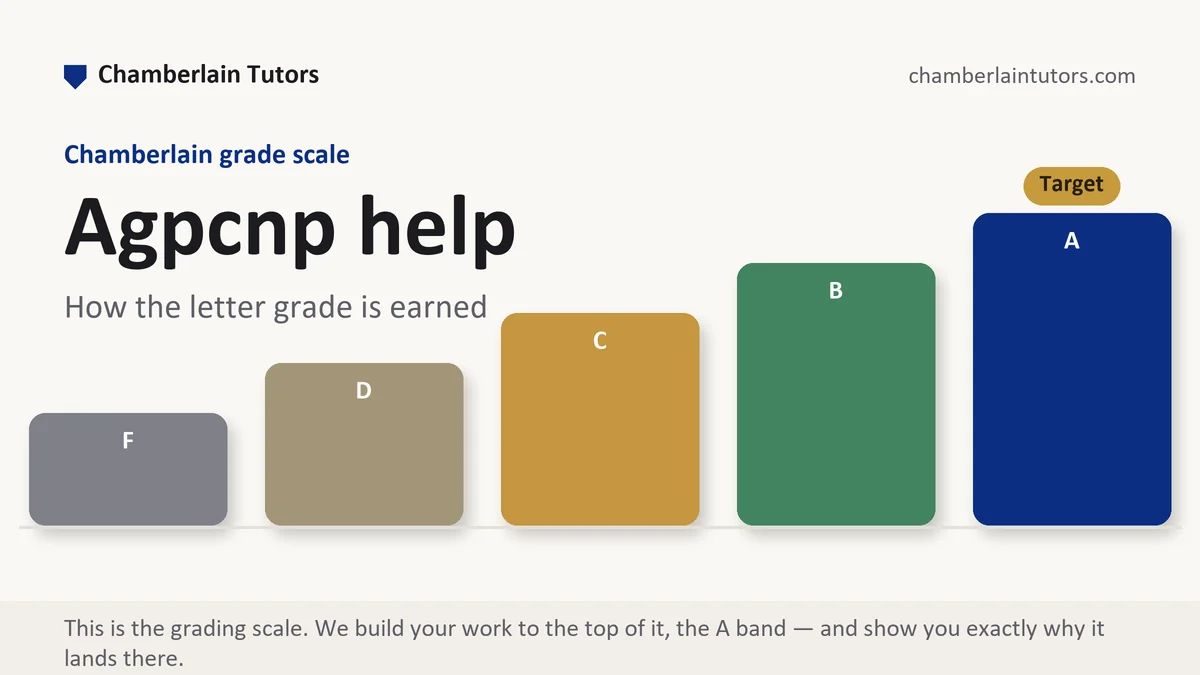
Adult-Gerontology Primary Care is Chamberlain's other adult-gerontology MSN track, and it is a different writing job from its acute care sibling. The patients are adolescents through the oldest old, seen across months and years rather than hours, so the graded argument is about long horizons: medication lists that grew for two decades, screening matched to age and risk, and what a person will realistically do between two appointments. Sessions run eight weeks with six start dates a year, the boards cannot be edited once posted, the track carries 625 clinical hours, and the specialty scale has no C band, so 84 is the pass line rather than 76. We draft the written work in that register inside 24 to 48 hours, rubric mapping shown.
What primary care writing has to prove
The mistake almost every new AGPCNP student makes is assuming the writing is easier because the patients are not crashing. It is not easier. It is differently hard, and the difficulty is that nothing forces your hand. In an acute case the patient's trajectory tells you what to argue about. In a primary care case you are handed a fifty-eight-year-old with three chronic conditions, eleven medications, a copay problem, and forty minutes, and the paper has to show that you chose what to do first and can defend the choice.
So the rubric rows here cluster around judgment rather than urgency. Did you individualize the target instead of quoting a population number. Did you reconcile the medication list rather than adding to it. Did you connect what the patient said about money, transport, or literacy to a plan that accounts for it, rather than recording it in the history and abandoning it. Did you commit to a follow-up interval and say what you will measure when the patient comes back. Those rows repeat across nearly every written deliverable in the track, which is the whole reason the arithmetic further down this page matters.
The population is also wider than the name suggests. Adult-gerontology primary care runs from adolescence upward, so one course can ask for a health maintenance plan for a nineteen-year-old and a deprescribing rationale for an eighty-eight-year-old inside the same session. Students who work in one setting write beautifully about one end of that range and thinly about the other.
The time horizon your written plan commits to
Read your week's rubric before you choose, since some assignments specify the format. Where the choice is yours, the horizon you write to decides which rows you can even answer. All three below are legitimate, and students default to the first one without noticing that they are defaulting.
| Horizon | What it demonstrates | Where it earns | What it costs |
|---|---|---|---|
| Today's visit only | Focused assessment, an accurate problem for today, an immediate plan you could carry out this afternoon. | The assessment and diagnosis rows, cleanly and quickly. | Chronic care and health promotion rows go unanswered, and in a primary care course those are usually the rows separating the mid band from the top of the scale. |
| The next follow-up cycle | Titration logic, monitoring, and what specifically you will measure when the patient returns. | Plan and evaluation rows, which tend to carry the heaviest point values on the rubric. | More writing, and every number you commit to has to be justified for this patient rather than borrowed from a guideline. |
| A twelve-month arc | Screening intervals matched to age and risk, immunization timing, a deprescribing plan, goals agreed with the patient. | Health promotion and individualized-goal rows, plus the coordination rows most students never reach. | The longest to write, and the easiest to drift into guideline recitation. Lose sight of the patient's constraints and it reads generic, which scores worse than a shorter honest plan. |
The practical default for graded work is the middle row plus one paragraph of the third. Commit to a follow-up interval and a monitoring parameter, then add a short paragraph on what the next year should look like and why. A plan that ends with return as needed is leaving points on the table in a track built around continuity.
Mid session and losing the same points every week?
Send the course, the week, the rubric, and last week's feedback. First premium sample free.
The one rubric row you keep losing, priced out
Primary care coursework is repetitive by design, because primary care is. That cuts both ways. Get a section right and you get it right eleven more times. Get it wrong and you get it wrong eleven more times, and nobody tells you loudly enough that it is the same section every week.
Here is what that costs. Take a course weighted 20 percent discussions, 45 percent weekly written work across six graded items, and 35 percent for a comprehensive final case. Substitute your own weights from the grading page in week one. Suppose the management plan row is worth 25 of the 100 points on each item, and you average 14 of those 25 every week because your plans name a treatment but never a follow-up interval or a monitoring parameter.
- Each written item lands at 89 rather than 100, so the category average is 89
- Written work contributes 0.45 x 89 = 40.05 instead of 45
- Discussions at 94 contribute 0.20 x 94 = 18.8
- A final case at 92 contributes 0.35 x 92 = 32.2
- Course total: 91.05
Now fix only that row. Nothing else about your knowledge or effort changes; you simply write the interval, the parameter, and the return precautions every time, and you average 22 of 25 instead of 14. Each item now lands at 97, the category contributes 0.45 x 97 = 43.65, and the same session finishes at 94.65 rather than 91.05.
Look at what that row is worth in the abstract. Losing 11 points of it on every item costs 0.45 x 11 = 4.95 points of your final grade. The distance from the A band at 94 down to the F line at 84 is ten points, so one repeated row spends half of your entire working range before the session even gets interesting. And the fix costs perhaps thirty to forty minutes per deliverable, which across six items is three or four hours spread over eight weeks. Nothing else available to you pays at that rate.
Which is why the highest-value five minutes in this track is reading the rubric feedback rather than the score. The score tells you how the week went. The comments tell you which row is quietly costing you five points a session, and it is almost always the same row.
Weighting your casework toward older adults, both directions
Most students here end up choosing, consciously or not, whether their written cases skew geriatric. Choose on purpose, because the tradeoff runs in both directions and neither answer is wrong for everyone.
For weighting geriatric: it is where the track's distinctive rubric rows live. Functional assessment, polypharmacy and deprescribing, cognition, caregiver context, and goals of care separate this track from a general adult one, and older patients give you something substantial to argue about on the page. Complexity is easier to write well than simplicity, because a plan requiring tradeoffs practically writes its own justification. It also matches the panel most graduates will carry.
Against: if every case you submit is over seventy-five, you never rehearse the writing for a twenty-four-year-old with a new diagnosis and a decade of prevention ahead of her. The health promotion rows for younger adults stay unpracticed, and they appear in a comprehensive assessment or on a certification exam either way. A grader reading your fifth paper about a similar patient also starts reading the sameness rather than the reasoning.
The workable version is a ledger rather than a rule. Keep a running list of the ages, sexes, and presentations you have written about this session, and deliberately spend two deliverables outside your comfortable band. Doing that in week two is free. Discovering the gap during a comprehensive assessment is not.
Where AGPCNP points quietly go
- A medication list that only grows. Adding a drug is half the job. If nothing in your plan reviews what is already there, asks whether it is still indicated, or names one thing you would consider stopping, the reconciliation row scores low no matter how good the new choice was.
- Screening named without an interval or a reason. Recommending a screening test is worth little on its own. Which test, at what interval, based on which age and risk factors, and what you will do with a positive result is the answer the row is built for.
- Universal targets applied to an individual. Quoting a population number for an eighty-nine-year-old with limited life expectancy tells a grader you copied rather than decided. Say what target you chose for this patient and why it differs.
- Constraints raised and then dropped. Cost, transport, health literacy, and caregiver availability get recorded in the history and then vanish from a plan that assumes none of them exist. The row is not testing whether you asked. It is testing whether it changed anything.
- Education written as facts instead of instructions. Three paragraphs of pathophysiology is not patient education. What to do, when, what to watch for, and when to come back, in language the patient can repeat back, is.
- Posting the discussion before rereading it. The boards cannot be edited after you submit, so the half-finished thought you meant to tidy is the version that gets scored. Write it, leave it, read it cold, post once.
What we draft, and what never leaves your hands
The graded academic writing is the service: case write-ups, management papers, evidence work, discussions and their replies, and the reflective assignments that sit beside a practicum. Drafts come back rubric-mapped so you can see the reasoning rather than only the prose, and you personalize and submit them yourself from your own account.
What we decline is not negotiable and does not move under deadline pressure. Chart documentation for a real encounter is a legal record of care you delivered, not coursework, and we do not touch it. Hour logs, preceptor evaluations, and site agreements are records of what you personally did and only you can honestly produce them. We do not contact your preceptor, your clinic, or your clinical coordinator, and we do not sign anything. We do not ask for your Canvas or My Chamberlain credentials. And if the remaining weight in a course cannot mathematically reach 84, we tell you that instead of selling you the rest of the session.
Two questions to put to any provider before money moves, including this one. Ask what happens when a returned draft misses the target you agreed on, who decides that, and how long the fix takes. Then ask them to name something they will not do. The second answer is more informative than the first, because a studio that has never turned work down has no line, and eventually that becomes your problem rather than theirs.