The last stage of a capstone asks you to argue that a nurse practitioner exists where a student used to be. The genre is a summative synthesis or portfolio piece: your opening charter revisited against evidence, competence claimed at stated levels in published competency language, the gaps that remain named without flinching, and a transition plan that reaches past the end of the program into a first year of practice. It is the final piece of graduate writing in the degree and it should read like it. The clinical record stays entirely yours: hours, encounter logs, competency sign-offs and preceptor evaluations are your own verified documentation and are never drafted, reconstructed or estimated with help. Your section may print this as NR 580 or NR580; it is the same course. Chamberlain publishes no syllabi outside Canvas. The placement here is our teaching judgment from the course's catalog arc; your section's rubric decides what your week actually asks.
What NR-580 Week 8 asks for
What is a closing capstone paper actually arguing? That you are safe to practise and that you know where you are not. Those two claims sound as if they pull against each other and they do not; the second is what makes the first credible. A student who writes that she is fully prepared across every domain has said something no faculty member believes about anyone at this stage, including the strongest candidates they have taught. A student who claims competence precisely, names three areas where she will be seeking support in her first year, and describes how she will get it has written the document the profession actually wants from a new graduate.
Picture the last day on the clinic floor. It is a Thursday at the community health center where you started in week one as somebody being shown things, and this morning the schedule has your name on rooms two and four. A hypertension follow-up, a new patient with a bag of medications, a fall in an eighty-year-old, a woman whose fatigue is still not explained. You work them. Your preceptor is available and mostly not needed. At the end of the day she signs what she signs and you go home, and the eight weeks have to become an argument on paper by Sunday. The argument is not that the days went well. It is that a specific set of capabilities now exists, evidenced by specific written work, at levels you can name.
Deliverables at this stage typically include a summative synthesis or portfolio narrative, a self-evaluation against program outcomes or competencies, and often a professional development or transition plan. Expect the heaviest rows on evidence of competency attainment and on the quality of the forward plan. If a final discussion runs, treat it as seriously as the paper; closing threads are read by faculty settling borderline grades, and posts do not reopen after submission in Canvas.
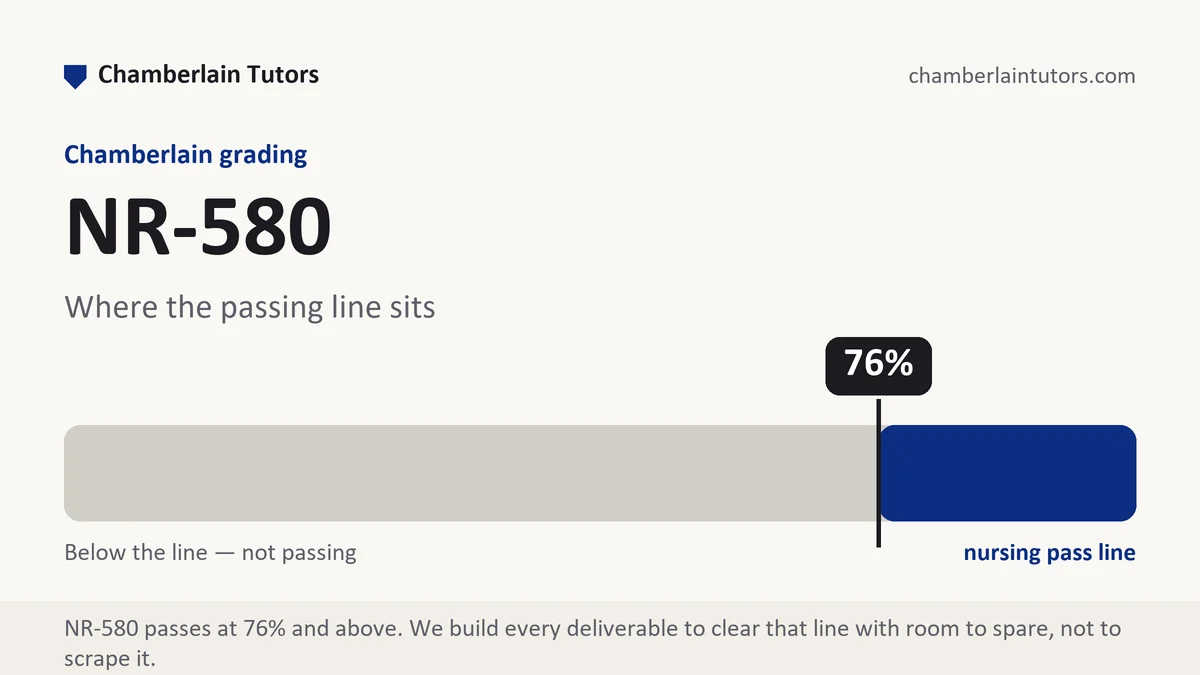
One arithmetic note about an eight-week capstone. This submission lands when the average is largely fixed, which matters in both directions. Core nursing courses carry a 76 percent floor, so a student in the low seventies has few levers left and this is one of them. A student well clear of the line has a different incentive: this is the final piece of writing a faculty member will read with your name on it before you ask them for a reference.
The placement boundary, stated plainly
This manual supports the written layer only, and the end of a capstone is where that boundary bears the most weight in the whole program. Your hour totals, encounter logs and categories, competency sign-offs, evaluation forms and every signature attached to them are your own verified record. They are never drafted for you, never reconstructed from memory with outside help and never estimated to reach a total. A capstone sits directly in front of certification eligibility and licensure, and the record behind it has to be yours without qualification. If anything is incomplete, the route is your own contemporaneous notes and an immediate conversation with your faculty member, not assistance.
The self-evaluation your preceptor countersigns is in the same category: it is your attestation about your own practice, and its content belongs to you alone. The scholarly synthesis paper is a different object entirely and is teachable in full. Structuring the argument, building the evidence table, calibrating competence claims, choosing which written artifacts to present, anchoring the whole thing in published competency language and getting the prose into graduate register are writing problems with writing answers.
De-identification applies across the whole document and is harder here than anywhere else, because a synthesis aggregates an entire session in one place. Removing names does not help when a paper describes a specific clinic in a specific region across eight weeks. Generalize the site to a type, generalize the roles, and present every patient as a clinical picture. The finished paper should be readable by anyone at your placement without a single person or organization being identifiable in it.
The NR-580 Week 8 method, step by step
Seven moves that turn the end of a capstone into an argument for readiness.
-
Reopen your week-one charter first
Put the three families of objectives at the top of a blank file. The closing paper is measured against them whether or not the instructions say so, and a synthesis that quietly writes toward different goals tells the grader the charter was never operative.
-
Build the evidence table before any prose
One row per objective: the claim, the written artifact that demonstrates it, the competency language it maps to, and a met, partly met or not met judgment. Papers written out of a filled table finish; papers written toward one stall.
-
Claim competence at a stated level, in published language
Performing with consultation, performing independently and able to teach are three different claims. Say which applies to each capability, and say it in the vocabulary of the competency document you have cited since the first stage.
-
Show one capability changing across the session
Take a single ability, most usefully diagnostic reasoning, and demonstrate the change with two de-identified encounters from different points. What you asked, what you missed, what you would now ask first. One worked pair outweighs a list of claims.
-
Cover all three strands, not just the clinical one
Clinical practice, the scholarly component and certification readiness were three commitments in week one. A synthesis that reports only clinical growth leaves two strands unevidenced and usually loses rows nobody told the student existed.
-
Write the first-year plan with specifics
Where you will seek consultation, what continuing education you will pursue, what mentorship arrangement you will ask for, and what you will do in the first month of practice when you meet something outside your competence. Vague intentions are visible instantly.
-
Cut every sentence that thanks, apologizes or inspires
Gratitude to your preceptor belongs in a message to her. Apology for shortfalls belongs nowhere; state them and plan for them instead. And a closing line about the privilege of caring for patients pulls the register down at the exact moment the grader forms a final impression.
A layout and word budget for a transition-to-practice synthesis
The frame our tutors keep beside a final capstone submission, sized for roughly 1,800 to 2,200 words. It is our own outline rather than anything the university issues, and your week's rubric outranks it wherever the two disagree. Scale proportionally if your assigned length differs, and drop any section your scoring rows do not ask for.
| Section | What belongs in it | Word target |
|---|---|---|
| The readiness claim | What you can now do that you could not in week one, in one sentence, before any account of the placement. | 90 to 120 |
| The clinic in brief | Type of clinic and population, generalized past identification, with only the detail the argument uses. | 110 to 150 |
| Clinical objectives against evidence | Each week-one clinical objective revisited with its artifact, its competency mapping and a met or partly met judgment. | 380 to 460 |
| Reasoning shown changing | One capability shown changing across two de-identified encounters, with the reasoning visible in both. | 280 to 340 |
| Scholarly strand | What the capstone paper established, what it could not settle, and what you would do with it in practice. | 200 to 250 |
| Certification readiness | Where the gap analysis stands now, what closed, what did not, and your examination window with its reasoning. | 200 to 250 |
| Competence by level | Each claimed capability placed at consultative, independent or teachable, in published competency vocabulary. | 230 to 280 |
| First-year transition plan | Consultation routes, continuing education, mentorship sought, and your rule for meeting the edge of competence. | 280 to 350 |
Evidence craft for a summative capstone paper
Cite the competency framework you opened with. Continuity between the week-one charter and the closing synthesis is itself scored in most versions of this rubric. Naming the same published document, with its issuing body and year, lets a grader read the session as a designed arc rather than an assembly at the end.
Evidence means artifacts, not adjectives. A claim that your diagnostic reasoning improved is supported by pointing at a specific reasoning trail or encounter analysis and saying what it contains. Confidence and competence move independently, and summative rubrics are built to catch the gap.
Use the role-transition literature. The move from registered nurse to certified nurse practitioner is well studied, including the difficulties of the first year in practice. A transition plan built on that literature is an argument; one built on personal expectation is a paragraph of intentions.
Keep reflective sections analytic. Reflection in graduate work examines a decision: what you believed, what you had, what you did, what happened, what changes. Reflection that reports emotional states is a different genre and scores as description wherever it appears.
Any number arrives with its base and its window. If you characterize the encounter mix your placement offered, take the counts from your own record rather than estimating them for the paper, and report them out of a total across a stated period. Forty-seven of 260 encounters over eight weeks is a figure a reader can weigh.
Six mistakes that cost points in this week's territory
- A farewell in place of an argument. Warmth toward the site is real and unscoreable, and it displaces the evidence the rows exist to find.
- Two strands missing. A synthesis covering only clinical practice leaves the scholarly and certification commitments unevidenced, and both were in your own charter.
- Uniform attainment claimed. Everything fully met after eight weeks is less credible than one honest shortfall with a plan, and rubrics reward the honesty explicitly.
- Competence without a level. I am competent in chronic disease management means little; competent to manage stable multimorbidity independently with consultation for renal dosing means something checkable.
- Hour totals offered as achievement. Completing the required hours is a condition of passing, and presenting it as evidence tells the grader the two are still fused.
- A transition plan made of intentions. Continue learning and stay current could have been written in week one by anyone, and they answer none of the questions the section asks.
Before you submit
- Your readiness claim appears in the first paragraph
- Every week-one objective is revisited by name with an artifact attached
- All three strands, clinical, scholarly and certification, are evidenced
- Each competence claim carries a level in published competency vocabulary
- One capability is shown changing across two de-identified encounters
- At least one objective is honestly reported as partly met, with a plan
- The first-year plan names consultation routes, education and a rule for the edge of competence
- Neither the clinic nor any patient, family member or colleague is identifiable
Closing out NR-580 this week?
Send the instructions and the rubric out of Canvas. A premium original draft of the written synthesis comes back in 24 to 48 hours with objectives mapped to artifacts, competence claimed at stated levels and a transition plan built from the role-transition literature, and revisions run until the grade lands. Your hours, logs and evaluations stay entirely your own.