The closing stage of a palliative practicum asks you to argue, in writing, what 125 precepted hours actually produced. The genre is summative synthesis: your opening objectives revisited against evidence, competence claimed at a stated level and defended with de-identified examples, the gaps that remain named honestly, and a plan for closing them after the session ends. It is an argument, not a farewell. The clinical record stays entirely yours: hours, logs, encounter counts and preceptor evaluations are your own verified documentation and are never drafted, reconstructed or estimated with help. Your section may print this as NR 579 or NR579; it is the same course. Chamberlain publishes no syllabi outside Canvas. The placement here is our teaching judgment from the course's catalog arc; your section's rubric decides what your week actually asks.
What NR-579 Week 8 asks for
What changes about your writing when there is nothing after it? Everything, if you let it. Closing submissions in eight-week sessions are written by tired students on a short clock, and they tend to collapse into two failure modes: gratitude, which reads as a thank-you note, and inventory, which reads as a list of things that happened. The stage is asking for neither. It wants a claim about your capability, at a specific level, supported by evidence drawn from your own placement, and it wants that claim tested against the objectives you wrote in the first stage.
Consider the last Friday at a community health center where you have spent two months on a palliative team. The nurse practitioner you have followed hands you a patient at nine in the morning: a woman in her seventies with advanced renal disease who has decided against dialysis and whose son has not accepted the decision. In week one you would have observed. Today you assess the symptom burden, structure the conversation, recognize where the son's questions are actually about his own guilt, and write it up afterwards in a form somebody else could act on. That is the arc your closing paper has to argue, and the argument is only as strong as the specific before-and-after evidence attached to it. Saying you grew is a feeling. Setting a week-one written analysis beside a week-seven one and naming exactly what improved in the reasoning is a demonstration.
Deliverables at this stage typically include a summative reflective paper or portfolio-style synthesis, sometimes with a final posted response and often with a self-evaluation component. Expect the heaviest scoring rows to sit on evidence of competency attainment and on honest identification of continuing learning needs. If your section runs a final discussion, treat it with the same care as the paper; closing threads are read by faculty deciding a borderline grade, and posts do not reopen after submission in Canvas.
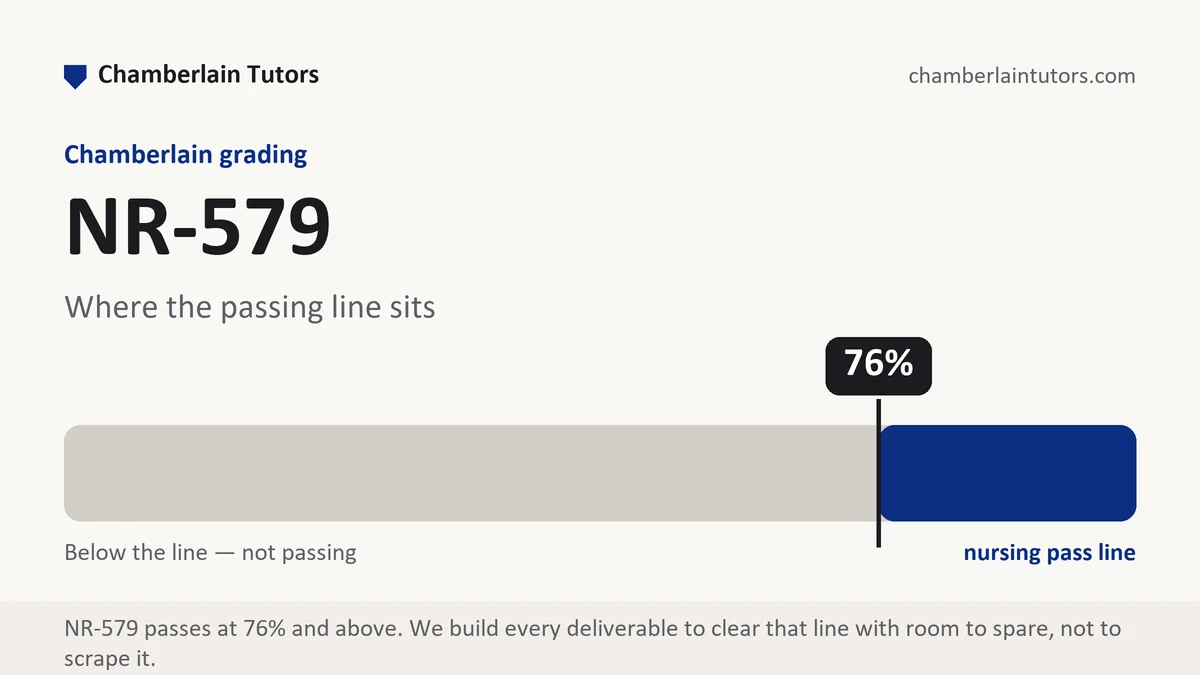
One structural note about eight-week sessions. This submission lands when your average is already mostly fixed, which cuts both ways. If you are near the 76 percent floor that core nursing courses carry, a strong closing paper is one of very few remaining levers. If you are comfortably clear, the temptation is to coast, and closing papers are also the ones faculty remember when they are later asked for a reference.
The placement boundary, stated plainly
This manual supports the written layer only, and the boundary matters most at the end of a practicum because this is the point where paperwork pressure peaks. Your hour totals, encounter logs, competency sign-offs, evaluation forms and any signature attached to them are your own verified record. They are never drafted for you, never reconstructed from memory with outside help and never estimated to reach a total. If your log is incomplete, the answer is your own contemporaneous notes and an early conversation with your faculty member, not assistance. The same applies to a self-evaluation form that your preceptor countersigns: the content is your attestation about your own practice, and it belongs to you alone.
The scholarly synthesis paper is a different object, and it is squarely on the teachable side. Structuring the argument, building the evidence table, calibrating competence claims, choosing which encounters to write about, anchoring the whole thing in published palliative competency language, and getting the prose into graduate register are all writing problems with writing answers.
De-identification applies to the final paper exactly as it did in week three, and it applies more broadly than students expect at this stage, because a synthesis draws on your whole placement. Removing names is not enough when a paper describes a small service in a named region across a whole session. Generalize the site, generalize the roles, and write every patient as a clinical picture rather than a person: an adult in her seventies with advanced renal disease who declined dialysis, not a description a colleague would recognize. Your closing paper should be readable by anyone at your site without a single person being identifiable in it.
The NR-579 Week 8 method, step by step
Seven moves that turn the end of a placement into a scored synthesis.
-
Reopen your week-one objectives before you write anything else
Put them at the top of a blank file. The closing paper is graded against them whether or not the instructions say so, and a synthesis that quietly writes toward different goals than the ones it set tells the grader the plan was never operative.
-
Build an evidence table before you build paragraphs
One row per objective: what you claimed you would develop, the written artifact that shows it, the specific competency language it maps to, and a one-line judgment of whether it was met, partly met or not met. The paper writes itself out of a filled table and stalls without one.
-
Claim competence at a stated level, not in the abstract
There is a difference between performing an assessment with supervision, performing it independently, and being able to teach it. Say which one you have reached for each ability, and say it in the vocabulary of the competency document you have been citing since week one.
-
Show one before-and-after pair in detail
Take a single ability and demonstrate the change with two de-identified examples from different points in the session. What you assessed, what you missed, what you would now ask first. One worked pair is worth more than five claimed improvements.
-
Write the unmet objective honestly
Almost nobody meets everything, and rubrics in this genre reward accurate self-appraisal over uniform success. Say which objective fell short, say why in structural terms rather than apologetic ones, and say what would close it. Faculty read overclaiming as a competency problem in itself.
-
Connect the placement forward to the next stage of the program
Name what this practicum has set up for the work that follows it and what you will carry into an independent-practice setting. A synthesis that ends inside the placement has treated the course as a container rather than a step.
-
Cut every sentence that thanks somebody
Gratitude toward your preceptor and your site is genuine and belongs in an email to them. In the paper it consumes words that scoring rows do not cover, and it pulls the register down from analysis into sentiment at exactly the moment the grader is forming a final impression.
A layout and word budget for a closing synthesis
The frame our tutors keep beside a final practicum submission, sized for a paper of roughly 1,500 to 1,800 words. It is our own outline rather than anything the university issues, and your week's rubric outranks it wherever the two disagree. Scale proportionally if your assigned length differs, and drop any section your scoring rows do not ask for.
| Section | What belongs in it | Word target |
|---|---|---|
| The capability claim | What you can now do that you could not do in week one, stated in one sentence before any account of the placement. | 80 to 110 |
| The placement in brief | Type of service and population, generalized enough to be unidentifiable, and only the detail the argument needs. | 110 to 150 |
| Objectives against evidence | Each opening objective revisited with its artifact, its competency mapping and a met, partly met or not met judgment. | 380 to 460 |
| The worked before-and-after | One ability shown changing across two de-identified encounters, with the reasoning made visible in both. | 280 to 340 |
| Competence stated by level | Each claimed ability placed at supervised, independent or able-to-teach, in published competency vocabulary. | 200 to 250 |
| Continuing learning needs | What remains unmet, why in structural terms, and the specific plan that would close it after the session. | 230 to 290 |
| Forward statement | What this placement sets up for the next stage of the program and for independent practice. | 90 to 130 |
Evidence craft for summative practicum writing
Cite the same competency document you opened with. Continuity between a week-one plan and a week-eight synthesis is itself scored in most versions of this rubric. Naming the same published palliative framework, with its issuing body and year, lets a grader see the arc as deliberate rather than assembled at the end.
Evidence means artifacts, not adjectives. A claim that your symptom assessment improved is supported by pointing to a specific written analysis and saying what it contains, not by describing your confidence. Confidence and competence move independently, and rubrics in this genre are built to catch the difference.
Bring literature into the closing paper, not just the middle ones. Summative papers are where citation density collapses, usually because students are writing about themselves and forget that claims about what palliative practice requires still belong to published sources. Keep supporting the standard you are measuring yourself against.
Keep the reflective sections analytic. Reflection in graduate work means examining a decision: what you believed, what information you had, what you did, what happened, and what you would change. Reflection that reports emotional states is a different genre and scores as description.
Any number arrives with its base and its window. If you characterize the mix of encounters your placement offered, give counts out of a total across a stated period rather than proportions floating alone, and take those counts from your own record rather than estimating them for the paper. Thirty-one of 88 encounters over eight weeks is a figure a reader can weigh.
Six mistakes that cost points in this week's territory
- A thank-you note in place of a synthesis. Warmth toward a site is real and unscoreable, and it displaces the evidence that the rows are actually looking for.
- Objectives quietly rewritten to match what happened. Graders have your week-one document, and a synthesis measured against goals nobody set reads exactly as it is.
- Uniform success across every objective. Claiming everything was fully met in eight weeks is less credible than one honest shortfall, and rubrics reward the honesty explicitly.
- Competence claimed without a level. I am now competent in goals-of-care conversations means little; competent with supervision in structured goals-of-care discussions means something checkable.
- Hour totals used as the achievement. Completing the required hours is a condition of passing, not evidence of learning, and offering it as evidence tells the grader the two are still fused in your thinking.
- A whole-session paper that identifies the site. Aggregated detail identifies more readily than a single case does, and the closing paper aggregates by design.
Before you submit
- Your capability claim appears in the first paragraph
- Every week-one objective is revisited by name with an artifact attached
- Each competence claim carries a level: supervised, independent or able to teach
- One ability is shown changing across two de-identified encounters in detail
- At least one objective is honestly reported as partly met or unmet, with a plan
- The same published competency framework you cited in week one appears again with its year
- No thanks, no apology and no inspirational closing sentence survives the final read
- Neither the site nor any patient, family member or colleague is identifiable
Closing out NR-579 this week?
Send the instructions and the rubric out of Canvas. A premium original draft of the written synthesis comes back in 24 to 48 hours with objectives mapped to artifacts and competence claimed at stated levels, and revisions run until the grade lands. Your hours, logs and evaluations stay entirely your own.