NR-558 Informatics for Professional Nursing Practice carries three theory credits with a practicum value of zero, so no hours attach to it. It applies healthcare informatics, emerging technology trends and ethical and legal considerations to professional practice. The deliverable that recurs is an evaluation: a technology described honestly, the evidence behind its claims weighed, and the ethical and legal consequences of adopting it worked out before anyone is asked to use it.
What NR-558 actually grades
The gap between what a tool does and what it is said to do. Rubric rows asking you to evaluate a technology are asking for a judgment supported by evidence, and the most common submission instead describes features fluently and concludes that the tool is promising. A feature list is a brochure. An evaluation names the practice problem, states what would count as the tool solving it, and reports whether anyone has shown that happening.
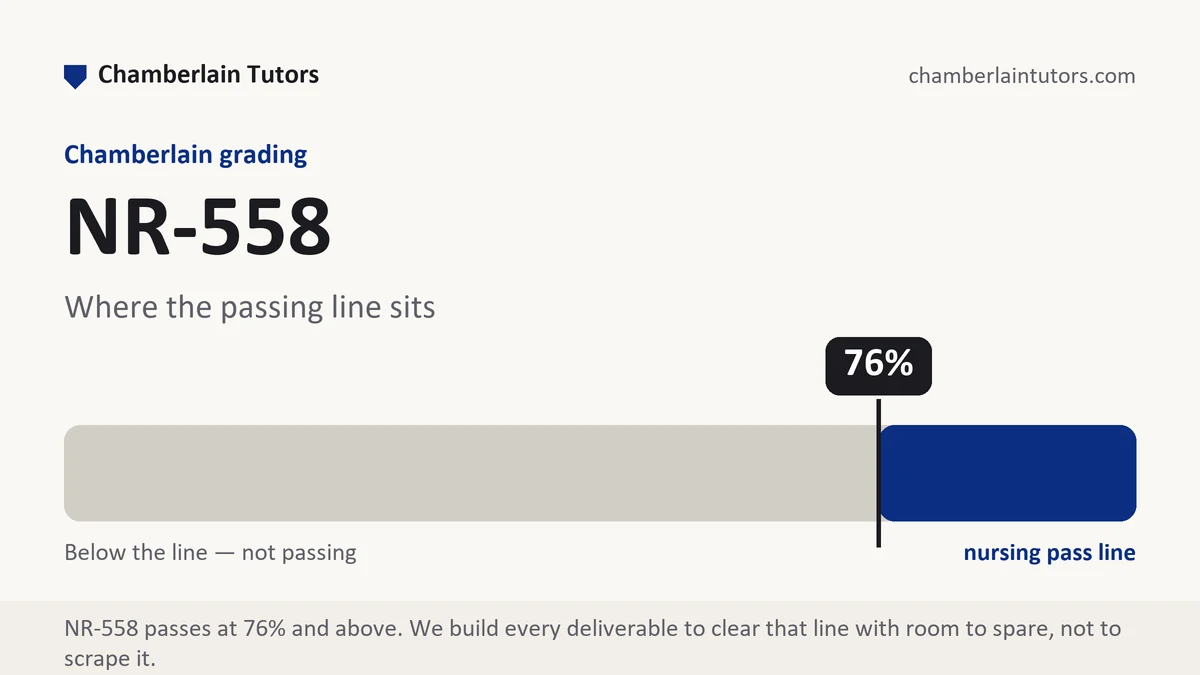
The second axis is ethical and legal reasoning that stays in its lane. You are expected to identify the obligations that attach to health data and to reason about who benefits and who carries the risk, without drifting into legal conclusions you are not positioned to give. Chamberlain's 76 percent floor for core nursing courses applies, and the accelerated route runs eight-week sessions with weekly deliverables, so a couple of descriptive papers early on shape an average that later work has to climb. Supplementary work does not repair a weighted average that has already settled.
How we help in this course
We draft technology evaluations, emerging trend papers, privacy and data-flow analyses, ethical case write-ups, adoption and readiness assessments, discussion responses and the session project. Our drafts separate the description of a tool from the evidence about it, which is the structural move that lifts these papers out of the brochure register.
We work from published literature and from what your prompt supplies. We do not access clinical systems, request vendor materials in your name, handle patient data, or provide legal advice about your obligations at work. Where a question is genuinely a legal or compliance question in your own setting, that goes to your organization rather than into a class paper.
In NR-558 right now?
Send the technology you picked and the rubric from Canvas. First premium sample free, floor-checked, back in 24 to 48 hours.
Read the rubric before the prompt
Technology assignments invite enthusiasm, and the guide is the thing that converts enthusiasm into a score. Lift the criterion rows into an empty file and cut each to its verb: describe, evaluate, apply, analyze, justify. Then mark which rows can be satisfied without evidence. Usually only the description row can, which tells you that everything else in the paper needs a citation attached to a claim rather than to a concept.
Then price the rows. Take a 1,400 word paper with five rows weighted 30, 20, 20, 20 and 10 percent. Multiply through: 420 words for the first, 280 for each of the next three, and 140 for the last. Three consecutive rows at 280 words is the guide telling you it wants three sections of equal seriousness, which in this course is normally evidence, ethics and legal considerations. Students who write 600 words describing the technology and 120 on ethics have inverted that instruction and will see it in the feedback. Title page and references sit outside the count unless your guide says otherwise.
Keep the five numbers beside your headings and audit them when the description is finished. Description running long is the diagnostic sign of a paper that has not yet found a claim to test.
The shape of an emerging technology evaluation
Whatever the section calls it, the dominant deliverable here decides whether a tool should be used and on what conditions. These are the parts that carry marks.
| Part | What it must establish | What a weak version does |
|---|---|---|
| The tool, functionally | What it takes in, what it produces, and what a clinician is expected to do with the output. | Lists product features in marketing order. |
| The practice problem | The specific failure it is meant to address, stated so it could be measured. | Says the tool improves efficiency and safety. |
| Evidence for the claim | Studies of the tool in use, with setting, population and outcome named. | Cites the vendor and a conference summary. |
| Fit with existing work | Where in the day it lands, who is displaced, what it adds to a shift. | Assumes adoption is a training problem. |
| Data flow | What is collected, where it goes, who can see it, how long it is kept. | Mentions privacy without tracing the data. |
| Legal obligations, described | The categories of obligation that attach and the source that sets them, cited. | Delivers a verdict on whether something is lawful. |
| Ethical analysis | Who gains, who carries the risk, who is excluded, and what consent is realistic. | Four principles defined and none applied. |
| Conditional decision | Adopt, pilot or decline, with the conditions and the failure plan attached. | Concludes that the technology holds great potential. |
Evidence and citation craft at this level
Technology evidence decays faster than anything else you will cite, and four habits keep it usable.
Currency, with a shorter fuse than usual. Where your guide sets no rule, five years is the standard line, and for tools and products even that is generous, because versions, integrations and regulatory posture change inside a year. Give the study year and, where you can, the version or generation of the tool studied. An evaluation of an earlier generation is evidence about a different product wearing the same name.
Say what kind of study it was before you use the result. The important distinction here is between a validation study, which tests whether a tool produces the right output on assembled data, and a deployment study, which tests what happens when real staff use it in a real week. Ten words of setup, such as validated retrospectively on a curated data set, tells the reader immediately how far the finding travels. Tools that perform well in validation and poorly in deployment are the rule rather than the exception.
Verbs the evidence can pay for. A tool that identifies risk has not reduced it, and a tool that produces an alert has not changed an outcome, because both depend on what a human then does. Write flagged, identified, was associated with earlier recognition rather than prevented or improved unless a deployment study with a comparison supports it. Vendor material and press coverage both use causal verbs freely and neither can pay for them.
Denominator and window on every performance figure. Sensitivity and specificity mean little without the population they were measured in, and an accuracy figure is close to meaningless when the outcome is rare. Write identified 84 of 97 events in a cohort of 12,000 admissions over one year rather than 87 percent accurate, and where you cite alert burden give it a base, such as alerts per 1,000 orders, since burden is what determines whether staff keep reading them.
What separates a passing evaluation from a strong one
A passing evaluation describes a current technology accurately, notes that privacy must be protected, and concludes that adoption would benefit practice. It scores in the high seventies to low eighties because it never tests a claim and never names anyone who might be harmed.
Strong evaluations do three things. They state in advance what would count as the tool working, then report whether that has been shown, which turns the paper from description into evaluation in a single structural move. They trace the data rather than gesturing at privacy: what is captured, which vendor holds it, who inside the organization can query it, what happens to it if the contract ends. And they name who is excluded or disadvantaged, because most emerging tools assume a device, a connection, a language and a level of literacy, and the patients who fail those assumptions are the ones your ethics section exists for. Close with a decision that carries conditions and a failure plan, including what happens when the system is down, and the applied rows are satisfied.
Mistakes that cost points here
- Features described as benefits. Integrates seamlessly and provides real-time insight are sales copy. Say what a nurse does differently on shift.
- Vendor evidence taken at face value. Use it to establish what a product claims, never to establish that the claim is true.
- Ethics as a glossary. Naming four principles without a case where two conflict leaves the ethics row unscored.
- Legal conclusions. Describe the obligations and cite the source; do not rule on whether a specific practice is permitted, and never present a paper as compliance guidance.
- No failure plan. Every clinical technology fails eventually. A paper with no downtime or fallback section has not thought past the demonstration.
- Posting an unchecked claim to the board. Discussion responses do not reopen once submitted at Chamberlain, so an accuracy figure quoted without its population stays visible all week. Verify first, then paste.
Questions NR-558 students ask
How do I write the legal section without giving legal advice?
What counts as an emerging technology for this paper?
What if the only evidence I can find comes from the company that sells it?
Where NR-558 sits in Chamberlain's programs
Open the exact program map for sequence, credit, and option context. The current student schedule and syllabus remain authoritative after transfer evaluation, electives, state rules, and approved plan changes.
The weeks, one by one
Week 1
In a pediatric practice the immunization history for one four-year-old can live in four places at once: the state registry, the chart the family brought from their last state, a scanned school form, and whatever the parent remembers. Read the full Week 1 manual.
Week 2
A number on a scale in a pediatric clinic travels a long way before it does anything useful, and tracing that journey is the whole exercise in the second stage of NR-558. Read the full Week 2 manual.
Week 3
Well-child visit templates are where the electronic health record shows its true design, because a fifteen-minute appointment with a two-year-old has to carry growth, development, immunization, anticipatory guidance and a parent's actual question, and the template decides which of those gets. Read the full Week 3 manual.
Week 4
Somebody is going to propose putting a connected inhaler sensor into a pediatric asthma population, and the question that decides whether it is a good idea is not what the device does but whether anyone has shown it changing an outcome anybody cares about. Read the full Week 4 manual.
Week 5
Proxy access to an adolescent's patient portal is the sharpest privacy problem in family practice, and it is a perfect subject for the stage where NR-558 turns to data protection. Read the full Week 5 manual.
Week 6
Consider a family practice that switches its well-child recall entirely to text message reminders and watches its no-show rate fall, then discovers a year later that the families who dropped off the schedule are the ones whose phone numbers change every few months. Read the full Week 6 manual.
Week 7
Hand every family practice front desk a tablet for patient intake and by the third week half of them are back on paper, not because the tablet failed but because nobody decided who charges them, who cleans them, what happens when a grandmother arrives with a toddler and no free hands, and who. Read the full Week 7 manual.
Week 8
Six months after a pediatric practice moves its immunization recall to an automated schedule, somebody will say it worked, and the closing stage of NR-558 is where you learn what that sentence has to contain before anyone should believe it. Read the full Week 8 manual.