Well-child visit templates are where the electronic health record shows its true design, because a fifteen-minute appointment with a two-year-old has to carry growth, development, immunization, anticipatory guidance and a parent's actual question, and the template decides which of those gets clicked and which gets typed into a box nobody will ever read again. The third stage of NR-558 normally turns to the record itself: what it does well, what it costs the clinician, what structured and unstructured capture buy and lose, and how to write about all of that with evidence instead of grievance. Your section may print this as NR 558 or NR558; it is the same course. Chamberlain publishes no syllabi outside Canvas. The placement here is our teaching judgment from the course's catalog arc; your section's rubric decides what your week actually asks.
What NR-558 Week 3 asks for
Writing about the electronic record at graduate level means writing about design choices and their consequences, not about how a particular product feels. Three axes carry almost every strong paper in this territory. The first is structure: which data is captured in coded, countable fields and which is captured as free text, and what each choice makes possible or impossible later. The second is burden: what documentation costs in time, in attention during the encounter, and in work carried home. The third is safety: where the interface helps a clinician avoid an error and where it manufactures a new one.
The two-year-old's visit puts all three on one screen. Growth measurements go into coded fields and become plottable and countable. Developmental screening may be coded or may live in a free-text note, and the difference decides whether the practice can ever answer how many of its toddlers were screened on schedule. Immunizations are coded and often exchanged with an external registry, which introduces reconciliation. Anticipatory guidance is usually template text that a clinician accepts wholesale, which is why so much of it is identical across children who have nothing in common. And the parent's actual question, the one about the sleep, ends up in a free-text line at the bottom, invisible to every report the organization will ever run.
The register problem in this stage is stronger than anywhere else in the course. Every nurse has grievances about the record, and grievance is not analysis. The move that converts one into the other is naming the design decision behind the annoyance. Too many clicks is a complaint. A template that requires nine discrete entries to record a single screening result, where the underlying standard defines three, is a design observation with a consequence attached, and it can be supported from published work on documentation burden.
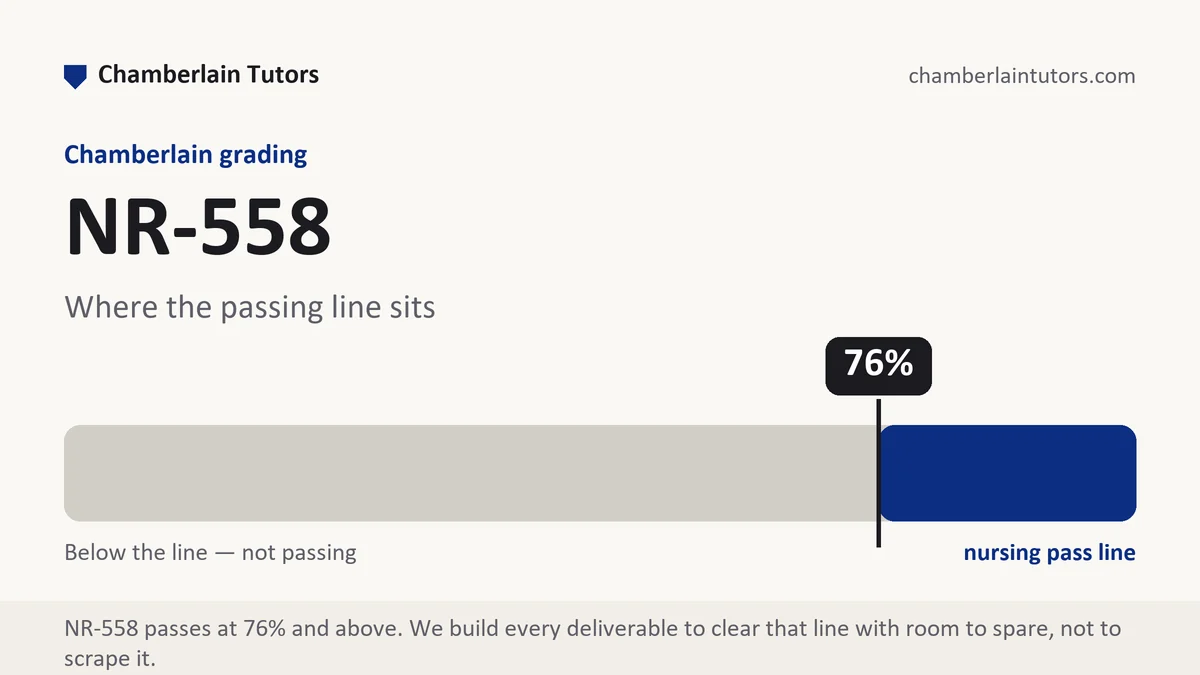
By the third stage of an eight-week session the deliverables usually carry real weight and the 76 percent floor for core nursing courses is close enough to matter. Expect an evaluative paper on the record or on a component of it, sometimes with a usability or burden framework named, and often a discussion post. Posts do not reopen once submitted in Canvas.
The NR-558 Week 3 method, step by step
Six moves for evaluating a clinical record system in writing.
-
Bound the object before you evaluate it
Do not evaluate the record. Evaluate one module, one template, one workflow inside it. A paper on a single well-child template can be specific and evidenced in 1,400 words; a paper on an entire system in the same space can only be general, and general is what the specificity rows are penalizing.
-
Name a published evaluation framework and use its categories
Usability, safety and documentation burden all have established assessment approaches in the health informatics literature. Choose one, cite it with its authors and year, and structure your evaluation under its categories rather than under headings you invented. A grader can then check your reasoning against a standard.
-
Classify the data your object captures as structured or unstructured
Go field by field and mark what is coded and countable against what is free text. Then say, for each unstructured item, what question the organization consequently cannot answer. This single classification pass produces more analytic content than any other step in the paper.
-
Quantify burden with something observable
Count the discrete entries a task requires, time the task across several repetitions, or count how many screens a clinician must visit to assemble one picture. Any of these is a measurement with a base and a window, and any of them beats a paragraph asserting that documentation takes too long.
-
Identify one place where the design creates a risk
Look for defaults that carry forward, values that copy from a previous visit, alerts that fire so often they are dismissed reflexively, and fields where a unit or a route can be entered ambiguously. Describe the mechanism of the risk rather than asserting that the system is unsafe, and support it with published work on the same class of problem.
-
Recommend at the level your evidence reaches
If your evidence is about one template, your recommendation is about that template. Configuration changes, field additions and default removals are all legitimate and defensible conclusions. Recommending a system replacement on the strength of one template analysis is the overreach that ends otherwise strong papers.
Evaluate the record: sections and word targets
Our frame for a record evaluation paper of roughly 1,300 to 1,600 words. This is our own outline rather than anything the university issues, and your week's scoring guide outranks it wherever the two disagree. If your guide names its own framework, replace our category labels with its own.
| Section | What belongs in it | Word target |
|---|---|---|
| Object and boundary | The specific module, template or workflow under evaluation, its users, its frequency of use, and what is deliberately excluded. | 110 to 150 |
| Framework, cited | The evaluation approach chosen, its authors and year, and the categories you will use, listed before they are applied. | 140 to 180 |
| Structured versus unstructured capture | A field-level account of what is coded and what is free text, with the reporting consequence of each unstructured item. | 280 to 340 |
| Documentation burden | An observable measure such as entry counts, screen counts or timed repetitions, with the base and window stated. | 230 to 290 |
| Safety and risk mechanism | One specific design feature that can produce an error, described mechanically and supported by literature on that class of risk. | 230 to 280 |
| Recommendation and its ceiling | Changes proportionate to the evidence, with an explicit statement of what this evaluation cannot support. | 180 to 230 |
Evidence craft for record evaluation
Cite studies of documentation burden rather than asserting it. The time cost of clinical documentation is a measured area with published findings, and a sentence anchored to one of those studies is worth ten sentences of personal testimony. Name the setting and the clinician group in the study, since a finding from one specialty does not transfer silently to another.
Report your own measurements like measurements. If you counted entries, say how many tasks you counted across how many observations. If you timed something, say how many repetitions and over what period. Fourteen discrete entries across five observed screening episodes is data. A lot of clicks is not, and the difference is a scoring row.
Separate the product from the configuration. Most of what frustrates clinicians is how a system was configured locally rather than what it can do, and a paper that confuses the two argues against the wrong thing. Where you cannot tell which is which, say so, and note that the distinction changes the remedy entirely.
Use interoperability language precisely. Systems that exchange data, systems that exchange data a receiving system can act on, and systems that merely transmit documents are three different situations with three different names in the literature. Precision here is directly graded in an informatics course, and imprecision is easy for a grader to spot.
Acknowledge what the record does well. An evaluation that finds only faults reads as a grievance, and balance is usually an explicit criterion. Legibility, availability across sites, decision support that genuinely helps, and the simple fact that a plotted growth curve exists at all are real gains, and naming them makes your criticisms land harder rather than softer.
Five mistakes that cost points in this week's territory
- Evaluating an entire system. The scope is too large for the word count, and every paragraph turns into a generality the guide cannot reward.
- Grievance without mechanism. Slow, clunky and frustrating describe an experience; a template requiring nine entries where the standard defines three describes a cause.
- No framework, or a framework named and abandoned. Invented headings leave the grader nothing to check your coverage against.
- Burden asserted rather than counted. Any observable count beats any adjective, and counts are usually available for the price of one attentive shift.
- A recommendation the evidence cannot carry. Replacing a system on the strength of one template analysis undoes the credibility of everything above it.
Before you submit
- The object of evaluation is one module, template or workflow, named explicitly
- A published framework is cited and its categories organize the paper
- Every field is classified as structured or unstructured with its consequence
- Burden appears as a count or a timing with its base and window
- The safety point describes a mechanism rather than a feeling
- Product and configuration are distinguished, or the ambiguity is stated
- The recommendation stays within what your evidence supports
Evaluating the record for NR-558?
Send the prompt and the scoring guide out of Canvas. A premium original draft comes back in 24 to 48 hours bounded to one object, organized under a cited framework and evidenced rather than asserted, and revisions run until the grade lands.