Six months after a pediatric practice moves its immunization recall to an automated schedule, somebody will say it worked, and the closing stage of NR-558 is where you learn what that sentence has to contain before anyone should believe it. A measurement plan names the outcome, the baseline, the interval, the source of the data, the rival explanations and the point at which the answer would be no. The session usually ends with a project that pulls the whole course together, and the measurement layer is the part that decides whether the project reads as a proposal or as a wish. Your section may print this as NR 558 or NR558; it is the same course. Chamberlain publishes no syllabi outside Canvas. The placement here is our teaching judgment from the course's catalog arc; your section's rubric decides what your week actually asks.
What NR-558 Week 8 asks for
Closing projects in informatics courses are integrative by design. They typically want the problem stated, the technology or change described, the evidence appraised, the ethical and legal layer addressed, the implementation planned and the evaluation specified, all in one document that holds together. The measurement section is where most of these projects are weakest, and it is also the section a grader can assess fastest, because a measurement plan either contains checkable elements or it does not.
The immunization recall example gives every element something to be. The outcome that matters is the proportion of the practice's children up to date at defined age checkpoints, not the number of messages sent. The baseline is that proportion before the change, computed the same way and over a comparable period. The interval has to be long enough for a schedule to have moved, which in this case means months rather than weeks. The data source is the registry or the record, with its known completeness problems stated. The rival explanations are the ones nobody controls: a school entry deadline, a local outbreak in the news, a staffing change, a seasonal pattern in attendance. And the equity check asks whether the improvement is spread across the panel or concentrated in the families who were already easiest to reach.
The register at the closing stage is the one the whole course has been building toward. You are writing as someone who can be trusted with a decision: honest about what the evidence supports, explicit about what the plan cannot establish, and precise about the conditions under which a change should be continued, modified or stopped. Papers that close on enthusiasm undo the analytic work above them, and it is a surprisingly common way to lose marks in a final week.
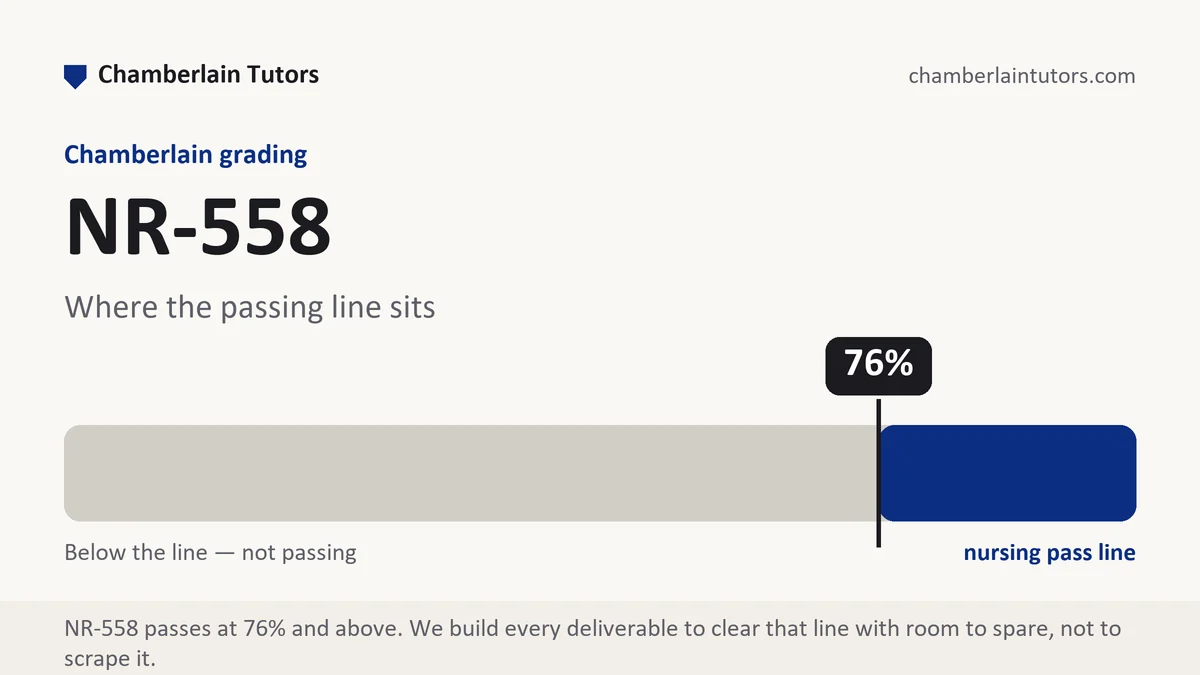
Practically, this stage is also an arithmetic problem. Core nursing courses carry a 76 percent floor, core assignments average separately from supplemental work, and nothing follows the eighth stage. If you are entering the final week below the line, the project is the only remaining instrument, and the schedule should be built around it. Draft early, leave a full day for the internal consistency check described below, and use whatever revision opportunity your section offers.
The NR-558 Week 8 method, step by step
Six moves for a closing project whose measurement layer can be believed.
-
Harvest the session before you write anything new
Open every graded submission from the earlier stages along with the feedback that came back, and pull forward the problem statement, the evidence appraisal, the ethical analysis and the implementation plan. A final project that repeats an error already marked in stage three is the most avoidable loss available in the course.
-
Distinguish process, outcome and balancing measures explicitly
Messages delivered is a process measure. Children up to date at a checkpoint is an outcome measure. Staff time spent per week on recall, and the proportion of families no longer reached at all, are balancing measures. Naming which is which, in the document, is the single clearest signal of competence in this territory.
-
Specify the baseline in the same terms as the outcome
Say what the value was before, how it was computed, over what period, and from what source. A baseline computed differently from the follow-up measure is worse than no baseline at all, because it invites a comparison that cannot be made and someone will make it anyway.
-
Name the rival explanations you cannot rule out
A single-site change with no control group cannot separate its effect from everything else that happened in the same period. List the plausible rivals specifically for your setting and season, and say which direction each would push the result. This is the paragraph that turns a proposal into an evaluation.
-
Build an equity check into the measurement, not into the discussion
Specify in advance how the result will be broken down and by what characteristic, so that a benefit concentrated among the already-reachable becomes visible rather than hidden inside an average. Where the data cannot support the breakdown, say that plainly, since it is a real limitation of the plan.
-
Audit the whole project for internal consistency
Read the problem statement alone and list what it promises. Read the measurement plan alone and list what it would demonstrate. Compare. Anything promised and not measured is a gap, and anything measured that answers no stated problem is a metric that arrived for its own convenience.
Close the project: sections and word targets
Our frame for a closing informatics project of roughly 2,000 to 2,600 words. This is our own outline rather than anything the university issues, and your week's scoring guide outranks it wherever the two disagree. Where earlier stages produced sections, rewrite rather than paste unless your guide explicitly builds the project as a compilation.
| Section | What belongs in it | Word target |
|---|---|---|
| Problem and population | The practice problem in measurable terms, the population affected, and the consequence of leaving it unaddressed. | 200 to 260 |
| The change proposed | The technology or process change described functionally, with inputs, outputs and the action it is meant to trigger. | 230 to 290 |
| Evidence base | The strongest available studies by design, setting and effect, plus an explicit statement of what evidence does not exist. | 350 to 450 |
| Ethical, legal and equity layer | Obligations described from named sources, distributional consequences by mechanism, and the boundary where legal determination begins. | 300 to 380 |
| Implementation summary | Readiness, stakeholders, training, phasing, support and fallback, condensed to the decisions a reader needs. | 300 to 380 |
| Measurement plan | Process, outcome and balancing measures, baselines, intervals, data sources, rival explanations and the equity breakdown. | 400 to 500 |
| Verdict and limits | What the project supports, under what conditions, and what it cannot establish as designed. | 200 to 260 |
Evidence craft for the closing project
Carry every source forward with its year and keep the list honest. A final project is where the professional standards, the primary studies, the ethical framework and the implementation literature you have accumulated all do work at once. Check that every citation in the text appears in the list and every listed source appears in the text, because mismatches in a final week are pure avoidable loss.
Report your measures with base, window and source, every time. Sixty-one of 214 children aged 24 months up to date at the checkpoint during the preceding six months, computed from the registry, is a measure. An up-to-date rate of 29 percent is a number with no provenance, and provenance is what makes a before-and-after comparison legitimate.
Say what design you are proposing and what it cannot rule out. A single-site before-and-after comparison is the most common design in practice change and the one most often overread. Name it, and name the threat: anything else that changed in the same period is a rival explanation nobody measured. Stating that plainly strengthens rather than weakens the project.
Keep statistical language accurate at the level you are using it. If you propose a comparison, say what would count as a meaningful difference in practical terms before invoking any test. Significance answers a question about chance and says nothing about whether a difference is worth the cost of the change, and conflating the two in a final project is a visible error in a graduate course.
Close on limits rather than on optimism. A final paragraph naming what the project cannot establish, and what would be needed to establish it, reads as professional judgment. A final paragraph summarizing how promising the change is reads as a student finishing an essay, and it is the last impression a grader carries into the score.
Five mistakes that cost points in this week's territory
- Process measures presented as outcomes. Messages sent, logins recorded and forms completed count activity, not benefit, and a project that stops there has not evaluated anything.
- A baseline computed differently from the follow-up. Two numbers built by different methods cannot be compared, and the comparison will be made regardless.
- No rival explanations named. A single-site change with no control group cannot claim causation, and pretending otherwise undoes the appraisal skills the course spent six weeks building.
- Equity mentioned only in the discussion. If the breakdown is not built into the measurement plan, the disparity will never appear in the results.
- Starting the project from scratch. Seven stages of graded material and feedback exist, and ignoring them wastes the only free content in the course.
Before you submit
- Feedback from every earlier stage has been read and applied
- Process, outcome and balancing measures are labelled as such
- Each baseline is defined in the same terms as its follow-up measure
- Data sources are named with their known completeness limits
- Rival explanations are listed with the direction each would push the result
- The equity breakdown is specified inside the measurement plan
- Every citation matches the list and the project closes on limits
Finishing NR-558 this week?
Send the project prompt, the earlier feedback and the scoring guide out of Canvas. A premium original draft comes back in 24 to 48 hours integrated, measured properly and audited section against section, and revisions run until the grade lands.