Proxy access to an adolescent's patient portal is the sharpest privacy problem in family practice, and it is a perfect subject for the stage where NR-558 turns to data protection. A parent has legitimate access to a child's record, an adolescent acquires protected categories of information as they grow, the portal was built to give access rather than to withhold it, and the practice has to decide what the system will show, to whom, at what age. The written task at this stage is to analyze obligations and risks structurally without drifting into legal conclusions you are not positioned to give. Your section may print this as NR 558 or NR558; it is the same course. Chamberlain publishes no syllabi outside Canvas. The placement here is our teaching judgment from the course's catalog arc; your section's rubric decides what your week actually asks.
What NR-558 Week 5 asks for
Privacy work in graduate informatics writing rests on three distinctions, and getting them right is most of the grade. Privacy is the person's interest in controlling information about themselves. Confidentiality is the obligation held by those who receive it. Security is the set of technical and administrative controls that make confidentiality achievable. Students who use the three words interchangeably produce papers that sound reasonable and analyze nothing, because a remedy that fits a security failure does not fit a privacy failure and the reader cannot tell which you have identified.
The adolescent portal problem separates cleanly along those lines. The privacy question is which information the young person controls and how that control is expressed as they age. The confidentiality question is what the practice is obliged to protect and from whom, including from a parent who holds the account credentials. The security question is whether the system can technically implement any of that: whether it can segment record content by category, whether it can maintain separate credentials, whether staff can suppress a result before it releases automatically, and what audit trail exists when someone views what they should not have.
The second demand is staying in lane. Obligations attaching to health information are governed by law and by organizational policy, and a graduate nursing paper analyzes them without issuing legal conclusions. The phrasing that works is descriptive and sourced: obligations of this kind attach under a named framework, this arrangement raises the question of whether, this is the point at which the organization's counsel or privacy officer would be involved. The phrasing that fails is confident advice about what is or is not permitted in a specific real situation, which is a legal determination and belongs elsewhere.
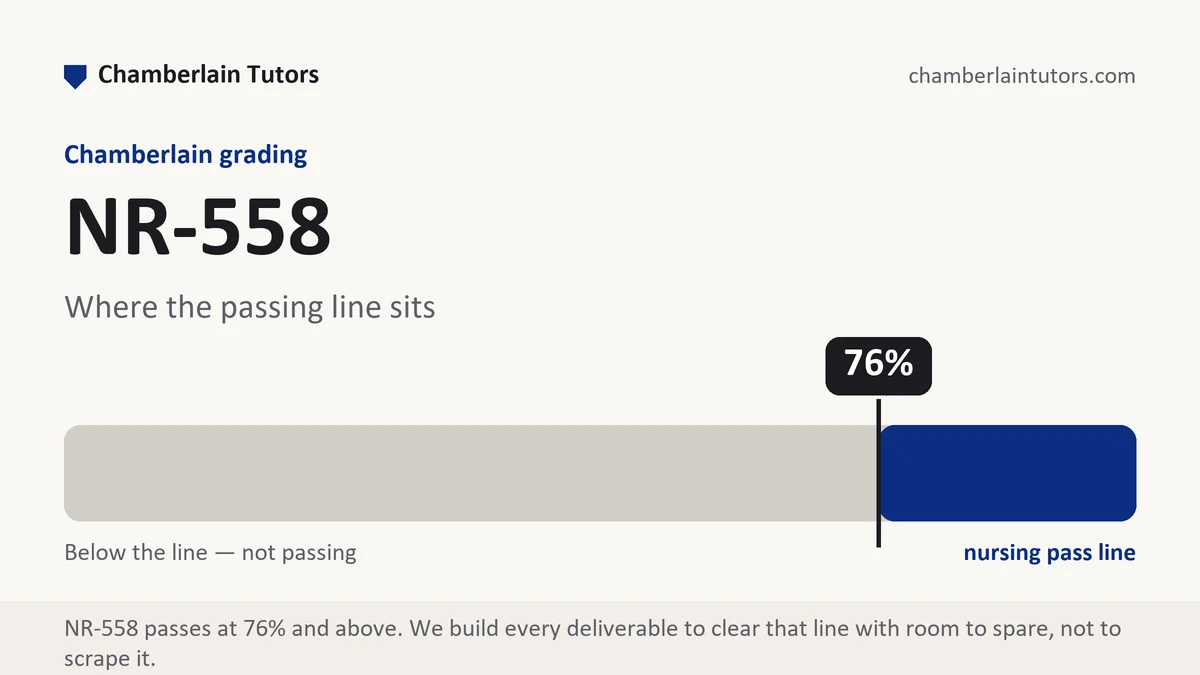
At the fifth stage of an eight-week session, expect a privacy and security analysis, a data-flow write-up, or an ethical and legal case paper. Some sections pair it with a discussion. Posts do not reopen once submitted in Canvas. With three stages remaining and a 76 percent floor applying to core nursing courses, this is the last comfortable place to correct a weak average.
The NR-558 Week 5 method, step by step
Six moves for a privacy and security analysis that stays inside its lane.
-
Define the three terms from sources and then hold the distinction
Write privacy, confidentiality and security as separate defined concepts with citations, then use each one only for what it names. Every later paragraph gets sharper, because each finding is now attached to a category that implies a specific kind of remedy.
-
Draw the data flow before you assess any risk
Follow the information from capture to storage to transmission to display to retention to disposal, naming who can see it at each stage and under what authority. Risk assessment without a flow map is guesswork, and the map is the artifact that makes the rest of the paper defensible.
-
Identify every party with access, including the ones nobody lists
Clinical staff, administrative staff, the parent holding the account, another caregiving household, the system vendor's support personnel, and anyone receiving an exported report. Access lists in real settings are always longer than the official version, and naming the unlisted parties is where this paper earns its analytic marks.
-
Sort each risk into its correct category
A parent seeing a result the adolescent controls is a privacy failure. A staff member browsing a neighbour's chart is a confidentiality breach. A shared workstation left logged in is a security control failure. Sorting them correctly determines which safeguard you go on to recommend, and mis-sorting produces a remedy that cannot work.
-
Match safeguards to categories, in the language the frameworks use
Administrative, physical and technical safeguards are the conventional categories, and using them lets a reader map your recommendations to a recognized structure. Role-based access, automatic session termination, audit logging, segmentation of record categories and staff training each belong to a specific one, and saying which is part of the analysis.
-
Mark the boundary where the question becomes legal
End the analysis with an explicit sentence naming what would require the organization's privacy officer or counsel to determine. That sentence is not a weakness in the paper; it demonstrates that you know where professional analysis stops and legal determination begins, which is exactly the judgment this stage is testing.
Trace the obligations: sections and word targets
Our frame for a privacy and security analysis of roughly 1,400 to 1,700 words. This is our own outline rather than anything the university issues, and your week's scoring guide outranks it wherever the two disagree. If your guide names its own safeguard categories, use those labels instead of ours.
| Section | What belongs in it | Word target |
|---|---|---|
| Scenario and scope | The specific situation analyzed, the population affected, and what the paper does and does not attempt to determine. | 110 to 150 |
| The three terms, defined | Privacy, confidentiality and security defined from named sources, with one line on why the distinction changes the remedy. | 170 to 210 |
| Data flow | Capture, storage, transmission, display, retention and disposal, with who can see the data at each stage and under what authority. | 300 to 370 |
| Parties with access | Every party including the unlisted ones, with the basis of their access and whether it is technically enforceable. | 200 to 250 |
| Risks by category | Each risk sorted as privacy, confidentiality or security, with the mechanism by which it would occur. | 280 to 340 |
| Safeguards and the legal boundary | Administrative, physical and technical safeguards matched to categories, then the explicit line where legal determination begins. | 250 to 310 |
Evidence craft for privacy and security writing
Cite frameworks by name, issuing body and version. Regulatory and security frameworks are revised on their own schedules, and a requirement quoted without a version is a claim about the present made from an unknown date. Name the body, name the document, give the year, and keep your description of it descriptive rather than advisory.
Write obligations in the conditional, and situations in the indicative. Obligations of this kind attach where the information is held by a covered entity is a supportable sentence. This practice must do X is a legal conclusion about a specific real organization. The first belongs in your paper; the second belongs with the organization's own counsel.
Use breach evidence with its context. Published analyses of health data breaches report causes, sectors and scale, and citing one with its population and period is far stronger than a general statement that breaches are increasing. Where you give a figure, give its base and its window, and note what kind of organization it describes.
Distinguish de-identification from anonymization, and both from pseudonymization. These are technically distinct with different re-identification risks, and precision is directly scored in a graduate informatics course. If your scenario involves secondary use of data, this distinction is likely to be the analytic core of the paper rather than a definitional aside.
Keep every example hypothetical or fully de-identified. A privacy paper that itself contains identifiable detail about a real patient or a real incident has failed in the most visible way available. Construct scenarios, say plainly that they are constructed, and describe organizations by type rather than by name.
Five mistakes that cost points in this week's territory
- The three terms used interchangeably. A paper that treats privacy, confidentiality and security as synonyms cannot match a remedy to a problem, and the reader can see it.
- Legal conclusions about a real workplace. Advising what an organization must do is a determination this paper is not positioned to make, and confident phrasing makes it worse.
- Risk assessment with no data flow behind it. Without the flow, the risks listed are the ones that came to mind rather than the ones the system actually creates.
- Access lists that only include staff. Parents, other households, vendor support and report recipients all see data, and omitting them hollows out the analysis.
- Safeguards listed without categories. An undifferentiated list of good practices does not show that you know which control answers which failure.
Before you submit
- Privacy, confidentiality and security are defined separately and used consistently
- A complete data flow appears before any risk is assessed
- Every party with access is named, including the unofficial ones
- Each risk is sorted into a category with its mechanism described
- Safeguards are labelled administrative, physical or technical
- Frameworks are cited with issuing body and version
- The paper states explicitly where legal determination begins
Writing the privacy analysis for NR-558?
Send the scenario and the scoring guide out of Canvas. A premium original draft comes back in 24 to 48 hours with the data flow mapped, risks categorized and the legal boundary stated rather than crossed, and revisions run until the grade lands.