NR-557 Health Assessment for Professional Nursing Practice carries three theory credits with a practicum value of zero, so no clinical hours attach to it. The graded work is documentation: written histories, focused write-ups and the reasoning that connects what a patient said to what you found. One transcription note first, because it affects how you read the course listing.
What NR-557 actually grades
A caution about the catalog before anything else. The entry printed under this title in the catalog carries the healthcare informatics description that also appears under NR-558, which looks like a duplication in the published listing rather than a description of assessment content. Take the title as your guide, and confirm the focus of your own section in Canvas during week one rather than assuming from the catalog text.
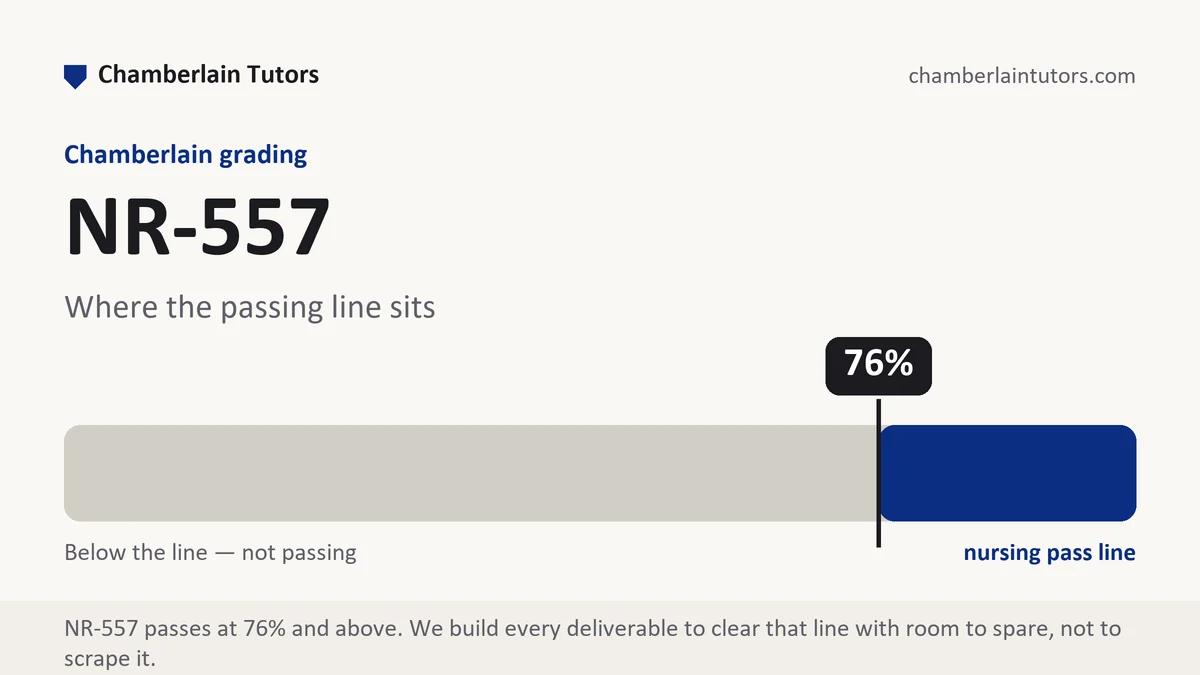
What assessment writing is scored on is separation. The subjective section holds what the patient reported and the objective section holds what you observed, and a paper that mixes them loses accuracy rows even when every clinical detail is right. The second scored habit is completeness in a bounded way: a full symptom analysis on the presenting concern, pertinent negatives that show what you ruled against, and silence about systems you did not examine. Chamberlain's 76 percent floor for core nursing courses applies, and the accelerated route runs on eight-week sessions with weekly deliverables, so an early habit of sloppy documentation is expensive quickly. Supplementary work cannot rescue a weighted average that has already settled.
How we help in this course
We draft health history write-ups, focused assessment documentation, case-based reasoning papers, developmental and cultural assessment sections, teaching plans built from findings, discussion responses and the session project. Our drafts hold the subjective and objective line strictly, because that single discipline is what moves an assessment paper up a band.
We write from the case your prompt supplies or the notes you took. We do not examine patients, sit any assessment or check-off for you, appear on a recording, or complete anything requiring your presence. If your section pairs written work with a recorded exam, that recording is yours alone: NR-509, for instance, pairs written work with a video-recorded physical exam check-off where failure reverts the whole course grade to F, so confirm early what your section expects.
In NR-557 right now?
Send the case or the notes plus the rubric from Canvas. First premium sample free, floor-checked, back in 24 to 48 hours.
Read the rubric before the prompt
Documentation guides are the most literal rubrics in the program, which makes them the easiest to convert into a plan. Copy the criterion rows into a blank file and reduce each to its verb: collect, document, differentiate, interpret, communicate. Where a row names a section of the write-up, that section is required whether or not your case gives you much to put in it, and an empty required section costs more than a thin one.
Then convert the weights. Take a 900 word write-up with four rows at 45, 30, 15 and 10 percent. That is 405 words for the first row, 270 for the second, 135 for the third and 90 for the fourth. Nine hundred words is short, and a 45 percent row means nearly half your text belongs to whichever section the guide priced highest, usually the history of the present concern. Ninety words for the smallest row means one disciplined paragraph, not an afterthought written at 11 p.m. Title page and references sit outside the count unless your guide says otherwise.
Keep the numbers beside the headings and check them once the subjective section is drafted. If the history came in at 150 words, you have summarized the patient instead of interviewing them on paper.
The shape of a written health assessment
Whatever your section calls the document, these are the parts a grader checks, in this order.
| Part | What it must contain | What loses the band |
|---|---|---|
| Identifying data and source | Age, sex as recorded, who gave the history and how reliable it is. | Any real name, record number or date of birth. |
| Reason for the visit | The patient's own words, in quotation marks, kept short. | A clinical term the patient never used. |
| History of the present concern | Onset, location, duration, character, what makes it better or worse, timing, severity and context. | Three sentences that skip half the elements. |
| Relevant history | Past medical, medications with doses, allergies, family and social history that bears on this concern. | A full life history with nothing connected to the complaint. |
| Review of systems | Subjective answers only, bounded to what the concern requires or what the guide lists. | Objective findings smuggled into the review. |
| Objective findings | What you measured and observed, system by system, in descriptive language. | Interpretations such as unremarkable or healthy appearing. |
| Pertinent negatives | The absent findings that matter, stated deliberately. | Nothing, leaving the reader unsure what was checked. |
| Summary and reasoning | The problem list and what the findings support, at the level your course permits. | A diagnosis asserted with no findings behind it. |
Evidence and citation craft at this level
Assessment papers cite less than policy papers but the citations they carry are load bearing, so four habits apply.
Current sources, especially for anything screening related. Where your guide sets no rule, treat five years as the line, and check the edition when you cite a screening interval, an age threshold or a risk tool, because recommendations are revised and student papers cite superseded versions constantly. Name the issuing body and the year in the sentence so a grader can see you know which version you used.
Say what population the recommendation was written for. Guidance is written for defined groups, and applying an adult recommendation to an adolescent or a general-population screening interval to a high-risk patient is the most common misuse in this course. Eight words of setup, such as for average-risk adults in this age band, prevents it entirely.
Verbs the evidence can pay for. A finding is not a diagnosis, and a risk factor is not a cause. Write is consistent with, raises the likelihood of and has been associated with rather than indicates or confirms. In the objective section the discipline is even tighter: describe what is there in physical terms and leave interpretation to the reasoning section, where it can be supported.
Denominator and window on every quantity. Assessment documentation is full of numbers that mean nothing loose. Write three episodes in the past two weeks, each lasting about 20 minutes rather than frequent episodes, and give tobacco history in pack-years, alcohol in drinks per week, pain on the stated scale with the scale named. A number without its unit and its period is an impression wearing a digit.
What separates a passing write-up from a strong one
A passing write-up records a plausible history, lists findings, and reaches a reasonable summary. It scores in the high seventies to low eighties because it is thin in a specific place: the history of the present concern is answered rather than explored, and the summary therefore rests on very little.
Strong write-ups do three things. They complete the symptom analysis without exception, so every element has an answer even when the answer is that the patient could not say, which is itself information. They include pertinent negatives deliberately, because an absent finding stated on purpose is the clearest evidence a reader gets that you were thinking rather than transcribing. And they keep interpretation out of the objective section entirely, then earn it in the reasoning section by naming the two or three findings that carry the conclusion and the one finding that argues against it. A write-up that says what does not fit is doing clinical reasoning; one that presents a tidy picture is doing dictation.
Mistakes that cost points here
- Interpretation inside the objective section. Appears anxious and looks well are conclusions. Describe posture, speech, skin and vital signs and let the reader see it.
- Normal recorded for systems not examined. Documenting an exam that did not happen is an integrity problem as well as a scoring one.
- A blanket denial line. Patient denies everything else tells the grader nothing about what you asked. Name the negatives that matter.
- Any identifier surviving the draft. No names, initials, record numbers, dates of birth, employers or distinctive details, in the body or in an appendix.
- Template systems the prompt excluded. A focused write-up that includes a full head-to-toe reads as unfiltered, and the bounded-scope row is scored.
- Posting a case response before checking it. Discussion posts do not reopen once submitted at Chamberlain, so a misplaced objective finding stays on the board. Draft in a document first.
Questions NR-557 students ask
Where exactly is the line between subjective and objective?
Can I write within normal limits or unremarkable?
The catalog entry under this course reads like an informatics description. Which is it?
Where NR-557 sits in Chamberlain's programs
Open the exact program map for sequence, credit, and option context. The current student schedule and syllabus remain authoritative after transfer evaluation, electives, state rules, and approved plan changes.
The weeks, one by one
Week 1
A four-year-old carried into a family practice office for two days of ear pain produces two entirely different kinds of sentence, and NR-557 Week 1 is the stage where you learn to keep them on separate sides of the page. Read the full Week 1 manual.
Week 2
Interviewing well and writing a history well are two different skills, and the second one is what NR-557 grades. Read the full Week 2 manual.
Week 3
Seven-year-olds point at their navel no matter where it hurts, which is why a written symptom analysis has to do the work the pointing finger cannot. Read the full Week 3 manual.
Week 4
Examining a six-month-old happens in whatever order the baby permits, and documenting that examination happens in a fixed order regardless. Read the full Week 4 manual.
Week 5
An eighteen-month-old and a seventy-nine-year-old can sit in the same family practice waiting room on the same afternoon, and the written assessment each one generates follows different rules about what counts as a finding. Read the full Week 5 manual.
Week 6
Ask a family what they think is causing the problem and you will get an answer that belongs in the record, not in a footnote. Read the full Week 6 manual.
Week 7
Narrow the record and the standard goes up, not down. Read the full Week 7 manual.
Week 8
A ten-year-old brought back to family practice for a third visit about recurrent stomach aches and poor appetite is exactly the kind of case a closing comprehensive paper is built on, and the students who struggle in the final stage are almost always the ones who begin from a blank page rather than. Read the full Week 8 manual.