Seven-year-olds point at their navel no matter where it hurts, which is why a written symptom analysis has to do the work the pointing finger cannot. NR-557 by the third stage of an eight-week session is normally past architecture and into depth: taking one presenting complaint and characterizing it completely on paper, dimension by dimension, then closing with the negatives that show what you deliberately asked about and did not find. A full symptom analysis is the densest paragraph in the whole record, and it is where documentation guides in graduate assessment courses concentrate their marks. Your section may print this as NR 557 or NR557; it is the same course. Note that the catalog prints the informatics text under this title, a duplication of the NR-558 entry rather than a description of assessment content, so use the title and confirm in Canvas. Chamberlain publishes no syllabi outside Canvas. The placement here is our teaching judgment from the course's catalog arc; your section's rubric decides what your week actually asks.
What NR-557 Week 3 asks for
A symptom has dimensions, and the graded task is to record all of them without collapsing any into a summary. Onset means when and how fast. Location means where, and whether it moves. Duration means how long each episode lasts and how long the pattern has run. Character means what the sensation is like in the historian's own words. Aggravating and relieving factors mean what makes it worse and what has been tried. Timing means when in the day, the week or the cycle. Severity means a rating with a scale attached and, more usefully, a function statement. Context means what surrounds the episodes. Associated complaints mean what travels with it.
The seven-year-old with intermittent belly pain shows why the dimensions cannot be skipped. His mother reports that the pain comes on school mornings, lasts roughly an hour, sits around the navel by his description, does not wake him at night, has never been accompanied by vomiting, and disappears entirely on Saturdays. None of those facts is a diagnosis and every one of them is scoreable. A student who writes intermittent periumbilical abdominal pain for three weeks has recorded a label. A student who writes the pattern above has produced a paragraph a reader can reason from.
The second thing this stage tests is the pertinent negative, and it is the most misunderstood element in assessment writing. A pertinent negative is not any symptom the patient denies. It is a symptom you asked about specifically because it would have changed your thinking, recorded because it was absent. No vomiting, no blood in the stool, no weight loss, no fever and no night waking, in a child with recurrent abdominal pain, is a short list that tells your reader precisely which serious possibilities you were probing. Twenty random denials tell the reader nothing except that you own a checklist.
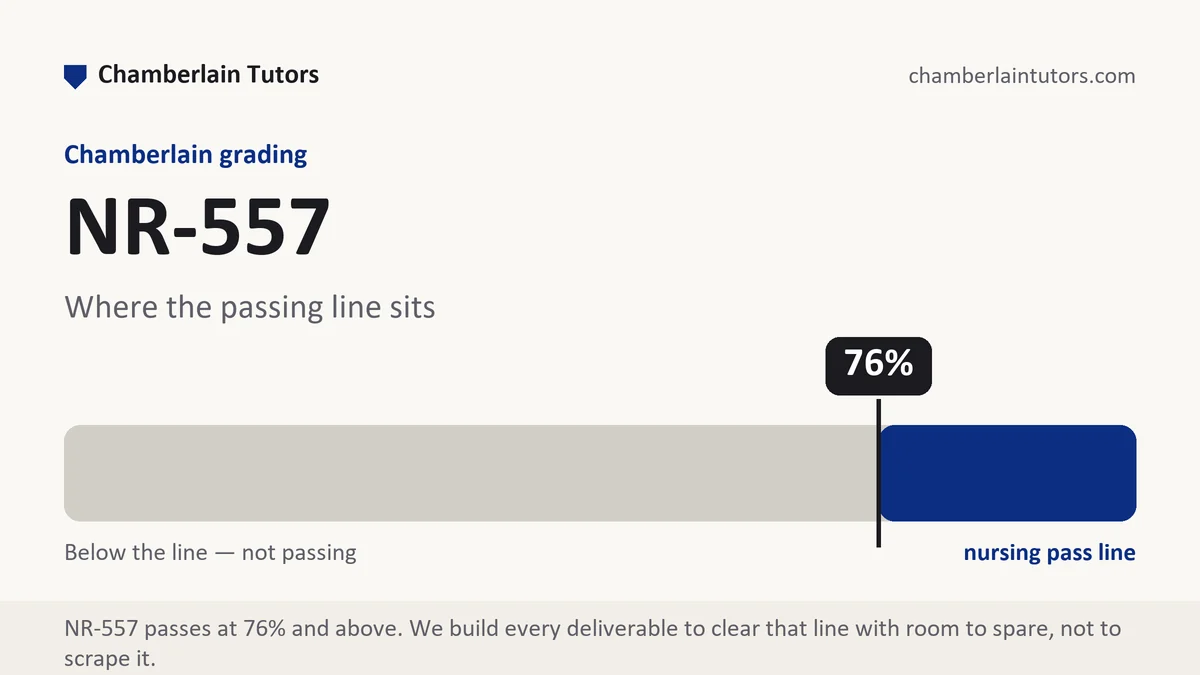
By the third stage of an accelerated session the graded work usually carries real weight, and Chamberlain's 76 percent floor for core nursing courses is close enough to matter. Expect a focused written analysis of one complaint from a supplied or constructed case, sometimes paired with a discussion post comparing how the same symptom would be characterized in different age groups. Posts do not reopen after submission in Canvas, so write them as final copy.
The NR-557 Week 3 method, step by step
Six moves for building a symptom analysis that survives a documentation rubric.
-
List the dimensions as a working checklist and tick them off
Write the eight or nine dimensions your assessment text names down the side of a page, then fill each with the case material before you compose a single sentence. Any dimension left empty is either a genuine gap you will document or a question you forgot, and the checklist is the only reliable way to tell those apart before submission.
-
Quote the character of the symptom in the historian's own language
Children and their parents describe sensation vividly and unclinically, and that language is data. It feels like a squeeze, it hurts like when I am hungry, she says it is a hot feeling. Keep those in quotation marks. Translating them into crampy, gnawing or burning replaces the patient's report with your interpretation, which is exactly the substitution this course is training you out of.
-
Anchor severity to function rather than to a number alone
A rating needs its scale named, and in pediatric documentation it needs the tool that produced it. Then add what the symptom stopped: missed the last hour of school on four days, stopped riding his bike, would not finish dinner. Function statements are checkable, comparable across visits and far more useful to a reader than an unanchored seven out of ten.
-
Map timing against the patient's actual week
Ask when the symptom does not happen and record that too. School mornings but not weekends, evenings but not mornings, before meals but not after. Negative timing is one of the most informative and least written elements of a symptom analysis, and it costs one clause to include.
-
Choose pertinent negatives from a stated line of reasoning
Decide which serious or common possibilities you were ruling against, then record the negatives that speak to them. You are not obliged to publish your differential at this stage, but the negatives should be legible as a set rather than as a scatter, because a grader can tell the difference in one reading.
-
Close the paragraph without diagnosing
End with what has been tried and what happened, not with a conclusion. Ibuprofen given twice with no reported change, a week of earlier bedtimes with no change, is the correct final note. The interpretation belongs in a later section of the document, and moving it forward undermines the separation the whole course is built on.
Budget the analysis: dimensions and word targets
Our frame for a focused symptom analysis inside a write-up of roughly 900 to 1,200 words, with the analysis itself taking the largest single share. This is our outline rather than anything the university issues, and your week's guide outranks it wherever the two disagree.
| Element | What belongs in it | Word target |
|---|---|---|
| Framing sentence | Age, sex as recorded, historian, and the complaint in the historian's quoted words with its total duration. | 40 to 60 |
| Onset and course | How it began, how quickly, whether it has changed since, and whether anything preceded the first episode. | 110 to 150 |
| Location, character and radiation | Where it sits by the patient's own indication, the quoted description of the sensation, and whether it travels. | 120 to 160 |
| Timing, frequency and pattern | Episode length, how often, time of day, and the periods when the symptom reliably does not occur. | 130 to 170 |
| Severity and function | A rating with the scale and tool named, plus what activities the symptom has interrupted or ended. | 100 to 140 |
| Aggravating, relieving and tried | What worsens it, what eases it, what the family has already attempted, at what dose, and with what result. | 120 to 160 |
| Associated complaints and pertinent negatives | What travels with the symptom, then the deliberate absences that show the line of reasoning being pursued. | 150 to 200 |
Evidence craft for symptom characterization
Name the framework you are analyzing under. Assessment texts publish structured mnemonics for symptom analysis, and citing the one you used lets a grader check completeness against a standard instead of against their own memory. Give the source and its year in the sentence, then follow its categories in its order rather than reshuffling them halfway through.
Attach the tool to the rating. A pain score in a seven-year-old means something different depending on whether it came from a self-report scale, a faces scale or a parental estimate, so say which. In graduate documentation, a number without its instrument is treated as an unsupported figure, and the fix is a four-word clause.
Record what was tried with dose and outcome, never just the name. Acetaminophen given is not evidence. Acetaminophen 240 mg by mouth on two mornings, given by the mother roughly thirty minutes after the pain began, with no reported reduction, is. The dose and the timing are what make the non-response interpretable to whoever reads the record next.
Keep age-specific claims sourced. Statements about how symptoms typically present at particular ages belong to the assessment and pediatric literature, not to your recollection. If you write that young children localize poorly, attribute it. A graduate paper is allowed to assert very little on the author's own authority, and this stage is where that rule starts to bite.
Show the negatives as a reasoned set, and say so in one clause. A sentence beginning the following were specifically asked about and denied signals to your grader that the list is deliberate. Left unframed, the same list can read as a checklist someone worked through, and the two versions score differently even when the content is identical.
Five mistakes that cost points in this week's territory
- Collapsing dimensions into a label. Intermittent periumbilical pain compresses six scoreable elements into three words and forfeits most of the row.
- Translating the patient's description. Replacing the child's own words with clinical vocabulary loses the data and adds an interpretation nobody asked for.
- Negatives with no reasoning behind them. A long list of denials without a visible line of thought reads as padding rather than as pertinent.
- Severity as a bare number. Without a named scale and a function statement, a rating cannot be compared to anything, including itself at the next visit.
- A diagnosis smuggled into the last sentence. The analysis section closes on what was tried and what happened, not on what you think it is.
Before you submit
- Every dimension in your named framework has content or a documented gap
- The character of the symptom appears in quoted lay language
- Severity carries a scale, the tool that produced it, and a function statement
- Timing includes the periods when the symptom does not occur
- Each treatment tried lists dose, who gave it, when and the outcome
- Pertinent negatives are framed as deliberately asked
- No diagnostic label appears anywhere in the analysis paragraph
Building the symptom analysis for NR-557?
Send the case and the scoring guide out of Canvas. A premium original draft comes back in 24 to 48 hours with every dimension filled and the negatives reasoned rather than listed, and revisions run until the grade lands.