Assemble, do not restart. A ten-year-old brought back to family practice for a third visit about recurrent stomach aches and poor appetite is exactly the kind of case a closing comprehensive paper is built on, and the students who struggle in the final stage are almost always the ones who begin from a blank page rather than from the seven stages of material behind them. NR-557 normally closes with a full written assessment, frequently paired with a teaching plan drawn from the findings, submitted in a week where nothing can be repaired afterwards. Your section may print this as NR 557 or NR557; it is the same course. One last transcription note: the catalog entry under this title carries the informatics description that also appears under NR-558, a duplication in the published listing rather than a statement of content. Chamberlain publishes no syllabi outside Canvas. The placement here is our teaching judgment from the course's catalog arc; your section's rubric decides what your week actually asks.
What NR-557 Week 8 asks for
A comprehensive assessment paper is judged on three things at once: completeness, internal consistency and the discipline you have been building since the opening stage. Completeness means every section the guide names exists and holds real content. Consistency means the objective section never contradicts the history, the impression never contradicts either, and a teaching plan, if one is required, addresses something the assessment actually found. Discipline means the subjective and objective line still holds in the eighth week, on a long document, written under end-of-session pressure.
The ten-year-old makes the consistency demand concrete. If the history records that he has stopped eating breakfast on school days and has lost interest in soccer, and the measurements section shows a weight that has crossed downward across percentile lines since the last recorded visit, the two must be visibly connected in the impression. If the teaching plan then addresses hand hygiene because that is the topic you found easiest to write, the document has come apart, and a grader reading three sections that do not speak to each other will mark all three. Integration is not a stylistic nicety in a closing paper; it is the thing being assessed.
The teaching component, where a section includes one, has its own rules. A teaching plan built from an assessment names the specific finding it is responding to, states what the family or patient will be able to do afterwards, uses methods matched to the learner's age and stated preferences, and describes how the outcome would be checked. Teaching content that could have been written before you ever saw the case is the tell that separates a strong closing paper from a generic one, and it is the most common way marks leave this section.
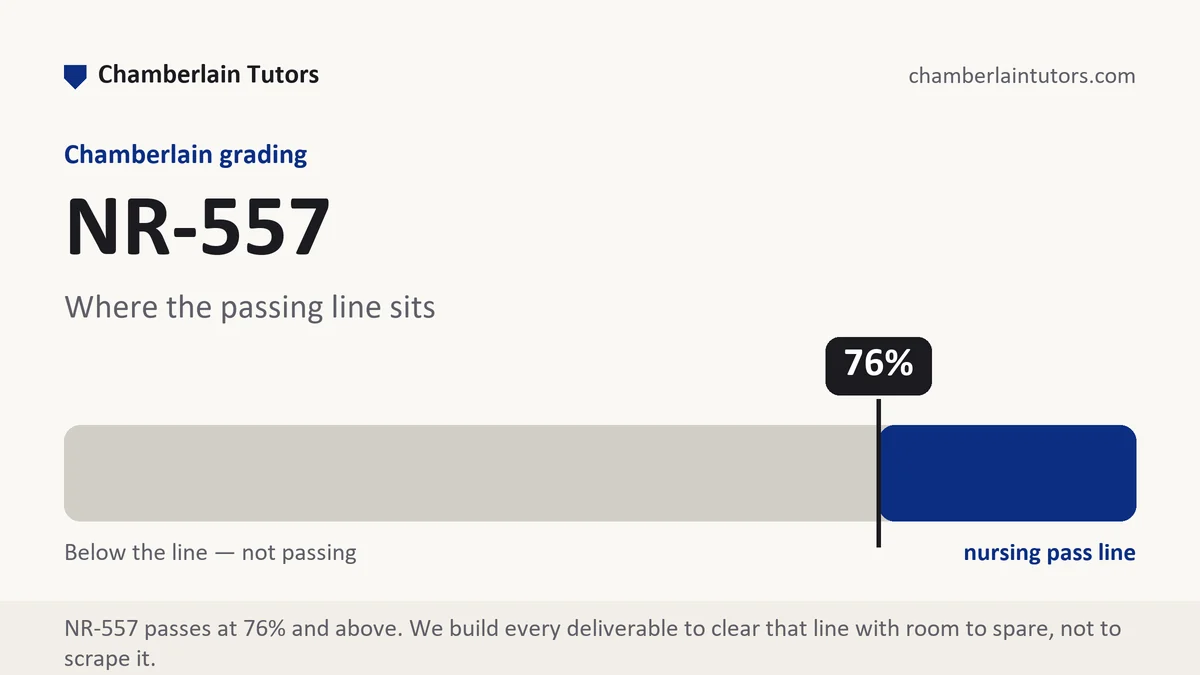
Practically, the eighth stage is also an arithmetic problem. Core nursing courses carry a 76 percent floor, core assignments average separately from supplemental work, and there is nothing after this. If you are entering the final stage below the line, the final paper is the only remaining instrument, so build the schedule around it rather than around whatever else is due. Draft early, revise against the guide, and leave a full day for the consistency audit described below.
The NR-557 Week 8 method, step by step
Six moves for assembling a comprehensive paper that holds together end to end.
-
Harvest your earlier submissions before you write anything new
Open every graded piece from the session and pull out the sections that survived contact with a grader, along with the feedback that came back. A closing paper that repeats an error already marked in an earlier stage is the most avoidable loss in the course, and thirty minutes of harvesting prevents it.
-
Build the section skeleton from the guide, in the guide's order
Lay every named section down empty, in the sequence the scoring guide lists them, before adding a word. Long documents drift out of the prescribed order more easily than short ones, and organization rows on a comprehensive paper are worth more than most students expect.
-
Fill the history completely, then the examination completely, then stop
Write the two data sections in full before you write a single interpretive sentence. Composing the impression while the data sections are still open is what produces documents where the findings quietly rearrange themselves to fit a conclusion the writer settled on early.
-
Run a three-way consistency audit
Read the history alone and list what it implies. Read the examination alone and list what it shows. Read the impression alone and list what it claims. Then compare the three lists. Anything appearing on the third list but neither of the first two is unsupported, and anything on the first two that never reaches the third is a finding you collected and abandoned.
-
Anchor every teaching objective to a named finding
Each objective starts by pointing at the sentence in your assessment that generated it. Given the reported loss of breakfast on school mornings and the downward weight trajectory recorded above, the family will be able to, is the correct opening shape. Objectives that could precede any assessment are the ones that lose the row.
-
Reserve a final pass for identifiers, mechanics and the reference list
Search the document for names, dates of birth, record numbers, facility names and locations, then check that every in-text citation appears in the list and every listed source appears in the text. This pass is mechanical, it takes twenty minutes, and it protects marks that have nothing to do with clinical content.
Assemble the final document: sections and word targets
Our frame for a comprehensive assessment paper of roughly 1,800 to 2,400 words with a teaching component. This is our own outline rather than anything the university issues, and your week's scoring guide outranks it wherever the two disagree. Drop the teaching block and redistribute its words if your guide does not ask for one.
| Section | What belongs in it | Word target |
|---|---|---|
| Frame, source and reliability | Age, sex as recorded, historians for each portion, setting, and an explicit judgment on the completeness of the account. | 90 to 130 |
| Complete history | Present concern in full dimensions, past medical and developmental, medications with dose and supervision, allergies as reactions, family and social history. | 520 to 680 |
| Review of systems | Reported symptoms by system, endorsed and denied, with a sentence stating which systems were covered. | 200 to 270 |
| Complete examination | General survey, measurements against named references, and system findings in conventional descriptors with laterality throughout. | 450 to 600 |
| Integrated impression | The pattern the whole record forms, the specific findings supporting it, and the uncertainty that remains. | 200 to 280 |
| Teaching plan from findings | Objectives anchored to named findings, methods matched to the learner, materials, and how the outcome would be checked. | 250 to 340 |
| Limits and outstanding questions | What was not assessed, why, and what the record cannot support as written. | 90 to 130 |
Evidence craft for the closing paper
Carry the references you have been accumulating all session. A comprehensive paper is the natural home for the growth reference, the assessment text, the screening instrument and the teaching or health literacy source you have used in earlier stages. Name each with its year in the sentence where it does work, and the support row fills itself without a single decorative citation.
Report trajectories, not snapshots, wherever the case supplies two points. A weight that has moved across percentile bands since a previously recorded visit is a far stronger piece of evidence than either measurement alone, and it needs both values, both references and the interval between them in the sentence. Trajectory is the most under-used evidence type in student assessment writing.
Attribute the teaching methods you choose. Approaches to patient and family education come from published work, and an objective supported by a named method with a source reads as designed rather than improvised. Match the method to the learner's age and to the preferences you documented in the psychosocial section, and say that you have done so.
Write outcome checks that someone else could perform. The family will demonstrate the routine at the next visit, or the child will name three of the four items without prompting, are checkable. The family will understand the plan is not, because understanding is invisible and nobody can score it. This is the same rule that governs goals anywhere in graduate writing, applied to teaching.
Close on limits rather than on reassurance. A final paragraph that names what the assessment could not establish, and what would be needed to establish it, reads as professional judgment. A final paragraph that summarizes how thorough the assessment was reads as a student closing an essay, and it is the last impression your grader takes into the score.
Five mistakes that cost points in this week's territory
- Starting from scratch in the final week. Seven stages of graded material and feedback exist, and ignoring them wastes the only free content in the course.
- Sections that contradict each other. A history, an examination and an impression that do not agree lose marks in all three rows at once rather than in one.
- Generic teaching content. An objective that could have been written before the assessment existed is the clearest evidence that the assessment was not used.
- Discipline dropping under deadline. Interpretive verbs, missing laterality and unattributed reports reappear in eighth-week documents more than anywhere else in the session.
- An unchecked reference list. Mismatches between text and list are pure avoidable loss in the week when there is nothing left to repair them with.
Before you submit
- Feedback from every earlier stage has been read and applied
- Sections appear in the order the scoring guide lists them
- The three-way audit found no claim without support and no finding abandoned
- Every teaching objective points at a named finding in your own assessment
- Outcome checks describe something another person could observe
- No identifier of any kind survives anywhere in the document
- Every citation matches the list and every listed source appears in the text
Finishing NR-557 this week?
Send the case, the earlier feedback and the scoring guide out of Canvas. A premium original draft comes back in 24 to 48 hours assembled, internally consistent and audited section against section, and revisions run until the grade lands.