Ask a family what they think is causing the problem and you will get an answer that belongs in the record, not in a footnote. NR-557 in its sixth stage normally moves to the cultural and psychosocial layer of assessment, and the written task is harder than it looks: you have to document beliefs, household structure, supports, stressors and mood in language that reports rather than characterizes. This is the section where assumptions leak into documentation most easily, and where a scoring guide can spot the leak in a single sentence. Your section may print this as NR 557 or NR557; it is the same course. The catalog entry under this title carries the informatics description that also appears under NR-558, which reads as a duplication in the published listing, so use the title and confirm your section's focus in Canvas. Chamberlain publishes no syllabi outside Canvas. The placement here is our teaching judgment from the course's catalog arc; your section's rubric decides what your week actually asks.
What NR-557 Week 6 asks for
Cultural assessment in graduate writing is not a paragraph of background about a group. It is a record of what this patient and this family said about their own health beliefs, practices, language preferences, decision-making arrangements and expectations of care. The distinction is absolute and it is where most submissions in this territory fail. A paper that explains what a named community generally believes has written about a population; a paper that records what the mother in the room said she believes is causing her son's rash, and what she has already tried at home, has written an assessment.
The psychosocial layer sits beside it and follows the same rule. Household composition, who else the patient cares for, work or school demands, financial pressure on the treatment plan, transport, food access, safety in the home, and mood are all documentable, and all of them are documentable as reported facts with a speaker attached. In family practice these are frequently the elements that decide whether a plan works, which is why documentation guides in graduate assessment courses give them their own rows rather than folding them into social history.
The third demand is the hardest to teach and the most valuable to learn: neutral language for sensitive content. Non-compliant, difficult, unmotivated and refuses are characterizations. Declined the referral and said the appointment time conflicts with the shift she cannot leave is documentation. The information content of the second version is higher and its bias content is zero, and once a writer sees the difference it becomes visible everywhere in their own drafts.
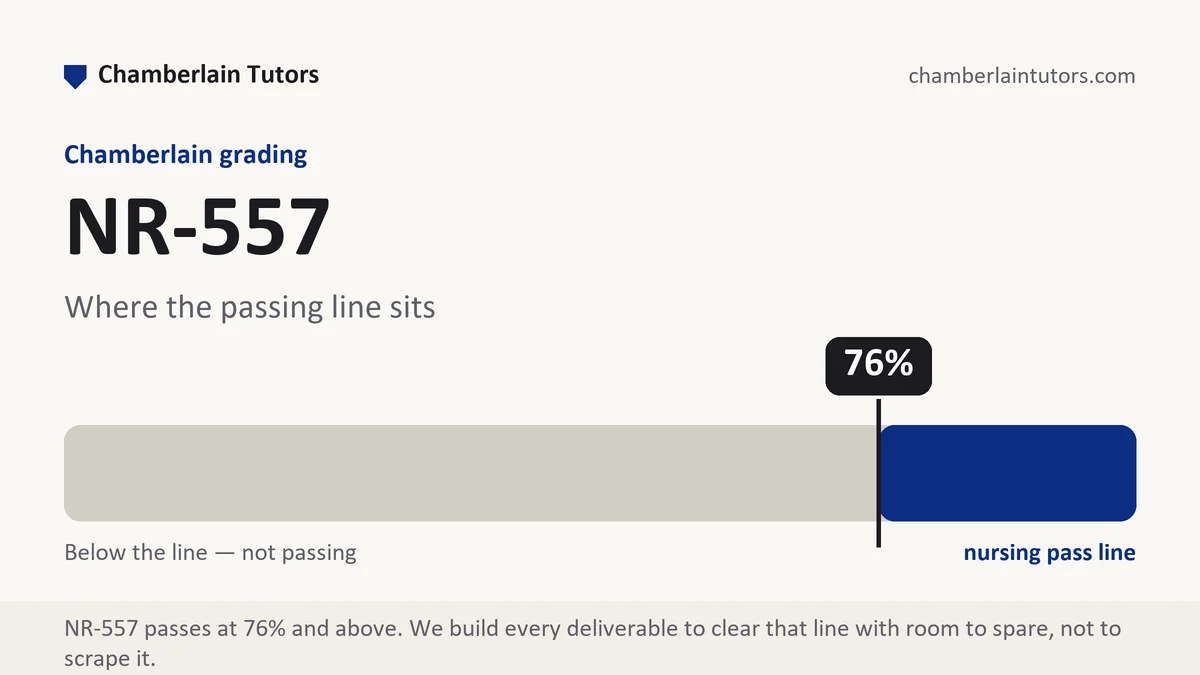
By the sixth stage of an eight-week session the deliverable is usually substantial and often integrative, combining a cultural or psychosocial assessment with material you built earlier. If your section runs a discussion here it commonly turns on a specific interviewing challenge, and posts do not reopen once submitted in Canvas, so treat them as final. With two stages left after this one, a weak score here has very little runway behind it against the 76 percent floor that applies to core nursing courses.
The NR-557 Week 6 method, step by step
Six moves for documenting cultural and psychosocial material without editorializing.
-
Adopt a named cultural assessment model and follow its domains
Published models for cultural assessment exist and each specifies its own domains. Choose one, cite it with its year, and use its categories as your headings rather than inventing your own. A grader can then check your coverage against a standard, and your paper stops depending on the reader agreeing with your improvised structure.
-
Record the family's explanatory account in their own words
Ask what they believe is happening, what they think caused it, what they fear most, and what they have already done. Then quote the answers. The mother who says she thinks it started with the new laundry soap and has been putting coconut oil on it twice a day has given you the two most useful sentences in the entire assessment, and paraphrasing them destroys both.
-
Document language and interpretation arrangements factually
State the preferred language for care, who interpreted if anyone did, and whether professional interpretation was used. Never record a family member as the interpreter without noting it plainly, because that arrangement changes how the rest of the history should be weighted and a reader needs to know.
-
Map the decision-making structure rather than assuming it
Ask who is involved in health decisions for this patient and record the answer as stated. In pediatric and family practice cases this is rarely obvious from the room: the parent who attends is not always the parent who decides, and grandparents, guardians and absent parents all appear in real households. One recorded sentence prevents a plan built on the wrong assumption.
-
Write stressors and supports as circumstances, not as character
Works two overlapping shifts, relies on a neighbour for after-school care three days a week, and has no vehicle, is documentation of circumstance. A chaotic home situation is a judgment that a reader cannot check and that will follow the family through the record. Choose the first version every time.
-
Anchor mood and mental status content to what was said and observed
Record affect and behaviour as observation, record mood as the patient's own description, and where a structured screen was used, name it, its version and its scoring convention. Keep clinical impressions out of the assessment section unless your guide asks for interpretation and gives it a place to live.
Document the psychosocial layer: domains and word targets
Our frame for a cultural and psychosocial assessment paper of roughly 1,200 to 1,500 words. This is our own outline rather than anything the university issues, and your week's scoring guide outranks it wherever the two disagree. If your guide names a specific model, replace our block labels with its domains.
| Block | What belongs in it | Word target |
|---|---|---|
| Model and its source | The cultural assessment model chosen, its author and year, and one line on why its domains suit this encounter. | 90 to 130 |
| Household and decision structure | Who lives in the home, who cares for whom, and who participates in health decisions, all as reported. | 150 to 200 |
| Language and communication | Preferred language for care, interpretation arrangements, literacy considerations raised by the family, and preferred contact method. | 110 to 150 |
| Health beliefs and practices | The family's own account of cause, meaning and expected course, plus home remedies and traditional practices already used. | 230 to 290 |
| Access and circumstance | Work and school demands, transport, cost pressures on the plan, food access, insurance situation as stated, and housing stability. | 200 to 250 |
| Supports, stressors and mood | Named supports, current stressors as circumstances, patient-described mood, observed affect, and any named screen with its result. | 200 to 260 |
| Implications for the written plan | What the assessment means for how care would need to be organized, stated as consequences rather than as advice. | 130 to 170 |
Evidence craft for cultural and psychosocial documentation
Keep population literature and patient data on different lines. You may cite what published work says about a group, and you must not let that citation stand in for what this family told you. The correct sequence is the family's own statement first, then the literature as context if your guide wants it, never the reverse. Reversed, the paragraph reads as a generalization with a patient attached.
Quote beliefs and let them stand unedited. A quoted explanatory account is the strongest single piece of evidence in this section and it needs no improvement. Resist the urge to add a clause explaining that the belief is not biomedically supported; the assessment records what was said, and a rubric row asking you to evaluate will tell you where evaluation goes.
Cite the model, and cite it accurately. Named cultural assessment frameworks have specific domains and specific authors, and misattributing a domain is the kind of error a grader in a graduate course notices instantly. Give author and year on first use, then use the model's own vocabulary consistently through the paper.
Record circumstance with numbers where numbers exist. Two buses and roughly ninety minutes each way to the clinic is stronger evidence than transport difficulties. Three missed appointments in six months, each falling on a weekday morning, is stronger than a pattern of non-attendance. Specificity here does the double duty of being accurate and of removing judgment.
Distinguish what you observed from what you concluded, one last time. Sat with arms crossed and gave one-word answers for the first ten minutes is observation. Guarded and resistant is a conclusion. The separation you installed in the first stage of this course is doing its hardest work in this section, where the temptation to characterize is at its highest.
Five mistakes that cost points in this week's territory
- Writing about a group instead of about a patient. Background paragraphs on a community are not a cultural assessment and usually cost the whole row.
- Characterizing language in a clinical record. Non-compliant, difficult and unmotivated report your frustration rather than the patient's situation.
- Assumed decision-making. Recording a plan agreed with the parent present, when the household decides differently, is an assessment failure disguised as an administrative one.
- Interpretation arrangements left unrecorded. A history taken through a relative reads very differently to the next clinician, and that fact belongs in the document.
- Advice substituted for assessment. This section records what is, and a paragraph of recommendations placed here displaces the content the row is actually pricing.
Before you submit
- A named cultural assessment model is cited and its domains are followed
- The family's explanatory account appears in quoted words
- Language preference and interpretation arrangements are stated
- Decision-making structure is recorded as reported, not assumed
- Stressors appear as circumstances with specifics attached
- No characterizing adjective survives anywhere in the section
- Mood is the patient's description and affect is your observation
Writing the cultural assessment for NR-557?
Send the case and the scoring guide out of Canvas. A premium original draft comes back in 24 to 48 hours built on a named model, quoted rather than paraphrased, and free of characterizing language, and revisions run until the grade lands.