NR-539 is the second half of the population health sequence, three theory hours, covering the planning, implementation and evaluation of evidence based population focused interventions. The assessment work is behind you. What is graded now is whether a plan connects a specific activity to a specific outcome through reasoning a reader can follow and a measurement someone could actually collect.
What NR-539 actually grades
The first scored ability is building an explicit chain from what you will do to what will change. Resources produce activities, activities produce outputs such as sessions delivered or people reached, outputs produce short term changes in knowledge, access or behaviour, and only then does a health outcome move. Papers that jump from an activity straight to a health outcome have skipped the two links where a plan usually fails, and rubric rows about intervention logic are built on those links.
The second is choosing an intervention that matches the level of the problem. A determinant operating at the level of transport or hours of opening is not addressed by a teaching session, and proposing education for a structural barrier is the single most common mismatch in this course.
The third is evaluation designed before implementation. Process evaluation asks whether the intervention was delivered as intended. Outcome evaluation asks whether anything changed. A plan that measures only the second cannot explain a null result, and saying that in your own paper is worth marks.
How we help in this course
NR-539 is a theory course with no clinical hours, so nothing on our side touches placement, preceptors, site paperwork or logs.
Send the prompt and the scoring guide from Canvas and a premium original draft comes back in 24 to 48 hours, planned against the criterion rows, with the intervention logic explicit and every measure carrying a source, a base and an interval. Both quality reviews and the floor check run before delivery, and revising is free until the plan lands.
Writing this course's deliverables from the rubric
Rubric, outcome, chain, activity, evaluation. Working backwards from the outcome you want is what keeps a population plan from becoming a list of good activities with a hopeful ending.
In NR-539 right now?
Send the week and the rubric from Canvas. First premium sample free, floor-checked, back in 24 to 48 hours.
The floor in the second half of a sequence
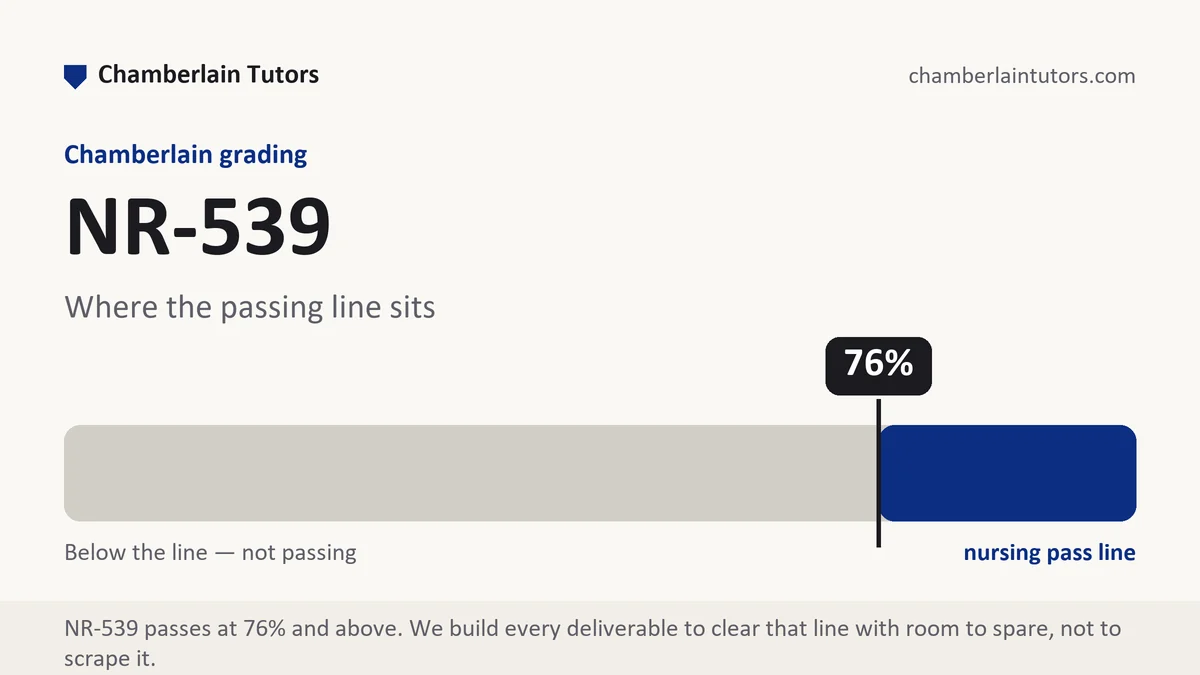
Core nursing courses pass at 76 percent, and where a track uses the nurse practitioner specialty scale, which has no C band, the last passing number is 84. The second course of a sequence carries an inherited risk: if the population you assessed earlier was defined loosely, every plan you write now rests on a foundation that cannot support a measurable target.
Two eight week sessions inside every sixteen week semester, up to six starts a year, a deliverable each week, and no supplementary work that repairs a weighted average. If your earlier assessment left a gap, fix the gap in week one with a short paragraph rather than building on it for eight weeks.
Turn the criterion rows into a section plan
Copy the rows into a blank file in printed order and reduce each to its verb: plan, justify, implement, measure, evaluate. Those verbs become your headings in the guide's own sequence, which stops a plan from being organized by activity when the rubric is organized by reasoning.
Then convert weight into a word budget. Suppose the assignment caps you at 1,850 words across four rows weighted 40, 25, 25 and 10 percent, giving roughly 740 words, 462, 462 and 185. The 740 word row is almost always the intervention plan and its justification, which means the chain from activity to outcome written out link by link rather than asserted. The two 462 word rows are usually implementation and evaluation, and evaluation is the one that gets compressed because it comes last in the document and last in the week. The 185 word row is one paragraph, often sustainability or a conclusion.
Keep the target beside each heading while drafting. Title page and references sit outside the count unless your guide says otherwise, and a logic model, a timeline or a measurement table usually does as well, which is the efficient home for the detail.
The shape of a population intervention plan
Most graded writing here is a plan for a population focused intervention with implementation and evaluation attached. Each part below is a link in the plan, and a missing link stops the chain.
| Part | What it has to establish | How the thin version reads |
|---|---|---|
| The target, quantified | What changes, in which group, by how much, by when, from a stated baseline. | A goal to improve health in the community. |
| The evidence for this approach | Where this intervention has worked, in what population, with what design and what effect. | A statement that the approach is evidence based. |
| The logic chain | Resources to activities to outputs to short term change to outcome, each link stated. | An activity followed immediately by a health outcome. |
| Partners and reach | Who delivers it, who else must agree, and how many people it realistically touches. | A plan delivered by an unspecified team to everyone. |
| Implementation detail | Sequence, timing, location, staffing and what happens in the first month. | A start date and a hope. |
| Evaluation, both kinds | Process measures for fidelity and reach, outcome measures with baseline, source and interval. | A plan to survey participants at the end. |
Evidence and citation craft for intervention planning
The evidence you cite here has to justify doing a specific thing to a specific group, which is a heavier burden than describing a problem.
- Currency, with the reason stated. Intervention evidence older than five years may predate changes in the services, technology or population it depended on. Where you use it, say why the mechanism still holds.
- Cite the trial or evaluation, not the programme website. Organizations describing their own initiatives are reporting intentions and outputs. The evidence that something changed comes from an evaluation with a comparison.
- Design, population and setting before the effect. Write that a cluster randomized trial across 24 community sites enrolled 3,100 adults and compared a peer led programme against usual services over 18 months, then the effect. Population interventions transfer poorly, so the setting is part of the claim.
- Verbs the design can pay for. Communities receiving the programme had higher screening uptake is defensible from a controlled evaluation. Programmes like this raise uptake generalizes further than one study can support, and uncontrolled before and after work supports even less.
- Denominator and window on every rate, including your own targets. Write that 640 of the 2,800 eligible adults completed screening in the twelve months before the programme, and set your target on the same base and period. A target expressed as a percentage improvement with no base is not measurable, and it is the most common flaw in the evaluation row.
The gap between a passing plan and a strong one
A passing NR-539 plan identifies a real problem, proposes a reasonable programme, names partners and promises evaluation. It is well intentioned and unmeasurable, because the target has no baseline and the evaluation has no interval.
Strong plans quantify the target against a baseline, which forces every other section to become specific. They write the logic chain out so a reader can see where it might break, and they say which link they consider weakest. They plan process evaluation alongside outcome evaluation, so that a disappointing result can be diagnosed as either a failed idea or a failed delivery rather than remaining a mystery. And they state what the plan does not address, because a population problem with several determinants and an intervention aimed at one is honest work rather than a limitation to hide.
Six mistakes that cost points here
- Education for a structural barrier. If people cannot reach a service, teaching them about it changes nothing. Match the intervention to the level of the cause.
- Targets with no baseline. A goal to increase something by a fifth means nothing without the starting figure, the base and the period.
- A missing middle in the chain. Activity to outcome with no outputs and no short term change is where most plans quietly fail.
- Outcome evaluation only. Without process measures a null result cannot be explained, and the evaluation row is scored on that distinction.
- Reach nobody checked. A programme reaching thirty people cannot move a county level indicator. Say what proportion of the population you touch.
- Posting to the board from the text box. Chamberlain posts do not reopen once submitted. Draft elsewhere, verify the figures, then paste.
Questions NR-539 students ask
How ambitious should the target be?
What goes in a process evaluation?
Can I plan something my organization would never fund?
Where NR-539 sits in Chamberlain's programs
Open the exact program map for sequence, credit, and option context. The current student schedule and syllabus remain authoritative after transfer evaluation, electives, state rules, and approved plan changes.
The weeks, one by one
Week 1
A second population health course opens where the first one stopped, and the opening written work in NR-539 usually asks you to convert an assessment finding into something a plan can actually be built on. Read the full Week 1 manual.
Week 2
The second stage of a planning course is normally where the chain gets drawn: inputs to activities, activities to outputs, outputs to short-term changes, and only then to the health outcome you named last week. Read the full Week 2 manual.
Week 3
A third stage in a planning course is normally where you stop describing and start choosing. Read the full Week 3 manual.
Week 4
Midway through a planning course the writing usually changes register. Read the full Week 4 manual.
Week 5
Around the midpoint a planning course usually turns outward. Read the full Week 5 manual.
Week 6
Evaluation is the half of this course's title that students reach with the least word budget left, and it is the half that separates a plan from a proposal. Read the full Week 6 manual.
Week 7
Late in a planning course the writing usually turns to results and their audience. Read the full Week 7 manual.
Week 8
The closing stage of a planning course usually asks two things at once: what keeps this program alive after the pilot ends and the attention moves on, and whether the seven stages behind you assemble into a single coherent document. Read the full Week 8 manual.