The closing stage of a planning course usually asks two things at once: what keeps this program alive after the pilot ends and the attention moves on, and whether the seven stages behind you assemble into a single coherent document. Sustainability is not a hopeful paragraph. It is a named budget line, a named owner, a place in an existing workflow, and a maintenance measure that somebody still reads in month eighteen. Your section may print this as NR 539 or NR539; it is the same course. Chamberlain publishes no syllabi outside Canvas. The placement here is our teaching judgment from the course's catalog arc; your section's rubric decides what your week actually asks.
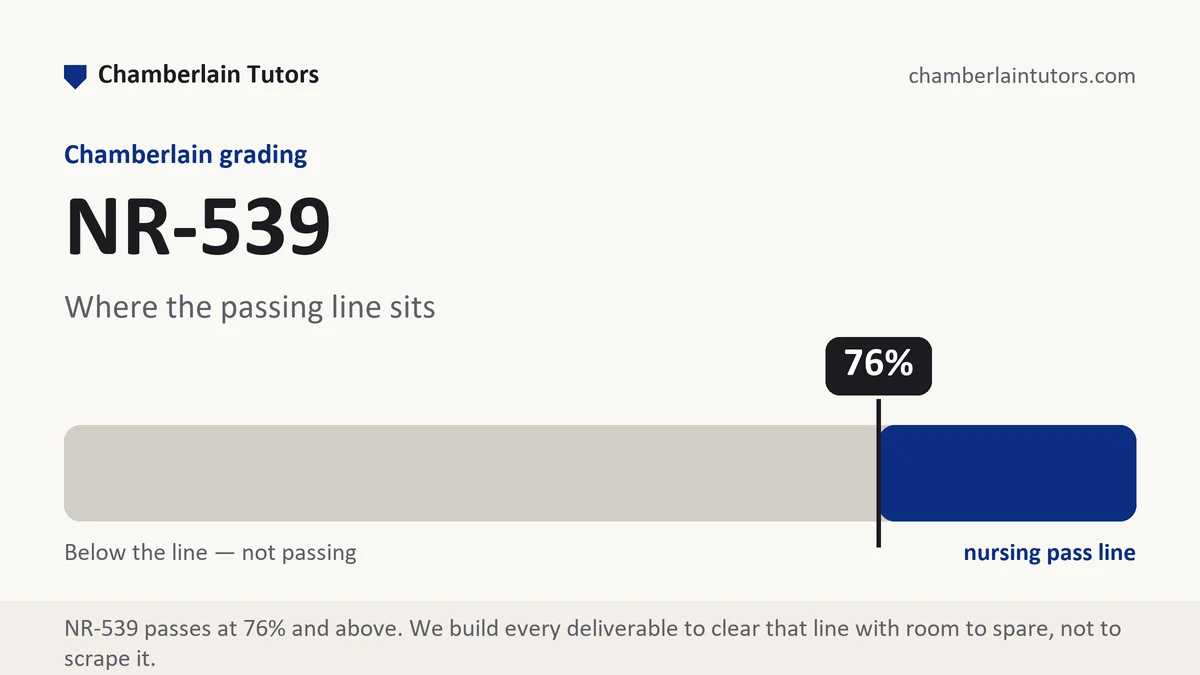
What NR-539 Week 8 asks for
Programs die quietly. A school-based referral pathway for adolescent behavioral health can run beautifully for a semester because a nurse practitioner and a school counselor happen to trust each other, then vanish in September when one of them changes district. Nothing failed clinically. What failed was that the pathway never became anyone's job description, never appeared in a budget, and never generated a number that a supervisor was accountable for. A sustainability section that names those three things is worth more than three pages describing the program's importance, and this stage is where a grader checks whether you know the difference.
The second demand is assembly. Final deliverables in planning courses are usually cumulative, which means the paper you submit contains the population definition from the opening stage, the logic model, the intervention justification, the implementation schedule, the engagement layer, the evaluation design, and now the sustainability plan. Assembly is not concatenation. The population sentence written in the first stage must be the same population your evaluation denominator uses, and every place those drifted apart is a defect the reader will find because it is easier to spot in a long document than a short one.
Deliverables here are commonly a final project, a portfolio, an executive summary, sometimes a presentation, and often a closing reflection. If a discussion runs, use it to name the single most fragile part of your plan rather than to summarize the session. Write it as final copy, since posts do not reopen after submission in Canvas.
The NR-539 Week 8 method, step by step
Six moves for closing a plan and assembling it.
-
Reconcile your numbers across all seven stages first
Open every earlier submission side by side and check that the denominator, the baseline, the target and the timeline agree. Fixing a drifted number takes ten minutes now and costs a whole coherence row if it survives to submission.
-
Name where the program's cost lives after the pilot ends
Absorbed into existing staff time, added to a departmental budget, covered by a grant with a stated end date, or offset by an avoided cost. Vague continued support is the sentence that identifies a plan nobody has thought through.
-
Embed each activity in an existing routine rather than a new one
A step that happens inside a visit workflow, a standing meeting or an existing report survives staff turnover. A step that depends on a dedicated committee formed for the project usually does not outlive the project.
-
Reduce the measurement set to what a busy site will actually keep
Pick one or two indicators for ongoing monitoring, name where they will be displayed, and say who looks at them and how often. A twelve-measure evaluation set becomes zero measures within a year.
-
Write the spread decision with its conditions
Under what result does this go to the other offices, in what order, with what adaptation. Spread written as a conditional plan reads as leadership; spread asserted as an aspiration reads as filler.
-
Write the executive summary last and from the results outward
One page: the problem in two sentences, the intervention in two, what it would take, what it would produce, and the decision you are asking for. Written last, it is a summary; written first, it becomes a promise the document then has to keep.
A layout and word budget for a final plan and sustainability section
Our frame for the closing document, sized for roughly 1,300 to 1,600 words of new material on top of the revised earlier sections. It is our own outline rather than anything the university issues, and your week's scoring guide outranks it wherever they disagree.
| Component | What has to be settled in it | Word target |
|---|---|---|
| Executive summary | Problem, intervention, cost, expected result and the decision requested, in one page and no jargon. | 230 to 280 |
| Financial continuation | Where the money and the hours come from after the pilot, with an end date on any temporary source. | 210 to 250 |
| Structural embedding | Which existing workflow, job description, report or meeting now carries each surviving activity. | 210 to 250 |
| Ongoing monitoring | The one or two measures kept, where they appear, who reviews them and what triggers a response. | 170 to 200 |
| Spread and adaptation | The conditions for expanding, the order of sites, and what would have to change at each new one. | 190 to 230 |
| Limitations and closing judgment | What the plan still cannot do, and a direct statement of what the reader should conclude. | 170 to 210 |
Evidence craft for sustainability writing
Use a published sustainability framework rather than a personal list. Frameworks exist that break sustainability into components such as funding stability, organizational capacity, partnerships, workforce and adaptation. Naming one and using its categories as your headings gives the section a structure a grader can score against, and it stops the paragraph from becoming a list of hopes.
Support any cost-offset claim or say plainly that it is an estimate. Avoided visits, avoided admissions and reduced staff time are legitimate arguments only when you can point at a published figure for the unit cost and state the assumption chain. A number with a visible derivation is persuasive; a confident savings figure with no origin is the fastest way to lose a reviewer.
Cite evidence about program discontinuation, not just program effect. There is published work on why interventions fade after the pilot period, and a sentence or two grounded in it makes your embedding choices look reasoned rather than arbitrary. It also gives you the vocabulary to name the specific failure mode your design is guarding against.
Keep the final claims inside the written layer. This is a theory course and the graded product is a plan on paper. Where your program requires clinical hours, direct care, preceptor signatures or logged activity, those remain entirely yours to perform and to document, and nothing in a writing manual substitutes for them. What we support is the document, which is where every point in this course is scored.
Five mistakes that cost points in this week's territory
- Sustainability written as enthusiasm. Continued stakeholder commitment names no budget, no owner and no workflow, so it guarantees nothing.
- Numbers that drifted between stages. A denominator in the final paper that contradicts the opening definition undermines every claim built on it.
- An executive summary written first. Summaries drafted before the analysis routinely promise more than the finished document delivers.
- Every measure kept forever. A monitoring set that ignores collection burden will be abandoned entirely rather than trimmed.
- A closing section with no judgment. A final plan that summarizes without recommending has skipped the one thing a decision-maker opened it for.
Before you submit
- Population, denominator, baseline and target agree across every section
- The post-pilot funding source is named, with an end date if it is temporary
- Each surviving activity sits inside an existing workflow or job description
- The ongoing monitoring set is small and has a named reviewer
- Spread is written as a condition, not an aspiration
- The executive summary was drafted last and requests a specific decision
Assembling the final NR-539 plan?
Send all eight stages, the final prompt and the rubric out of Canvas. A premium original draft comes back in 24 to 48 hours with numbers reconciled across sections and sustainability written as budget, owner and workflow, and revisions run until the grade lands.