NR-527 is the three theory hour course on advanced communication and collaboration at three levels at once: between individuals, across populations, and inside systems. The three levels are what the rubric rows are built on. A paper that handles a difficult conversation beautifully and never rises to the population or system level has answered a third of the assignment.
What NR-527 actually grades
The interpersonal level is scored on structure rather than warmth. You are expected to show a communication episode with its moves visible: what was said, what the other person heard, where the exchange broke, and which technique would have changed the outcome. Reporting that a conversation went badly because a colleague was defensive is a description. Naming the moment the exchange turned and the specific alternative move is analysis.
The population level asks something different. Communication aimed at a group has to account for reach, literacy, channel and trust, and a message that would work in a clinic room often fails at scale for reasons you are expected to predict rather than discover.
The systems level is where most points are quietly available, because most students skip it. Handoffs, escalation pathways, documentation conventions and meeting structures are all communication designed into an organization, and analyzing one of them as a designed thing rather than as a habit is the move that separates graduate writing from a reflection.
How we help in this course
NR-527 is theory only, so nothing on our side touches placement, preceptors, site paperwork or logs.
Send the prompt and the scoring guide from Canvas and a premium original draft returns in 24 to 48 hours, planned against the criterion rows, with each level of communication answered rather than the one that came easiest. Both quality passes and the floor check run before it reaches you, and revision is free until the piece lands.
Writing this course's deliverables from the rubric
Rubric first, then the level, then the episode. Choosing the story before checking which level the rubric wants is how a vivid account of a conflict ends up scoring in the middle of a systems assignment.
In NR-527 right now?
Send the week and the rubric from Canvas. First premium sample free, floor-checked, back in 24 to 48 hours.
A soft sounding course with a hard floor
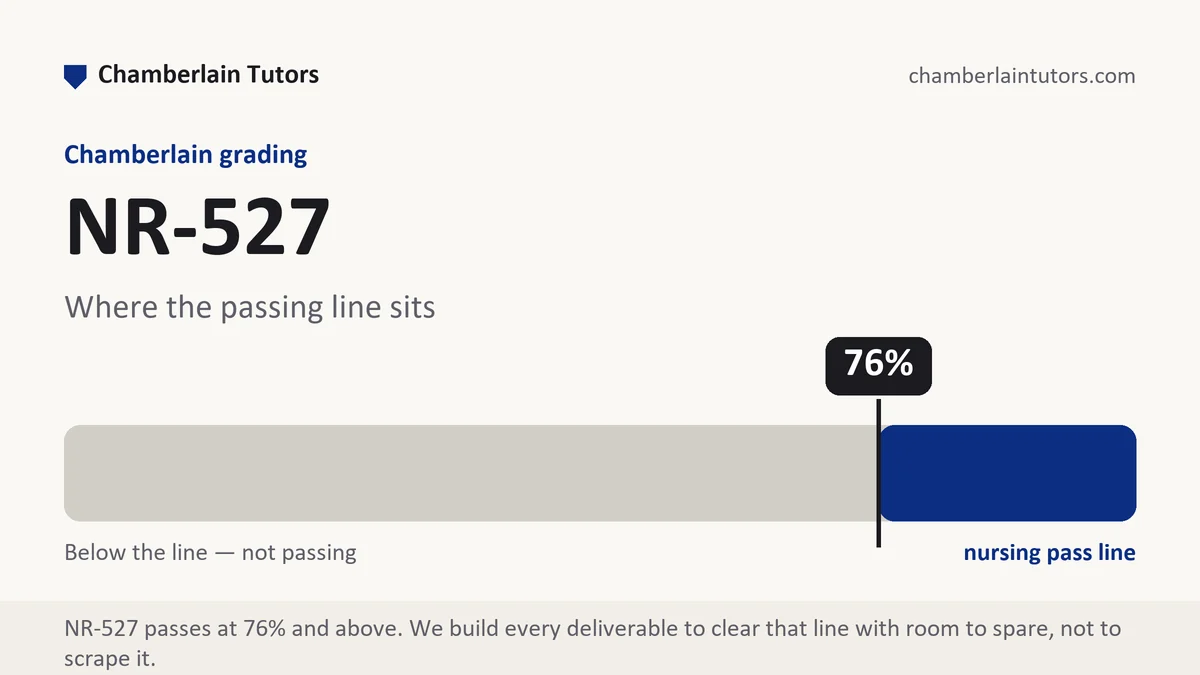
Core nursing courses pass at 76 percent, and where your track uses the nurse practitioner specialty scale there is no C band, which puts the last passing number at 84. Communication courses collect low grades from confident writers, because fluency feels like the thing being measured and it is not. Structure is.
The clock is the usual one. The clock is the usual one: two eight week sessions inside a sixteen week semester, as many as six starts a year, a deliverable every week, and no supplementary work that can lift a weighted average. In a course where the writing comes easily, the risk is spending the week on prose and never checking the draft against the rows.
Turn the criterion rows into a section plan
Paste the rows into a blank file in printed order and reduce each to its verb: describe, analyze, apply, evaluate, propose. Headings follow the verbs in the guide's own sequence, which is worth more in this course than in most, because communication assignments invite a narrative order that does not match the scoring order.
Then convert the weights into words. Say the assignment caps you at 1,300 words with four rows weighted 35, 30, 25 and 10 percent, giving roughly 455 words, 390, 325 and 130. The shape carries a warning: the 10 percent row, usually a short reflection or a self assessment, takes one paragraph and no more, while students routinely give it three because it is the most comfortable part of the assignment to write. Meanwhile the 455 word analysis row, where the technique and the theory have to be applied to the episode, is the one that gets compressed at midnight.
Keep the number beside each heading while drafting and clear it as the section fills. Title page and references sit outside the count unless your guide says otherwise, and a dialogue excerpt in an appendix usually does as well.
The shape of a communication analysis
Most graded writing here is an analysis of a communication episode or a collaboration structure. These parts recur, and each is something a grader is looking for.
| Part | What it has to establish | How the thin version reads |
|---|---|---|
| The situation and the stakes | Who was involved, what decision was in play, and what a failure would have cost, in one paragraph. | A story told for its own sake with no decision attached. |
| The exchange, reconstructed | What was actually said or written, closely enough that a reader can locate the turning point. | A summary of how the conversation felt. |
| The break, located | The specific moment where meaning failed to transfer, and why, using named concepts. | A general observation that communication broke down. |
| Theory or technique applied | A named framework or structured tool used to explain the break and to design the alternative. | A tool mentioned once with no application. |
| The alternative move | What you would say or build instead, concretely enough to be tried tomorrow. | Advice to communicate more openly. |
| Level shift | What the same failure would look like at population or system scale, and what that implies for design. | The analysis staying entirely between two people. |
Evidence and citation craft in a communication course
The literature here mixes communication research, patient safety work and organizational studies, and it is easy to cite loosely because the claims sound obvious.
- Currency with a stated reason. Structured communication tools and team training programs are revised, and the versions matter. Where a source is older than five years, put the justification in the sentence; foundational theory usually survives, adoption and outcome figures usually do not.
- Cite the study, not the training slide. Claims about how many adverse events involve communication failure circulate widely with no traceable origin. Follow the figure back to the analysis that produced it or leave it out.
- Design and setting before the finding. Write that a pre and post evaluation on four surgical units measured handoff omissions before and after a structured tool, then the result. Team communication studies are usually single site, and that is a boundary on your argument rather than a flaw to conceal.
- Verbs the design can pay for. Most team training evidence is uncontrolled and confounded by attention effects. Units adopting the tool reported fewer omitted items is honest. The tool reduces omissions is a claim beyond what a before and after evaluation supplies.
- Denominator and window on every rate. Write that 92 of the 730 handoffs observed over three months omitted at least one required element, rather than that 13 percent did. Observation counts and periods change what the number means.
The gap between a passing paper and a strong one
A passing NR-527 paper tells a real story, names a communication concept, and concludes that better collaboration improves care. It reads well and it asserts more than it analyzes, which is precisely how the middle band of a scoring guide is worded.
Strong papers reconstruct rather than summarize, so the reader can see the exchange and judge the diagnosis. They accept some of the responsibility, because an analysis in which the writer was entirely reasonable and everyone else was not has nothing to learn from. And they climb the levels, showing that the same breakdown is a design flaw in a handoff structure or a population message, which is the reasoning that turns an incident into a graduate level argument.
Six mistakes that cost points here
- Telling the story and stopping. Narrative is the setup. The analysis row wants concepts applied to the moment the exchange failed.
- Staying at one level. Where the rubric names population or systems, an interpersonal answer leaves rows unfed.
- Recommending openness. Communicate better is not an intervention. Name the structure, the script or the checkpoint you would change.
- Identifying colleagues. Keep people unidentifiable and units generic. A paper that reads as a complaint about a named person creates a problem no grade repairs.
- Quoting unsourced safety statistics. The widely repeated figures about communication and harm need a traceable origin before they earn a place.
- Posting to the board from the text box. Chamberlain posts cannot be edited once submitted, which matters most in a course where classmates disagree. Draft elsewhere and read it once before pasting.
Questions NR-527 students ask
How do I write about a conflict without it reading as a complaint?
What counts as a systems level communication problem?
Do I need to use a named communication tool?
The weeks, one by one
Week 1
NR-527 Week 1 opens the course at ground level: what communication actually is when nursing is practiced at an advanced level, which frameworks describe it, and where your own habits sit against those frameworks. Read the full Week 1 manual.
Week 2
NR-527 Week 2 moves from the map to the first level on it: the exchange between one clinician and one patient, where therapeutic technique either happens in the actual sentences or does not happen at all. Read the full Week 2 manual.
Week 3
NR-527 Week 3 stays at the interpersonal level but changes the other party: the colleague who disagrees, the physician who cuts you off, the peer whose incivility everyone absorbs. Read the full Week 3 manual.
Week 4
NR-527 Week 4 widens the lens from two people to the team: how a group of different disciplines shares one patient's information, and how structured tools, standard handoff formats, briefings, closed-loop orders, exist to stop meaning from leaking between roles. Read the full Week 4 manual.
Week 5
NR-527 Week 5 climbs to the second level on the course's map: communication aimed at a population rather than a person, where the audience cannot answer back, literacy varies across the whole range, and the channel decides who ever receives the message at all. Read the full Week 5 manual.
Week 6
NR-527 Week 6 reaches the third level on the course's map: communication that nobody speaks, because it is built into the organization, escalation pathways, documentation conventions, alert routing, the standing meeting and its agenda. Read the full Week 6 manual.
Week 7
NR-527 Week 7 puts a screen, a portal or a phone line between the parties and asks what survives. Read the full Week 7 manual.
Week 8
NR-527 Week 8 closes the course by asking for synthesis: one argument that runs the three levels together, showing how a communication ability you have examined all session operates between individuals, across a population and inside a system at once. Read the full Week 8 manual.
Where NR-527 sits in Chamberlain's programs
Open the exact program map for sequence, credit, and option context. The current student schedule and syllabus remain authoritative after transfer evaluation, electives, state rules, and approved plan changes.