NR-527 Week 2 moves from the map to the first level on it: the exchange between one clinician and one patient, where therapeutic technique either happens in the actual sentences or does not happen at all. Your section may print this as NR 527 or NR527; it is the same course. Chamberlain publishes no syllabi outside Canvas. The placement here is our teaching judgment from the course's catalog arc; your section's rubric decides what your week actually asks.
What NR-527 Week 2 asks for
After a framework week, the natural next territory is the interpersonal level with patients, because it is the level every nurse already inhabits and the one where technique is easiest to demonstrate on paper. The named moves of therapeutic communication, open-ended questions, reflective listening, silence held on purpose, summarizing, and the comprehension check that asks the patient to say the plan back, are each visible in a transcript. That visibility is the point. Written work in this territory usually asks you to reconstruct a patient encounter and show the techniques operating in the actual dialogue, not to assert that you used them.
The distinction the week turns on is between warmth and technique. Warmth is a disposition; technique is a sequence of observable moves that changes what the patient says next. A paper can be warm on every line and show no technique anywhere, and in a graduate course the technique is what the scoring rows can credit. Expect the strongest weight to fall on your ability to name the move, quote the line where it happened, and trace what it produced in the patient's response.
If your section runs a discussion this week, the same standard shrinks to post size: one encounter, one technique, one traced effect. Draft it outside Canvas and read it once before pasting, because posts cannot be edited once submitted, and dialogue excerpts are where typos hide.
The NR-527 Week 2 method, step by step
Six moves that turn a remembered conversation into an encounter analysis.
-
Read your week's rubric before choosing the encounter
Rows built on analyze and apply want technique traced through dialogue; rows built on describe tolerate summary. Where the guide names specific techniques, your encounter has to contain at least a place where each one belonged, used or missed.
-
Choose an encounter where the patient's understanding was in doubt
New diagnoses, medication changes, discharge instructions and refusals all qualify. An encounter where nothing was at stake gives technique nothing to do, and the analysis will show the strain of inventing significance.
-
Reconstruct the dialogue before you interpret one line of it
Write the exchange as close to verbatim as memory allows, in order, with the patient unidentifiable. Reconstruction first keeps the interpretation honest, because a dialogue written after the analysis tends to bend toward it.
-
Label the moves, yours and the ones you missed
Mark each turn where a named technique appears, and mark the turns where one belonged and did not appear. The missed moves are worth more on paper than the made ones, because they show you can see the encounter from outside your own performance.
-
Trace each technique to what the patient said next
An open-ended question matters because of what it opened. Quote the patient's response and say what it revealed that a closed question would have left buried. Technique without traced effect is name-dropping in dialogue form.
-
End with the rewritten exchange, not with a resolution
Take the weakest moment and write the two or three turns you would run instead, with the technique visible in the wording. A concrete rewrite is the deliverable's proof that the analysis produced something usable.
A layout and word budget for an encounter analysis
This is the frame our tutors keep beside patient-encounter work, sized for roughly 1,100 to 1,300 words. It is a tutor's scaffold rather than anything the university issues, and your week's rubric outranks it wherever the two disagree. Scale the targets proportionally if your assigned length differs.
| Section | What belongs in it | Word target |
|---|---|---|
| The encounter and its stakes | Setting, what was clinically in play, and what a communication failure would have cost, with the patient unidentifiable. | 120 to 150 |
| The dialogue, reconstructed | The exchange in order, close to verbatim, long enough that a reader can see the turns without commentary. | 220 to 280 |
| Techniques used, traced | Each named move located in a quoted line and followed into the patient's response. | 240 to 280 |
| Techniques missed | The turns where a named move belonged and did not happen, and what the absence cost. | 180 to 220 |
| The rewrite | The weakest moment rerun in two or three turns of new dialogue with the technique visible in the wording. | 150 to 190 |
| Close | The one habit this analysis changes in your next encounter, stated as a checkable behavior. | 80 to 100 |
Evidence craft for patient communication writing
Anchor each technique to literature, not to habit. Every named therapeutic move has a research base describing what it does to disclosure, recall or adherence, and the sentence that introduces a technique should carry a source saying what it is for. A technique introduced by custom alone reads as folklore in a graduate paper.
Claims about understanding need the study's own terms. Work on comprehension checks reports how often patients could restate instructions, in which populations, at what time after teaching. Cite those terms rather than the rounded slogan, because the rounded version is usually stronger than the study and a grader who knows the literature will notice.
Keep effect claims inside the design that produced them. Much patient communication research is observational or single-site, which supports wording like patients asked more questions or recall improved in this sample. It does not support the technique guarantees anything, and the verb you choose is scored material in a course about language.
Numbers arrive with denominator and setting. If you cite how many patients misunderstood their discharge instructions, say how many out of how many, where, and when the measurement happened. A percentage traveling alone tells the reader nothing about whether it transfers to your unit.
Five mistakes that cost points in this week's territory
- Summarizing the conversation instead of reconstructing it. A paragraph about how the talk went denies the grader the evidence, and the analysis rows have nothing to score.
- Asserting empathy instead of showing a move. I showed empathy is a claim; the quoted reflective statement and the patient's answer to it are the demonstration.
- Analyzing only your best moments. An encounter in which you made no errors reads as curated, and the missed-technique material is usually where the strongest marks live.
- Making the patient identifiable. Age band, setting type and clinical situation are enough. Names, exact dates and rare diagnoses in combination can identify a person as surely as a photograph.
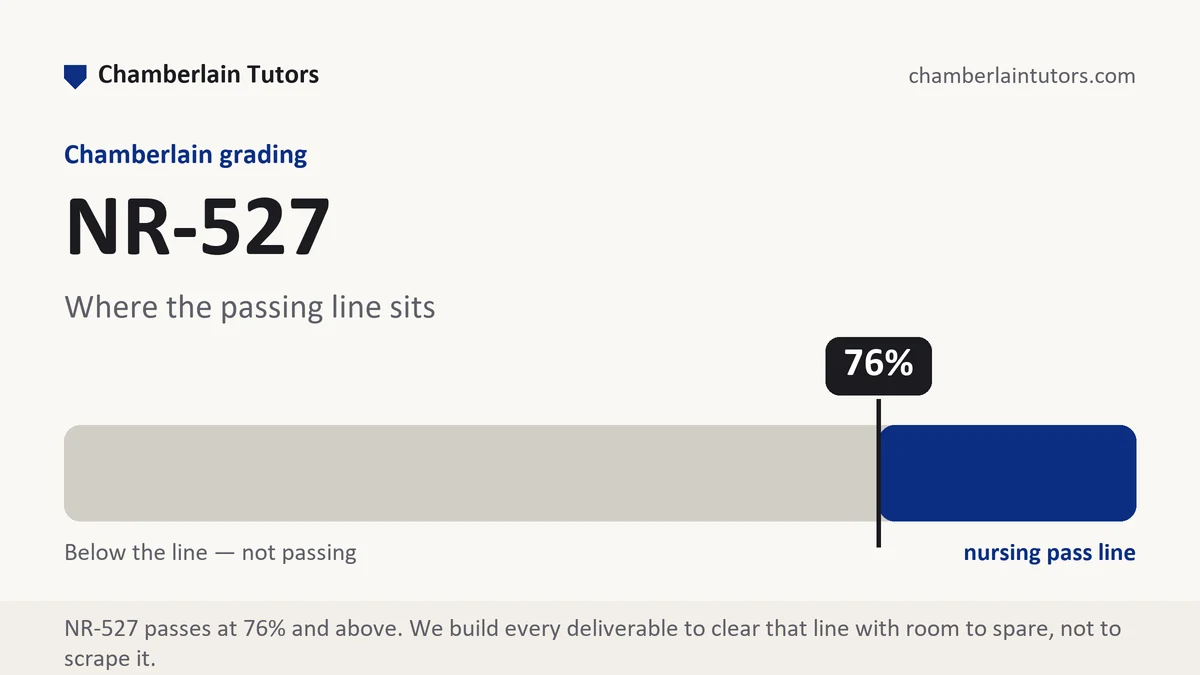
- Spending the week on prose and skipping the trace. Fluent commentary that never follows a technique into the patient's next line misses the mechanism the rubric is built to reward, and with the 76 percent floor under core courses, a middle-band week two is a debt the session has to repay.
Before you submit
- The encounter has real clinical stakes and an unidentifiable patient
- The dialogue is reconstructed in order before any interpretation
- Every named technique is located in a quoted line
- At least one missed technique is analyzed with its cost
- The rewrite shows the technique inside new wording
- Every general claim about communication carries a dated source
In NR-527 Week 2 right now?
Send the instructions and the rubric out of Canvas. A premium original draft comes back in 24 to 48 hours with the dialogue analyzed turn by turn, and revisions run until the grade lands.