NR-527 Week 8 closes the course by asking for synthesis: one argument that runs the three levels together, showing how a communication ability you have examined all session operates between individuals, across a population and inside a system at once. The graded skill is integration, which is a different act from summary. Your section may print this as NR 527 or NR527; it is the same course. Chamberlain publishes no syllabi outside Canvas. The placement here is our teaching judgment from the course's catalog arc; your section's rubric decides what your week actually asks.
What NR-527 Week 8 asks for
Final stages in a levels-based course almost always ask you to demonstrate that the levels were one subject all along. The classic closing deliverable is an integrative piece: a communication improvement argument for your own practice that draws on the session's whole arc, the framework vocabulary, interpersonal technique, conflict structure, team tools, population design, systems reading, mediated channels, without touring it. The distinction that decides the grade is between synthesis and summary. Summary walks back through the weeks in order, reporting what each contained. Synthesis picks one thread, one ability, one recurring failure, one improvement worth making, and uses whichever prior material advances that argument, in the argument's own order.
The strongest closing papers are built around a single claim about your own practice that the session has equipped you to defend: that one specific communication behavior, changed at all three levels, would measurably improve something you can name. That shape forces integration naturally, because defending the claim at the interpersonal level requires technique, defending it at scale requires design vocabulary, and defending it structurally requires the systems reading, and none of the material arrives as a recap.
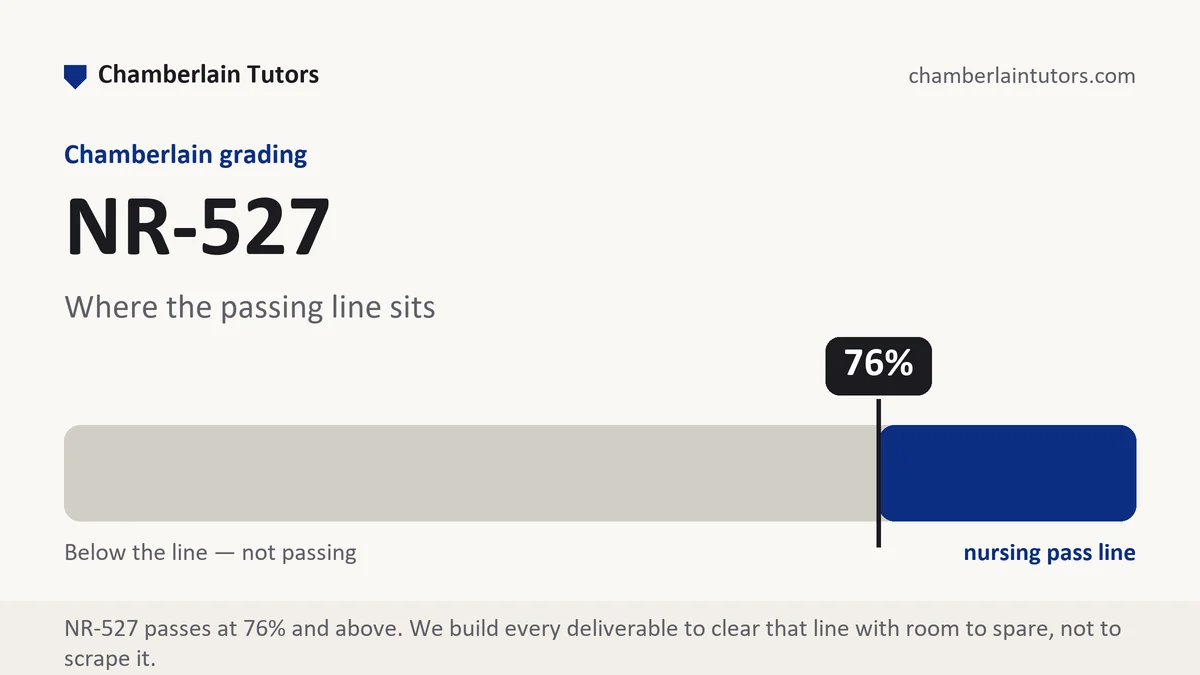
Expect the writing standard to be at its strictest here. A closing paper is graded by someone who has read your prose for seven prior stages and knows what you can do. It is also due in the same week as everything else that closes a session, which is why the papers that score best are usually the ones started earliest. The 76 percent floor on core courses does its final arithmetic this week, and on nurse practitioner specialty tracks the scale is tighter still, with anything below 84 failing, so a closing deliverable is not the place to bank on momentum.
The NR-527 Week 8 method, step by step
Six moves that turn eight stages of material into one argument.
-
Read your week's rubric for the integration verbs
Synthesize, integrate and evaluate rows are paid differently from describe rows, and a closing guide usually weights them heavily. Mark which rows demand cross-level work, because those are the ones a week-by-week recap cannot feed.
-
Choose the one thread your practice actually needs
Look back over your session's work and find the failure that kept reappearing: the missing comprehension check, the avoided conversation, the leaky junction. The thread that showed up at more than one level is your argument, because the levels are where the marks are.
-
Write the claim before rereading anything
One sentence: this behavior, changed in these ways, would improve this outcome in my practice. Writing the claim first prevents the paper from becoming an anthology, because material that does not serve the sentence now has no way in.
-
Run the claim through the three levels in the claim's order
Show the behavior operating between two people, then at population or team scale, then inside the structure that shapes it. Each level should borrow its vocabulary from the session's material, cited fresh, and each should end one step further into the argument.
-
Set the measure of improvement
Say what you would observe in ninety days if the change took: a count, a sampled check, a recurring event that stops recurring. A synthesis that ends in intention has skipped the course's own lesson about checking what landed.
-
Cut everything that is only there because it happened
The last pass removes the recap sentences, the weeks that did not serve the claim and the citations carried out of habit. A shorter argued paper outscores a longer remembered one every time this territory is graded.
A layout and word budget for an integrative synthesis
This is the frame our tutors keep beside closing work in this course, sized for roughly 1,200 to 1,500 words. It is a tutor's scaffold rather than anything the university issues, and your week's rubric outranks it wherever the two disagree. Scale the targets proportionally if your assigned length differs.
| Section | What belongs in it | Word target |
|---|---|---|
| The claim | The one communication behavior, the change proposed, and the outcome it would move, stated before any review of the course. | 100 to 130 |
| The thread's evidence | Where this failure or ability surfaced across the session's territory, compressed to what the claim needs. | 180 to 220 |
| The interpersonal level | The behavior operating between two people, with technique vocabulary doing the work. | 220 to 260 |
| The wider level | The same behavior at team or population scale, where design replaces improvisation. | 220 to 260 |
| The systems level | The structure that currently shapes the behavior and the structural change that would hold the improvement. | 220 to 260 |
| The measure and close | What gets observed in ninety days, and the single sentence the course has earned. | 130 to 160 |
Evidence craft for a closing synthesis
Recited sources read differently from used ones, and a closer sees both. Every source in the final paper should be doing work for the claim in the sentence where it appears. A reference list assembled from the session's readings, attached to a paper that never leans on them, is visible at a glance to the person who assigned those readings.
Your earlier conclusions are citable as experience, not as literature. What you found in your own prior analyses belongs in the paper as your practice's evidence, in your own voice. The published claims underneath it still need their original sources, freshly cited, because your week 3 paper is not a source a reader can retrieve.
Synthesis multiplies the chance of citation drift, so audit at the end. Pulling material from eight weeks of notes is how a claim migrates from one source to another and how a figure loses its denominator in transit. The final pass checks every number and attributed idea against its origin, not against your notes.
Let the strongest claim in the paper be the most carefully supported. The sentence doing the most work, usually the claim itself, deserves the best evidence you have, stated with design and setting. Papers often support the background generously and leave the central claim running on confidence, which is exactly backwards.
Five mistakes that cost points in this week's territory
- The tour. A paper organized as week one taught me, week two taught me, is a summary wearing a synthesis's title, and the integration rows score it as the middle band they were worded for.
- A new topic in the final week. The closing paper is not the place to introduce material the session never touched. The assignment is integration of what happened, not one last expansion.
- Levels visited but never connected. Three sections that each handle one level, without the argument that binds them, reproduce the course's table of contents rather than its point.
- Improvement without a measure. A commitment to communicate better in future is the closing line this course exists to make impossible. Name the observable.
- Banking on the deadline. Closing weeks stack every course's final work into the same days, and a synthesis drafted the night before reads exactly like one. Start it in week seven; your week 8 self will inherit an argument instead of a blank page.
Before you submit
- The claim appears in the first paragraph and never changes shape
- Every prior-week reference serves the claim rather than the calendar
- All three levels are connected by the argument, not just present
- The improvement has a measure, a window and an observer
- Every figure and attributed idea was checked against its original source
- The recap sentences are gone and the paper is shorter for it
Closing NR-527 this week?
Send the instructions and the rubric out of Canvas. A premium original draft comes back in 24 to 48 hours argued rather than recapped, and revisions run until the grade lands.