NR-507 Week 8 closes the session in the tissue with the least tolerance for error, the central nervous system, and then asks you to put the eight weeks together in one patient who has more than one thing wrong. Your section may print this as NR 507 or NR507; it is the same course. Chamberlain publishes no syllabi outside Canvas. The placement here is our teaching judgment from the course's catalog arc; your section's rubric decides what your week actually asks. Closing work is graded on synthesis: mechanisms that interact rather than mechanisms listed.
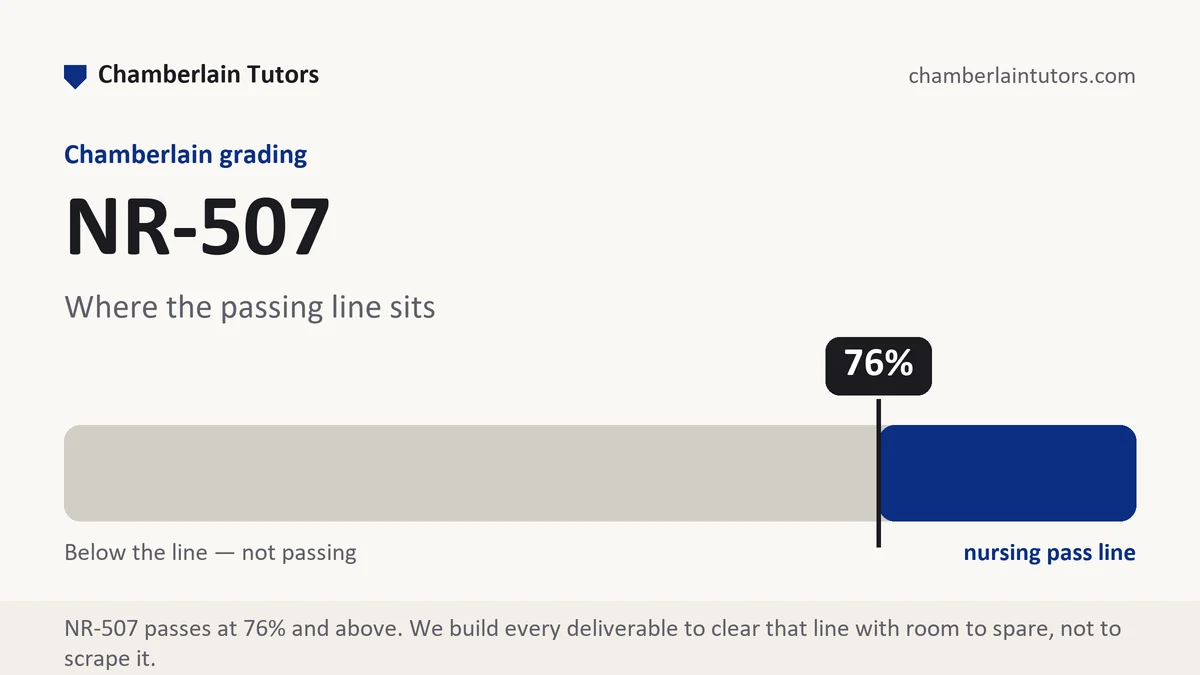
What NR-507 Week 8 asks for
The neurologic territory turns on a physical constraint. The skull is a fixed box holding brain, blood and cerebrospinal fluid, so anything new inside it, a bleed, a tumor, oedema, must be paid for by displacing something else, and once that buffering is spent, pressure climbs steeply and perfusion pressure falls. Ischemic and hemorrhagic stroke share a presentation and differ in mechanism, one an occluded supply with a salvageable border zone around a dead core, the other blood under pressure damaging tissue directly and by displacement. Seizure activity is a synchronization problem, degenerative disease is a slow loss of a specific neuron population, and pain divides into nociceptive signaling and neuropathic signaling from the injured nerve itself.
The integration half is the reason this stage sits last. Real patients carry combinations: the older adult with reduced renal clearance, chronic hypoxia and a new stroke, or the pregnant patient whose plasma volume, filtration rate and immune posture have all shifted. Lifespan modifiers belong here as mechanisms rather than as caveats: an infant's immature blood brain barrier and thermoregulation, an older adult's stiffened vessels, lowered reserve and blunted thirst.
Final-stage deliverables tend to be longer and more integrative than earlier ones, and they are the pieces most likely to decide a borderline grade on a scale where 84 is the last passing number. Draft any posted response outside Canvas, since posts cannot be edited once submitted.
The NR-507 Week 8 method, step by step
Six moves for a closing paper that has to hold more than one system at once.
-
Localize before you diagnose
Say what level the findings point to, cortex, brainstem, cord, root or peripheral nerve, and which side, using the crossing pattern of the tracts involved. Localization is evidence a grader can check, and it makes the diagnosis that follows look earned.
-
Split primary injury from secondary injury
The initial event is fixed by the time the patient arrives. What follows, oedema, raised pressure, falling perfusion, excitotoxic calcium entry, is where clinicians work. Writing that division explicitly answers the implications rows in almost any neurologic case.
-
Do the perfusion arithmetic out loud
Cerebral perfusion depends on the difference between systemic arterial pressure and intracranial pressure. State both sides and say which one moved. That single relationship explains why a falling blood pressure and a rising intracranial pressure are the same emergency from opposite directions.
-
Classify pain by pathway, not by severity
Nociceptive pain reports tissue damage through intact pathways; neuropathic pain is generated by the damaged pathway itself, which is why it burns, follows a nerve distribution and responds differently. Name the pathway and the rest of the paragraph becomes specific.
-
Build an interaction map, not a list
For a multisystem patient, write each mechanism as a line that ends somewhere: reduced clearance raises circulating levels, hypoxia raises pulmonary pressure, a raised right heart pressure limits venous drainage from the head. Two or three connected lines are worth more than six separate paragraphs.
-
Apply lifespan modifiers as mechanisms
Say what is physiologically different in this patient's age or state and what that changes. Lower reserve, altered barriers, changed body composition, shifted plasma volume. A closing paper that treats age as a mechanism rather than a footnote reads as advanced practice work.
A layout and word budget for an integrative final paper
Sized for a closing piece of roughly 1,500 to 1,800 words. It is our own drafting frame rather than a university form, and your week's rubric outranks it wherever the two differ.
| Section | What belongs in it | Word target |
|---|---|---|
| Patient and question | The presentation, the comorbid picture and the specific question the paper will answer. | 120 to 150 |
| Localization or primary process | Where the lesion sits or which process opened the sequence, argued from the findings. | 200 to 250 |
| Primary and secondary injury | The initial event, then the cascade that follows and remains open to intervention. | 300 to 350 |
| System interactions | Two or three mechanisms from earlier in the session shown acting on each other in this patient. | 350 to 400 |
| Lifespan and reserve | What age, pregnancy or frailty changes physiologically, and what that changes clinically. | 200 to 250 |
| Synthesis and close | The single sentence the whole paper supports, plus the monitoring priority it implies. | 180 to 220 |
Evidence craft for a closing integrative paper
Time windows are claims with sources. Statements about how long tissue remains salvageable, or how quickly a deficit becomes fixed, carry citations and usually carry ranges. Report the range rather than the tidiest number in the abstract.
Scales are instruments, not verdicts. Any severity or consciousness score you quote has an interrater reliability and a purpose. Say what the instrument measures and what it does not, and a grader reads a clinician rather than a chart summary.
Studies in one age group do not settle another. Neurologic and multisystem evidence in older adults, children and pregnancy diverge in ways that matter. Where you transfer a finding across those lines, say you are doing it and give the reason.
Spread the citations across the argument. Closing papers often carry six sources clustered in the first two sections and nothing under integration, which reads as unevenly evidenced. Every substantive claim in the synthesis section deserves support, and that section is where the heaviest rows usually sit.
Five mistakes that cost points in this week's territory
- Findings described without localization. Reporting weakness, pupil changes and speech difficulty as a list, with no statement of where a lesion would produce that combination, leaves the reasoning row untouched.
- The fixed box ignored. Any intracranial process written without the pressure and volume relationship misses the mechanism that makes neurologic emergencies urgent.
- Integration written as a summary. Restating each earlier system in turn is a recap. Showing one mechanism changing another is synthesis, and only the second earns the closing rows.
- Age used as a disclaimer. Sentences noting that the patient is older, with no physiological consequence attached, add words and no analysis.
- A conclusion that only repeats. A closing paragraph that lists what the paper covered wastes the last impression; a closing paragraph that answers the question earns it.
Before you submit
- The lesion or primary process is localized from the findings, not assumed
- Primary and secondary injury appear as separate, labeled ideas
- The perfusion relationship is stated where intracranial pressure is involved
- At least two mechanisms from earlier in the session are shown acting on each other
- Age, pregnancy or frailty is written as a physiological change with a consequence
- The final paragraph answers the question rather than reviewing the paper
Closing out NR-507?
Send the final prompt and the scoring guide from Canvas. A premium original draft comes back in 24 to 48 hours with the integration argued rather than summarized, revised free until the grade lands.