NR-507 Week 1 opens advanced pathophysiology at the cell, because every organ chapter later in the session is this same chemistry at a larger scale. The opening stage asks what a cell does when its oxygen, its fuel or its signaling changes: it adapts by growing, shrinking, multiplying or switching type, and past a threshold it dies. Your section may print this as NR 507 or NR507; it is the same course. Chamberlain publishes no syllabi outside Canvas. The placement here is our teaching judgment from the course's catalog arc; your section's rubric decides what your week actually asks.
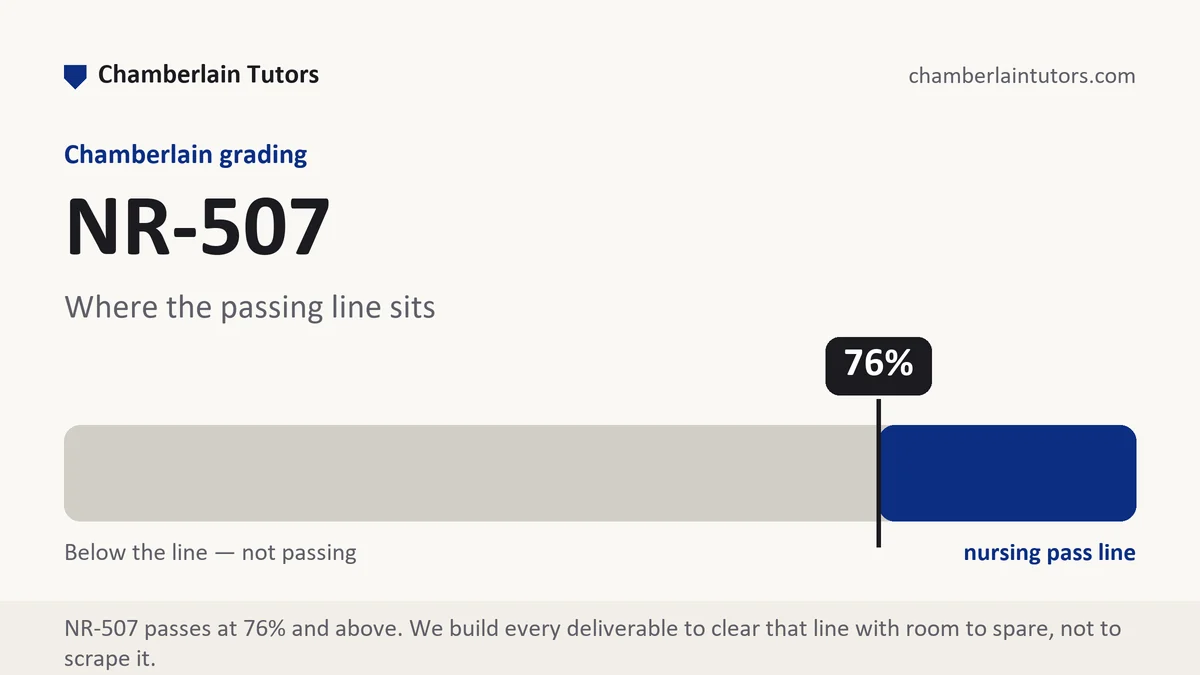
What NR-507 Week 1 asks for
The territory of an opening pathophysiology stage is the vocabulary of disease itself: hypertrophy, hyperplasia, atrophy and metaplasia on the adaptive side, and hypoxic, chemical, infectious and free radical injury on the failing side, with apoptosis and necrosis as the two endings. Graduate work on this material is not a definitions exercise. The reasoning the course wants is a chain: a stressor of a stated intensity acting for a stated time, an adaptive attempt, a point where the attempt fails, and a visible consequence in tissue.
At this point in an eight-week session the deliverable shape is usually short. Opening weeks tend to carry a written response of one to three pages, or a posted response in the classroom, sometimes both, because faculty want a reading of your baseline before the heavier applied weeks arrive. Treat whatever appears as a mechanism sample rather than a survey. If your section runs a discussion this week, remember that posts do not reopen once submitted in Canvas, so the first version is the graded version.
One habit set here pays for the rest of the session. Write at the level of the structure that failed, not the level of the disease name. A grader reading "ischemic injury occurred" has learned nothing they did not already have from the case; a grader reading that perfusion fell below the tissue's demand, that the cell fell back on anaerobic glycolysis, and that adenosine triphosphate production could no longer hold the sodium and potassium pump has watched you reason.
The NR-507 Week 1 method, step by step
Six moves that take a stressed cell from a blank page to a chain your grader can follow without stopping.
-
Read the scoring guide before the case
Copy your week's rubric rows into a blank document and strip each to its verb. Explain, differentiate, analyze and apply are four different assignments, and the row weights tell you which one the points live in. The rows become your headings, kept in the order the guide prints them.
-
Fix the insult in time and intensity
Write down what changed, where it acted, and for how long. Pressure over a bony prominence for six hours, a clamped vessel, a solvent, a virus. Dose and duration decide which adaptive route is even open to the cell, so a paper that skips them cannot argue reversibility later.
-
Decide whether the cell is adapting or failing
Hypertrophy, hyperplasia, atrophy and metaplasia are working responses with a cost attached. Swelling, membrane rupture and nuclear dissolution are not responses at all. Name which side of that line your case sits on in the first paragraph, because every later sentence depends on the answer.
-
Follow the energy before the symptom
Most injury in this territory is an energy story. State what happened to oxygen delivery, what the mitochondria did about it, and what the cell switched to instead. Lactate accumulating and intracellular pH falling are consequences you have then earned the right to report.
-
Mark the point of no return
Name the threshold: mitochondrial permeability transition, plasma membrane rupture, calcium flooding the cytosol and activating phospholipases and proteases. A draft that never marks that point cannot explain why one patient recovered and another lost the tissue, which is the question the week is really built around.
-
Land the cell fate in the patient
Close by separating apoptosis from necrosis and saying which one your case shows and how you can tell. One is quiet and contained, the other spills contents and recruits inflammation, and only the second explains the redness, warmth and systemic response the chart describes.
A layout and word budget for a mechanism write-up
Below is the drafting frame our tutors keep beside an opening pathophysiology piece, sized for a paper of roughly 1,000 to 1,200 words. It is our own outline rather than anything the university issues, and your week's rubric outranks it wherever the two disagree. Scale each target proportionally if your assigned length differs.
| Section | What belongs in it | Word target |
|---|---|---|
| Opening frame | The cell type, the stressor and the question you are answering, with no runway sentences ahead of it. | 80 to 100 |
| Normal function baseline | Only the part of that cell's job the stressor is about to interfere with, carried to the depth the contrast needs. | 120 to 150 |
| Adaptive response | The change the cell attempts first, named precisely, argued as an attempt at survival, with the price of the attempt stated. | 200 to 250 |
| Injury cascade | Energy failure, ion shifts, free radical damage and enzyme activation, in the order they occur rather than the order you learned them. | 250 to 300 |
| Cell fate and tissue effect | Apoptosis or necrosis, chosen and defended, then joined to the inflammation, scarring or organ change the case reports. | 180 to 220 |
| Close | An answer to the question asked, not a summary of the paragraphs above it. | 70 to 90 |
Evidence craft for cellular mechanisms
Physiology and prevalence age differently. A mechanistic account of the sodium and potassium pump does not expire; an incidence figure or a treatment threshold does. Where your guide sets no rule, treat five years as the default limit for anything clinical and let the mechanism sources stand older, provided the sentence makes clear why the older source is the right one.
Put the citation on the contested step. Most drafts cite the sentence everyone already agrees with and leave the interesting claim bare. Read your paragraph backwards and find the step a skeptical reader would question first. That step is where the reference belongs.
Do not let a textbook do a study's work. A physiology text is the right source for the cascade and the wrong source for a number. If you report how often a complication follows an injury, cite the work that counted it, and say in the sentence how many patients were counted and across how long.
Match the verb to the evidence. Controlled experimental work licenses caused and produced. Observational work licenses accompanied, tracked with, was more frequent among. In a mechanism paper the temptation runs the other way, because the cascade feels causal, but a grader can mark an overclaimed verb without knowing your case at all.
Five mistakes that cost points in this week's territory
- Vocabulary standing in for mechanism. Listing autophagy, apoptosis and hyperplasia proves you read the chapter. Saying which one this cell chose, and what made that route available, is what the scoring rows pay for.
- The energy step never appears. Skipping adenosine triphosphate failure forces the paper to assert swelling, calcium influx and enzyme activation with nothing underneath them.
- Adaptation described as damage. A hypertrophied myocyte is succeeding at something for a while. Treating every change as pathology throws away the contrast the opening stage is built on.
- A baseline that never returns. Normal function written as a textbook summary and then abandoned wastes the section that was supposed to make the disruption legible.
- Necrosis and apoptosis used interchangeably. They differ in trigger, in membrane behavior and in whether inflammation follows, and a grader reads the swap as a gap in the reading rather than a slip of the pen.
Before you submit
- The stressor is named with both its intensity and its duration
- Adaptation and injury sit on separate, clearly marked sides of the draft
- Energy failure appears before any consequence that depends on it
- The point where injury becomes irreversible is stated rather than implied
- The chosen cell fate matches the tissue findings the case reports
- Every reference appears in the text and every in-text citation appears in the list
Opening NR-507 this week?
Send the instructions and the rubric out of Canvas. A premium original draft comes back in 24 to 48 hours with the cellular chain written out step by step, and revisions run until the grade lands.