NR-452 is the three credit version of the capstone: two theory credits, one clinical credit, 48 clinical hours at the end of the program. The catalog describes it as synthesis of liberal arts, sciences and nursing coursework together with trends and issues, easing the move into professional nursing. Translated into graded writing, that means a paper where one real encounter has to be connected backwards to the courses that explain it and outwards to a professional issue it is an instance of. Most students write the encounter beautifully and the two connections thinly. This page is about fixing that ratio.
What NR-452 actually grades
Two words in the catalog description do the scoring work here: synthesis and transition. Synthesis means the paper has to show older coursework still operating. When you noticed something at the bedside, the reason you noticed it came from somewhere: a pathophysiology sequence, a pharmacology course, the statistics behind a screening threshold, an ethics discussion, a communication unit. A paper that says everything came together is claiming synthesis. A paper that says which content produced which judgment is showing it, and only the second one is scoreable.
Transition means the writing has to look forward rather than only back. The last course before licensure is where a program asks whether you can name what you are still weak at, in language specific enough to act on during orientation. Vague confidence reads as unprepared. So does a list of everything you are afraid of. What scores is one or two named gaps with a plan attached to each.
How we help in this course
Our side is the writing. You send rough notes about what happened on the unit, which courses you think it touches, and the scoring guide, and we build a draft that keeps your reasoning intact while giving the synthesis and issue sections the room the guide is paying for. We also strip anything identifying before it reaches a draft.
Your side stays yours completely. We do not complete clinical hours, contact a site or a preceptor, sign paperwork, fill in an hour log or sit an assessment for you, and no draft describes an encounter you did not have. The events are yours. The structure is what we bring.
How to write this course's deliverables
Section materials live in Canvas and Chamberlain publishes no syllabi, so a week-numbered guide here would be guesswork. This one is organized by craft instead: how to convert your scoring guide into a paragraph plan, the parts a synthesis and transition paper has to carry, and how to write about a real patient without creating a privacy problem or an overstated claim.
In NR-452 right now?
Send the week and the rubric from Canvas. First premium sample free, floor-checked, back in 24 to 48 hours.
Six shifts, and what 48 clinical hours changes
One clinical credit here buys 48 hours, which is around six twelve hour shifts or eight eight hour ones. That short window decides what your writing can honestly claim. Six shifts do not produce a story about how you developed over a placement. They produce two or three encounters you remember in detail, which is enough for this paper if you capture them while they are fresh. The highest value habit in this course is writing four or five lines the same evening: what the patient presented with, what you noticed, what you did, what you were unsure about. Those lines are the raw material for every section that scores, and no careful writing later reconstructs a detail that was never recorded.
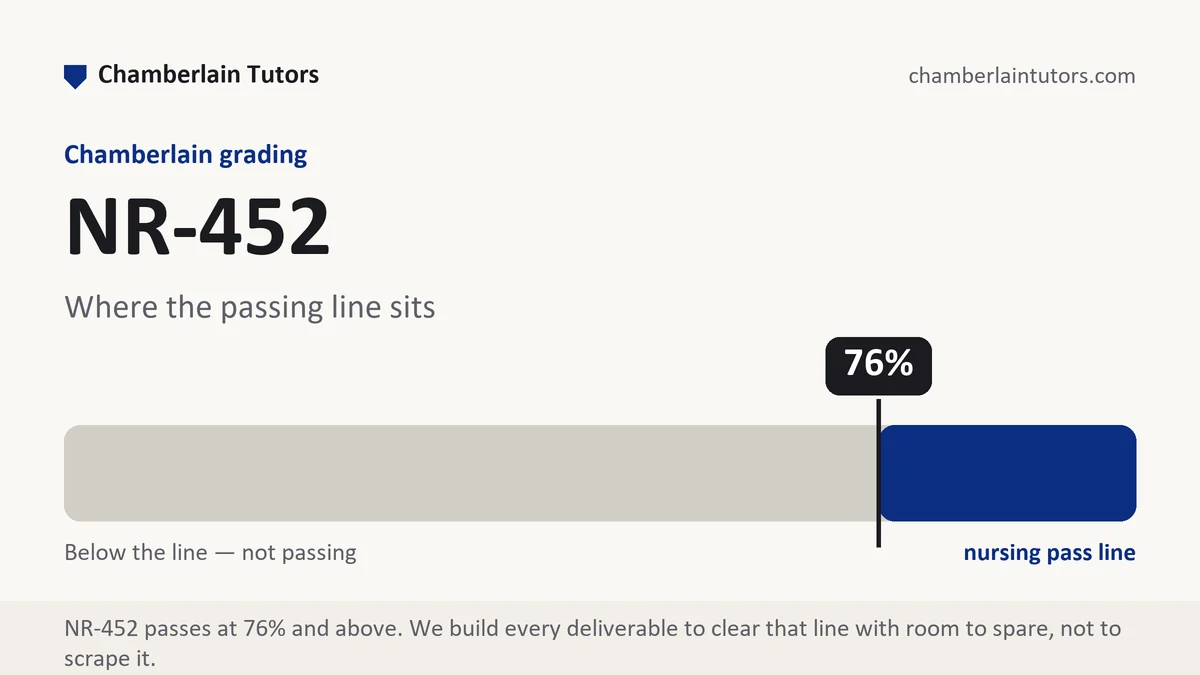
The calendar is unforgiving about catching up. Sixteen week semesters run as two eight week sessions, as many as six starts appear in a year, and written deliverables land weekly inside whichever session holds your placement. In core nursing courses 76 percent is the passing floor, supplementary work cannot rescue a weak weighted average, and discussion posts cannot be edited once submitted, so a board post describing your encounter is permanent the moment it goes up. Draft board posts elsewhere first, especially here, where the first description of a patient is the one most likely to contain a detail that should not be there.
Read the rubric before the prompt, then budget in paragraphs
The prompt tells you the topic. The scoring guide tells you the proportions, and proportions are where this paper is usually lost. Open the guide first, copy every criterion row into a blank document in the guide's order, and turn each into a heading you will actually keep in the finished paper.
Then budget in paragraphs rather than words, because paragraphs are what you can count while drafting. Use one paragraph per five points. Say the guide runs to 100 points across five rows: 35 for synthesis of prior coursework, 25 for the professional issue, 20 for application to your encounter, 10 for the transition plan, and 10 for scholarly writing and APA. The writing row is cross-cutting and earns no paragraphs of its own, since it is judged everywhere. The other four give you seven, five, four and two paragraphs, which is eighteen. At a working average of 150 words a paragraph that is 2,700 words, and if your section caps the paper at 1,800 you are 900 over. So scale every row by two thirds and keep the shape: five paragraphs, three, three, one. Twelve paragraphs, roughly 1,800 words, in the guide's own proportions.
The value of counting paragraphs is that the check takes ten seconds. When the draft is done, count the paragraphs under each heading. If the encounter narrative has eight and the synthesis section has two, you have inverted the guide, and no amount of vivid clinical detail will pay that back.
The parts of a synthesis and transition paper
Whatever your section calls the document, it carries the same load-bearing parts. Each proves something a grader can find, and each has a weak version that turns up constantly.
| Part | What it has to prove | The weak version |
|---|---|---|
| The encounter, bounded | One patient, one shift, one decision point, with enough clinical detail to reason from | A composite of several patients, which no reasoning can be checked against |
| The reasoning you used | What you noticed, what you concluded, what you did next, in that order | The textbook answer written in afterwards as though you had it at the time |
| The nursing coursework behind it | Named content doing visible work: the pathophysiology behind the sign, the pharmacology behind the drug | A sentence saying prior courses all came together |
| The general education thread | The statistics, ethics or communication content the judgment actually rested on | A gesture at holistic care with nothing underneath it |
| The professional issue | The staffing, delegation, scope or handoff issue your encounter is one instance of | An issue announced in its own section and never connected back |
| Evidence for that issue | Current sources with the design and the sample stated before the finding | A trade piece with no method in it, cited as though it were a study |
| The standard you measured against | A guideline, policy or scope statement, named and cited by its current version | Best practice, unattributed |
| What you would do differently | One changed action at a named point in the shift | I would research more and be better prepared |
| The transition goal | Something observable during orientation, with a way to tell whether it happened | A goal to feel more confident |
Writing about a real patient without breaking anything
This paper puts a real person on a page you are submitting for a grade, and it puts published claims next to your own. Four habits keep both halves defensible.
De-identify while drafting, not afterwards. No names, no admission dates, no room or bed numbers, no employer named next to a rare diagnosis. Write a man in his sixties admitted through the emergency department with new onset shortness of breath, and describe the setting by type rather than by name. Removal at the end of a draft misses things, because identifiers hide inside detail you added for color.
Currency with a reason attached. Treat anything older than five years as needing a stated justification unless your guide says otherwise, and cite guidelines by their current version. Workforce and staffing figures age faster than clinical content, so a nursing shortage statistic from a decade ago is describing a different labor market than the one you are entering.
Design and sample before the finding. Name the study that generated a number in the same sentence that reports it. In a cross-sectional survey of 1,180 medical-surgical nurses costs ten words and converts an assertion into evidence, which is what the issue section is judged on.
Denominator and window before any rate. A 27 percent turnover figure is meaningless until the sentence carries which employers, which year, and how many nurses were in the base. The same discipline applies to your own experience: two patients out of the four you carried is a fact, half of my patients is arithmetic hiding a sample of four. And keep the verbs sized to the design, since survey and observational work supports was associated with rather than caused.
Passing paper, strong paper, in this course
A passing NR-452 paper tells a clear clinical story, cites a few sources, mentions that earlier courses were useful and ends with an intention to keep learning. It clears the floor and could have been written by any student in any placement.
A strong one is specific in three places. Its synthesis section names content and shows it working, so a reader can see which course produced which judgment at which moment. Its issue section moves in both directions, from your shift out to the profession and back down to what the issue meant for one patient that day. And its transition section commits to something checkable during orientation, such as asking to take a second patient with a particular drip by week three, rather than to a feeling. Named content, a two-way link, and a goal with an observable outcome.
Six mistakes that cost points here
- The narrative swallowing the paper. The encounter is the evidence, not the argument. When it runs past its share the analytical sections get compressed into apologies.
- Synthesis claimed rather than shown. Saying that prior coursework informed your practice earns nothing. Naming the content and the judgment it produced earns the row.
- An issue with no line back to the shift. A well researched section on staffing that never touches your patient reads as a separate essay stapled on.
- Identifiers left in. A date, a unit name and a diagnosis together can identify a patient even with no name attached.
- Writing the shift you wish you had. Rewriting a decision so it looks correct deletes the analysis the paper exists for.
- Skipping the liberal arts and sciences half. The catalog frames this course as synthesis across general education and nursing, so a paper drawing only on nursing courses answers half of what it was set.
Questions students ask in this course
I only had six shifts and one was cancelled. Is that enough to write about?
How do I show synthesis when the paper is about one patient?
How much can I say about my preceptor's practice?
Where NR-452 sits in Chamberlain's programs
Open the exact program map for sequence, credit, and option context. The current student schedule and syllabus remain authoritative after transfer evaluation, electives, state rules, and approved plan changes.
The weeks, one by one
Week 1
NR-452 Week 1 is the stage where the capstone announces its terms: everything you have studied across liberal arts, sciences and nursing coursework is about to be pulled into one argument about the nurse you are becoming, and a 48-hour clinical practicum is about to give that argument a real setting. Read the full Week 1 manual.
Week 2
NR-452 Week 2 sits in the trends-and-issues territory the catalog promises: the profession is changing around you, and the written work at this stage usually asks you to pick one current issue in nursing, analyze what is driving it, and argue what it means for a nurse entering practice now. Read the full Week 2 manual.
Week 3
NR-452 Week 3 belongs to the part of the catalog promise most students skim past: synthesis of the liberal arts and sciences with nursing coursework. Read the full Week 3 manual.
Week 4
NR-452 Week 4 is where the 48-hour clinical practicum starts producing written work, and the usual container is reflective: journal entries or a structured reflection that turns hours already lived into analysis a grader can score. Read the full Week 4 manual.
Week 5
NR-452 Week 5 typically moves the capstone from reflection to argument: take something you noticed in practice, ask whether the way it is done matches what published evidence supports, and write the case. Read the full Week 5 manual.
Week 6
NR-452 Week 6 usually turns the capstone toward the door: the catalog promises an eased transition into professional nursing, and the written work at this stage tends to be a concrete plan for it, covering licensure examination preparation, the first-job search, and the strategies that carry a new. Read the full Week 6 manual.
Week 7
NR-452 Week 7 is where the capstone's separate threads, the self-assessment, the issue analysis, the liberal arts braid, the practicum reflections and the transition plan, get pulled into the course's largest written deliverable: a culminating synthesis paper arguing that your education has. Read the full Week 7 manual.
Week 8
NR-452 Week 8 closes both the course and, for many students, the program: the usual written work is a final reflection measuring the person who finished the 48 practicum hours against the person who wrote Week 1's goals, sometimes alongside the polished final version of the culminating paper and. Read the full Week 8 manual.