NR-452 Week 2 sits in the trends-and-issues territory the catalog promises: the profession is changing around you, and the written work at this stage usually asks you to pick one current issue in nursing, analyze what is driving it, and argue what it means for a nurse entering practice now. The move that scores is analysis of causes and consequences, not a report that an issue exists. Your section may print this as NR 452 or NR452; it is the same course. Chamberlain publishes no syllabi outside Canvas. The placement here is our teaching judgment from the course's catalog arc; your section's rubric decides what your week actually asks.
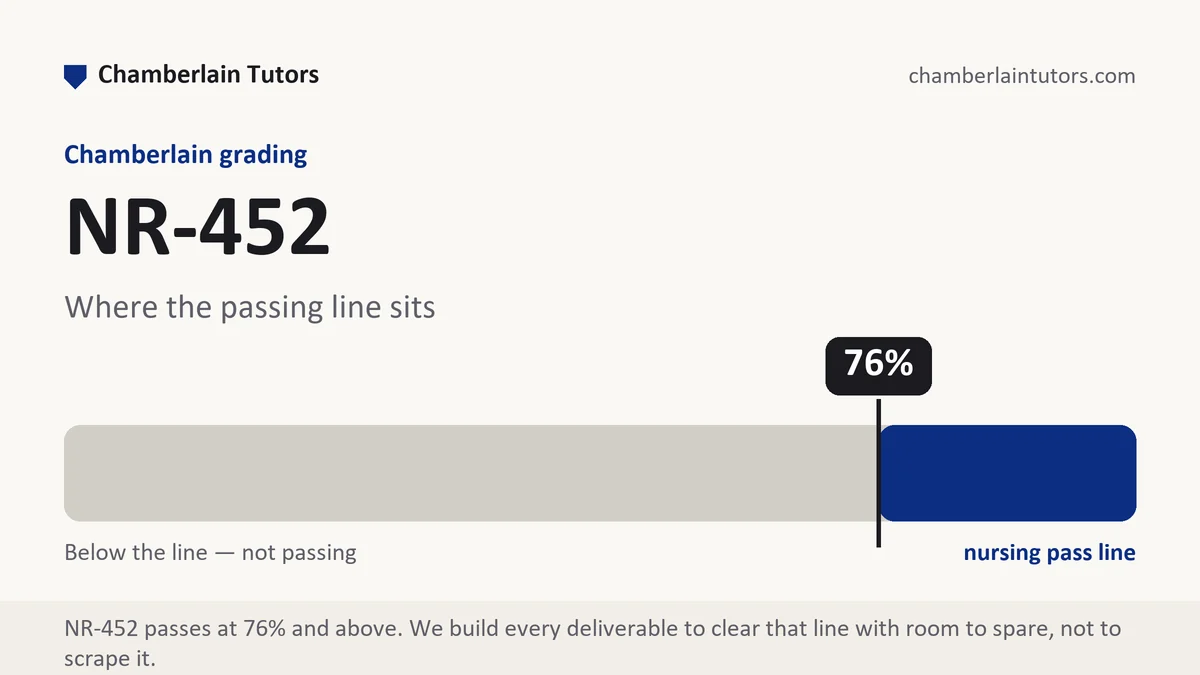
Know what NR-452 Week 2 asks for
A pediatric floor at shift change tells you more about the state of the profession than most textbooks do. Watch a charge nurse juggle two travelers, one new graduate and a call-out during RSV season, and you have seen workforce strain, retention, onboarding and safety culture compressed into fifteen minutes. Trends-and-issues writing asks you to take one such force, hold it still long enough to examine, and explain it with sources rather than frustration. The issue you choose matters less than the discipline you bring to it: staffing models, incivility, the growth of telehealth in family practice, workplace violence, the aging workforce and new-graduate transition programs are all workable territory when the analysis is honest.
Expect the deliverable at this stage to be a short analytic paper, a structured discussion post, or both. Whatever the container, the shape faculty reward is the same: name the issue precisely, trace where it came from, show who it touches with sourced specifics, and land on what it demands from the profession, including from you. A post that merely agrees the issue is important has performed concern, not analysis, and capstone rubrics are built to tell those apart. Write the discussion post as final copy before submitting it, because Canvas does not give it back for repairs.
Choose an issue you have actually brushed against if you can. A student who spent a community rotation in a family-practice clinic that lost two medical assistants in a quarter can write about support-staff turnover with a texture no library-only paper achieves. The scene does not replace evidence, and your practicum hours remain entirely your own real-world work, but a two-sentence observed moment gives your sourced analysis a floor to stand on, and graders feel the difference immediately.
Work the Week 2 method, step by step
Six moves that turn a complaint about the profession into an analysis of it.
-
Narrow the issue until it fits the assignment
The nursing shortage is a book. The exit of experienced pediatric nurses from inpatient units, and what it does to new-graduate support, is a paper. Keep cutting scope until one week's word count can actually cover the claim you are making.
-
Separate the trend from the issue
A trend is a direction of change; an issue is the problem or question the change creates. Telehealth growth is a trend. Whether virtual visits in family practice can safely carry pediatric assessment is an issue. Papers that name both, in that order, organize themselves.
-
Trace the drivers before you judge the effects
Every issue has a history: policy shifts, economics, demographics, technology or a pandemic aftershock. Give the causes one sourced paragraph before you write a word about consequences, and your later argument inherits the credibility of that setup.
-
Show the stakes at the bedside, not just the system
System-level claims need a human-scale anchor. If you argue that turnover degrades safety, spend two sentences on what that looks like beside an infant's crib on a night shift, drawn as a de-identified composite, then return to the sourced level.
-
Bring in what the professional bodies say
Major nursing organizations publish position statements on most live issues. Naming one, with its year, shows the reader your analysis sits inside a professional conversation rather than beside it, and it usually satisfies a scoring row students otherwise miss.
-
End on implication, not alarm
The closing paragraph answers the question a capstone quietly asks all session: what does this mean for a nurse entering practice now? One or two concrete implications, stated plainly, outscore a paragraph of urgency every time.
Budget the words for an issue analysis
The frame below fits an analytic piece of roughly 900 to 1,200 words. It is our own teaching outline, not a university document, and the rubric in your section outranks it at every point of disagreement.
| Section | What belongs in it | Word target |
|---|---|---|
| Issue statement | The narrowed issue and why it matters now, claimed in the first three sentences. | 80 to 110 |
| Trend behind it | The direction of change producing the issue, with one dated source establishing that it is real. | 130 to 160 |
| Drivers | Two or three causes, each sourced, arranged from structural to local. | 200 to 240 |
| Consequences | Who is affected and how, moving from system level to one bedside-scale anchor. | 220 to 260 |
| Professional response | What organized nursing says or does about it, with the position named and dated. | 150 to 190 |
| Implication for entering nurses | What the analysis obliges a new professional to know or do, said without slogans. | 90 to 120 |
Handle the evidence like an analyst
Date everything about a moving target. Trends writing decays fast, so a claim about staffing, technology adoption or workforce demographics needs its year visible in the sentence. A statistic from an unstated moment is an anecdote wearing a suit.
Prefer primary and organizational sources over news coverage. Journalism tells you an issue exists; workforce reports, peer-reviewed studies and position statements tell you its size and shape. Use news, if at all, only to establish currency, and hang the analysis on sturdier material.
Report magnitudes with their base and window. Write how many out of how many, over what period, before any proportion appears. A turnover figure without a denominator or a timeframe cannot be weighed, and a grader who cannot weigh your number discounts your paragraph.
Keep observed scenes clearly labeled as observation. A moment from your own rotation is legitimate texture when it is de-identified and framed as one setting's experience, never as proof of a national pattern. The sequence that scores is sourced claim first, scene as illustration second.
Avoid the five mistakes that cost points here
- Choosing an issue too large to analyze. A paper that gestures at everything wrong in healthcare says nothing checkable about any of it.
- Describing instead of arguing. A rubric row that says analyze is asking for causes, mechanisms and consequences, not a well-organized description that the issue exists.
- Running on opinion voltage. Frustration is a reason to pick the topic, not a method for writing it. Every judgment needs a source or a clearly framed observation under it.
- Ignoring the professional response. Writing about an issue as if organized nursing had never addressed it forfeits an easy scoring row and makes the analysis look under-read.
- Closing with a plea. Something must be done is not an implication. Name what an entering nurse should watch, learn or refuse, and stop.
Check these before you submit
- The issue is narrowed to something one paper can genuinely cover
- Trend and issue are distinguished explicitly, in that order
- Every driver and consequence paragraph carries a dated source
- One professional position statement is named with its organization and year
- Any observed scene is de-identified and framed as illustration, not proof
- The close states implications for entering practice, not alarm
Analyzing an issue for NR-452?
Send the prompt and the rubric out of Canvas. A premium original analysis comes back in 24 to 48 hours with the drivers sourced and the implications argued, and revisions run until the grade lands.